We are thrilled to announce our $8M seed financing lead by @iendeavors along with @fiftyyears@ycombinator Boom Capital and @caffeinatedcap! We are also excited to announce that @jdudley will be joining our Board of Directors!
https://t.co/e5LkEaXMiZ
🗝️The right drug molecule will bind to a protein to treat a disease. But what about "undruggable targets"? #JClinic PIs @BarzilayRegina & @MarzyehGhassemi co-authored a new paper in @NatureBiotech w/ 15 co-authors on how AI could challenge drug design.
https://t.co/IewlHEAeRj
@owl_posting We have some good reviews and a book chapter if you’re interested in recent advances in multi-target drug design https://t.co/XSnVxWutEW
https://t.co/aZmeqhzp0W
BREAKING: Trump administration orders Pentagon to plan for sweeping budget cuts, slashing 8% from the defense budget in each of the next 5 years, per WaPo
Also whats the value in autocompleting a prokaryotic genome? What would be pretty cool would be actually synthesizing the genome and showing viability after a genome transplant ( as well as showing significant evolutionary divergence)
This recent paper (https://t.co/DD5ly6o2aN) makes me pretty skeptical of DNA foundation models. If you claim to predict pathogenic variants, the minimum should be to generate totally unseen (pathogenic & benign) mutations, express them in cells and confirm pathogenicity via assay
AI provides a universal framework that leverages data and compute at scale to uncover higher-order patterns
Today, @arcinstitute in collaboration with @nvidia releases Evo 2—a fully open source biological foundation model trained on genomes spanning the entire tree of life 🧵
BREAKING: President Trump just announced that he will place massive tariffs on Denmark if they don't immediately relinquish all control of Greenland.
"We need Greenland for national security purposes."
LET THE 3D CHESS COMMENCE!
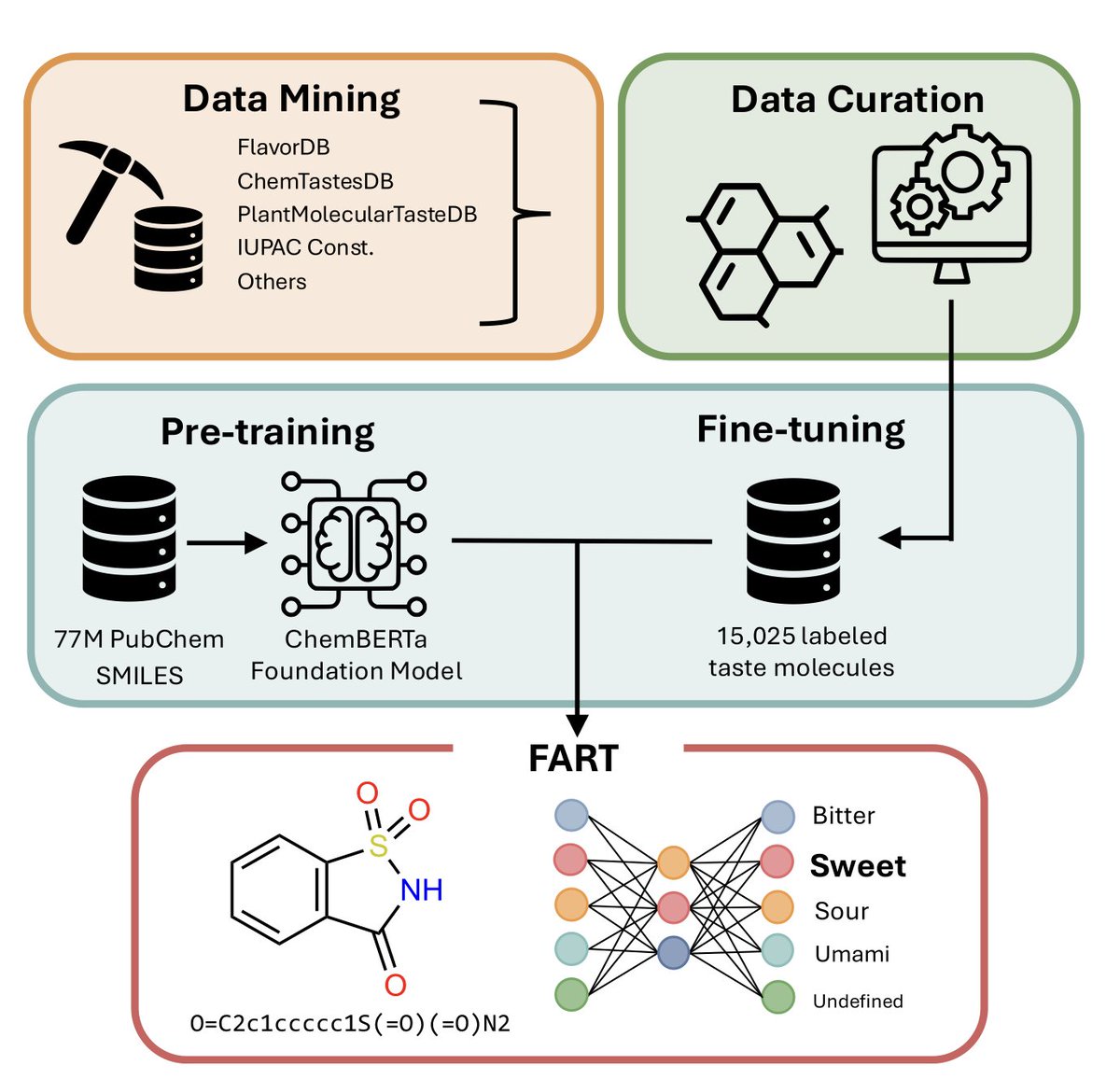
A Chemical Language Model for Molecular Taste Prediction
1. Introducing FART (Flavor Analysis and Recognition Transformer), a chemical language model trained on the largest molecular taste dataset (15,025 compounds), capable of predicting four taste categories (sweet, bitter, sour, umami) simultaneously with over 91% accuracy.
2. FART outperforms previous binary classifiers, delivering state-of-the-art results across individual taste classes, even when benchmarked on larger and more diverse test sets.
3. A key feature is its interpretability: gradient-based visualization highlights molecular substructures driving taste predictions, offering insights into the chemical basis of taste.
4. SMILES augmentation enhances FART’s robustness, ensuring consistency across diverse molecular representations and enabling a confidence metric that boosts prediction reliability to 94%.
5. FART’s architecture, built on ChemBERTa and fine-tuned on taste data, captures nuanced patterns in molecular taste prediction while handling undefined classes, such as tasteless compounds or out-of-distribution molecules.
6. Practical applications include food science, drug formulation, and natural product analysis, providing a tool for rapid, interpretable predictions to accelerate tastant discovery and systematic flavor exploration.
7. By making FART and its dataset publicly available, this study paves the way for further advancements in molecular taste prediction and its integration into broader chemical discovery workflows.
💻Code: https://t.co/uQ8jbzpqfb
📜Paper: https://t.co/UVHmI0Yma4
#ChemicalLanguageModel #TastePrediction #MachineLearning #FoodScience #ChemBERTa #AI
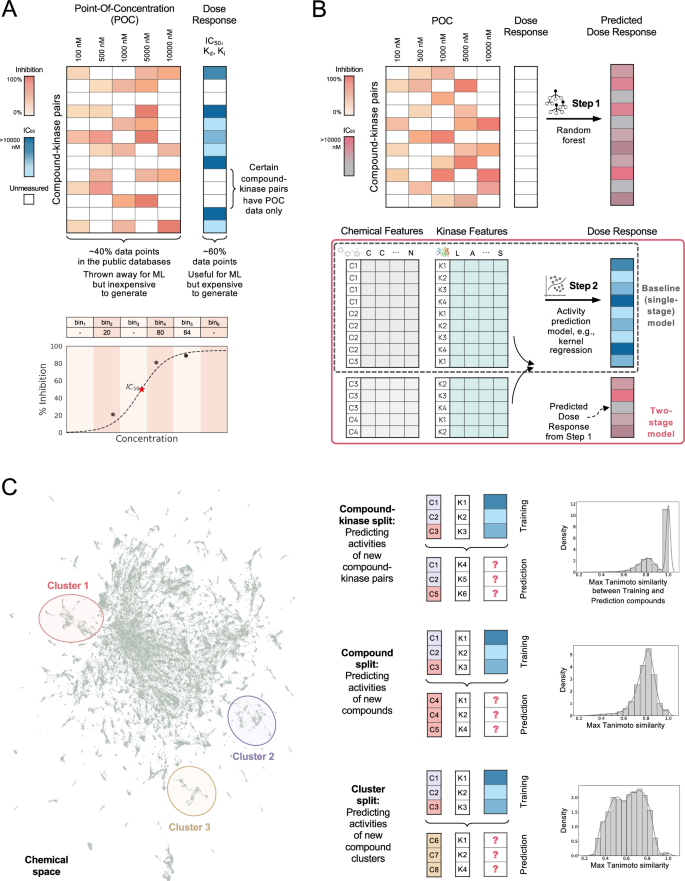
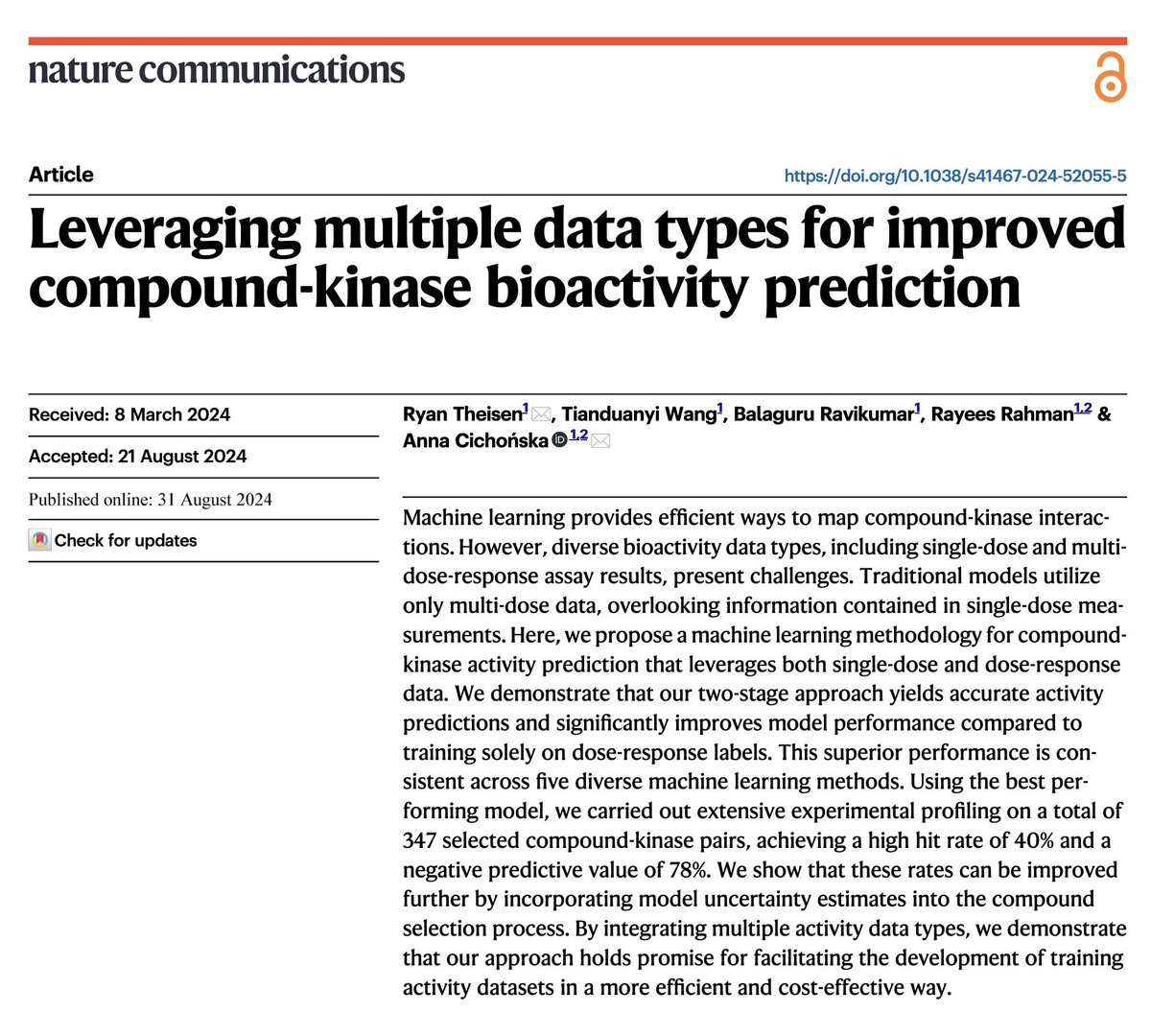
@HarmonicDiscov, @rayrah_, and @CichonskaAnna present a method that enhances compound bioactivity modeling by integrating diverse data types, enabling cost-effective training data generation.
https://t.co/tobrltzEKl
Excited to share our paper published in @NatureComms led by @rythei & @CichonskaAnna!
By integrating diverse bioactivity datatypes, we built a best-in-class drug-target interaction model called Kanopy—achieving an experimentally confirmed prospective hit rate of 40% (at 1µM)!
Amazing. Train a network to classify papers (accept/reject). Then run the network on the paper describing the network, and it classifies the paper as a strong reject. This is why we can't have nice paper classifiers. (h/t @hardmaru) https://t.co/OC2baCI1Za
The GenAI explosion is reshaping how industries think and work. What does this look like for drug discovery?
We're cohosting a panel with @HarmonicDiscov at @BioLabsNY for #NYTechWeek, joined by @AWSstartups & other leading experts.
Register: https://t.co/S8QkPcRgfT
@Techweek_
👀 Big news! The official calendar of events for #NYTechWeek is now LIVE, and we are so excited to announce that this is officially our largest Tech Week EVER!
- 500+ events hosted by VCs & startups 🤯
- June 3-9 2024
🗽 Want the complete list of events? Register here for access: https://t.co/Wtl41sKOj4
Can we train LLMs on the language of chemistry? What about build a DALL-E for new medicines?
We're throwing an event on gen AI and Drug Discovery with @Techweek_, @kaleidoscopebio, @BioLabsNY, @awscloud, @a16z for #NYTechWeek .
Register👉https://t.co/K71O8CG08B
The annual ASRC Sensor CAT Symposium is two days away. Get ready to discuss the present and future of hard technology development and applications with CUNY entrepreneurs, start-up founders, and industry leaders. https://t.co/csdPmI75IS
🗓️April 17
⏰1 p.m. to 7 p.m.
📍CUNY ASRC
Our workshop ML4LMS = "ML for Life and Material Science: From Theory to Industry Applications" has been accepted for ICML this year. We have a fantastic line-up and are quickly editing submission guidlines, a website, and much more.