The results in this preprint have made me update my beliefs about the future of AI in biology more than anything else I've seen so far.
Six months ago, I would have thought that specialist models in biology would be outperforming frontier LLMs until we scale things up by another couple orders of magnitude. My median estimate for when something like this would happen would have probably been 2030.
Instead, our generalist language models, today, are performing tasks at or above the state-of-the-art in various protein design & understanding tasks. And there is clear improvement across all domains as our models improve generally.
The implications of this are enormous - we are on the doorstep of being able to program biology using natural language.
Truly incredible work from @Masa_Uehara_1, @joyjiao12, and the team! An absolute milestone for @OpenAI and the field as a whole
Q: Which one are you?
- Inventor: See Problem -> Find Solution
- Builder: Solution -> Create Product, Find Customers
- Operator: Product -> Scale Business, Run Systems
cc @aCharoo@MapleVCFund
Everyone working in cancer care — and every oncologist — should read this piece.
@sytses is grounded, rational, informed, and respectful to the current oncology establishment. He underwent standard of care therapies and has deep trust in his oncologist.
But — he also creates space for every cancer patient to be irreverent. To keep fighting when standard of care runs out. Because he knows what’s it’s like to be fighting for your life.
An MIT physicist spent 3 years writing a book that Demis Hassabis the man who just won the Nobel Prize calls one of the most important books he has ever read, and the reason it scared me is that it does not argue about whether AGI is coming. It assumes it already did.
His name is Max Tegmark. The book is called Life 3.0.
I picked it up at midnight on a Tuesday thinking it would read like a philosophy textbook. It does not. It reads like a very calm person explaining exactly how the planet might end, in the same tone a pilot uses to describe turbulence.
Here is what he actually argues, and why the argument is the part that stays with you.
Tegmark opens by distinguishing three types of life. Life 1.0 is biology. You are born with your hardware and your software already installed. A spider does not choose to spin a web. It runs the program evolution gave it. Life 2.0 is what humans are.
You get the hardware from biology, but you can rewrite your own software. You learn a new language. You read a book that changes how you think. You are, in his framing, the only thing on Earth that can redesign its own mind from the inside.
Life 3.0 is what comes next. A system that can redesign both its hardware and its software. That upgrades itself faster than any external force can contain it.
He does not say this is inevitable. He says it is the most important question we have ever faced, and we are answering it by accident.
The part that hit me hardest was not the scary scenario. It was the one he calls the beneficial AGI scenario. The version where it goes well. He walks through what a world run by a system far more intelligent than any human might actually look like, and the discomfort is that even the good version requires you to completely let go of the assumption that humans will be the ones making the decisions that matter.
He is not a pessimist. That is the thing most people get wrong about this book. Tegmark spent years building the Future of Life Institute specifically because he believes the outcome is not determined. He believes the decisions being made right now, inside a small number of labs, by a small number of people, will echo for the rest of human history in either direction.
The chapter on consciousness floored me. He argues that consciousness is not some spiritual phenomenon that biology invented. It is what certain types of information processing feel like from the inside.
Which means if you build a system that processes information in the right way, you do not get an unconscious machine. You might get something that experiences existence. That feels things. And we have no idea how to check.
The chapter on power is the one I keep thinking about. He asks a simple question. If a system becomes more intelligent than every human combined, what mechanism exists to make sure it does what we want? Not because it is evil. Because misaligned goals are not a character flaw. A system optimizing hard for the wrong thing will cause catastrophic harm without malice, the same way a river does not hate the valley it floods.
He runs through twelve different scenarios for how AGI ends up shaping the century. Some are utopian. Some are not. What they share is that the outcome in every single one is determined not by the AGI itself, but by the decisions made before it arrives. Who controls it. What values were baked into it. What oversight was built before anyone had the leverage to build it afterward.
The thing Tegmark says that I have not been able to shake is this. The most dangerous assumption is that someone else is thinking about this carefully. The labs are moving fast. The researchers are brilliant. And the question of what we actually want from this, at the level of civilization, has barely been asked.
Demis Hassabis built the system that folded two hundred million proteins. He recommended this book. That should tell you something about what the people closest to this think is worth your time.
Life 3.0 does not leave you with answers. It leaves you with the specific, uncomfortable feeling that the questions are more urgent than most people realize, and that the window to ask them at the right scale is shorter than it looks.
I finished it at 4am and sat there for a while doing nothing.
That is either a good sign about the book or a bad sign about everything else.
What is the one AI book that genuinely changed how you think about where this is all going?
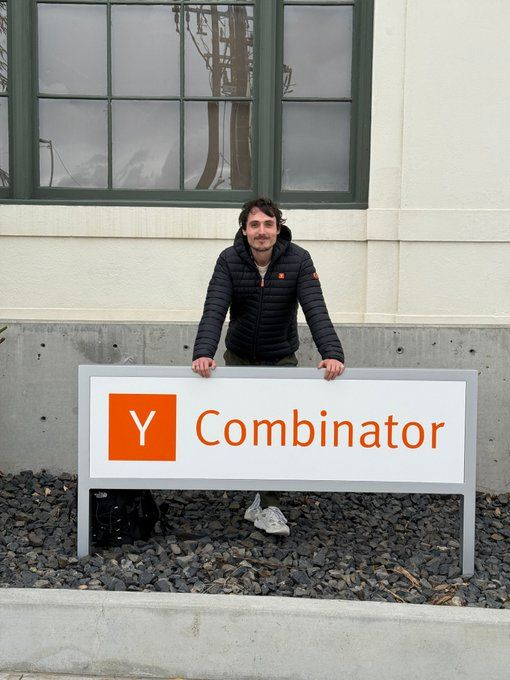
I got into @ycombinator
I'm 18, solo founder, and 3 years ago was studying 10th grade at a random city in Iran (Qazvin, love it).
In Iran, I had to build my own VPN to access UK curriculum material, then got myself into a boarding school in Oxford, paid the tuition by selling my AI thing, and then got a full-ride to study AI at Rice University.
After I got in the US I did some more things that led to Magma.
I don't have much to say for advice as I'm unlearning a lot recently. However, as an observation, the laws of physics seem to be flexible enough that you can simply do things; anything in fact. Human brain just evolutionarily underestimates that flexibility.
PS: Repost and I'll send you the full application that got me in.
In just 9 years since the 2017 Transformer paper, we’ve encoded a significant portion of human knowledge: text, design, and reasoning into floating-point vectors in high-dimensional space.
LLMs don’t “know” things in the human sense. They navigate geometry: shifting attention, activating weight pathways, and recomposing representations via linear algebra and probabilistic sampling.
So let’s stop debating benchmarks and ask a harder question:
Freeze the world at 1905.
No relativity. No quantum mechanics. No modern physics.
Can a transformer, trained only on pre-1905 data, derive Einstein-level insights? (@demishassabis's idea that i love!)
Repeat this across key inflection points in science and engineering.
If it can, we’re looking at systems capable of genuine discovery under constraint, not just interpolation over compressed history.
That’s the real AGI test. @elonmusk@sundarpichai@satyanadella@ylecun
One pattern I find useful for working with LLMs is a nice long ramble session. Sometimes the LLM needs more bits to understand what you're trying to achieve, but you're too lazy to type them. In these cases I like to lean back, switch to /voice and just ramble for like 10 minutes, total mess, anything goes, full stream of consciousness. Sometimes I declare it up top, something like "switching to speech recognition sorry for any typos...". Sometimes I turn it into a small interview of a few turns. But I find that the LLMs are somehow very good at reconstructing long incoherent rambles and often their echo of your own tangle of thoughts comes out quite a bit cleaner than what you started with. The result is that you improve the mind meld and have to correct things less from that point on.
I tried to explain the Jacobian conjecture disproof to my 10-year-old son. I went through 3-4 analogies before I finally got to "imagine someone asserted that the sequence 01082016 (his birthday) never appeared in pi. Then imagine people believed it for a century. Then someone comes along and asks Claude to disprove it and it just thinks for a little while and come back with an example."
My son decided that was the best analogy and I could stop.
Just for fun, I tried it – and @claudeai did a pretty good job. 01082016 appears 44,347,772 digits into pi.
Also sorry @conviction team, I think I exhausted our Ant budget for the month.
In 2018, Sarah Guo became the youngest general partner in Greylock's 60-year history. She was 28. Four years later, she quit to launch Conviction, a firm staked entirely on AI.
Before ChatGPT shipped, she seeded Baseten and Harvey; each is now worth over $11 billion. In Conviction's first year, she wrote early checks into Sierra, Cognition, and Mistral; those three companies are now worth, together, $54 billion.
Andrej Karpathy worked out of Conviction's office until Anthropic hired him in May. Guo has been close to Jensen Huang for over a decade. Her first two calls after starting the firm were to Sam Altman and Nat Friedman.
And yet the investor closest to the AI frontier is betting against its biggest companies.
The two big frontier labs, worth close to a trillion dollars apiece, no longer just want to build the models. They also want to build every product and company on top of them, leaving nothing for anyone else.
The market is paying as though they might succeed. Of the $300 billion in venture capital deployed in the first quarter of 2026, the biggest quarter in the history of the trade, 65% went to only four companies: Anthropic, OpenAI, xAI, and Waymo.
Guo is betting the labs can't build everything, and she spends her days making sure of it. She won Harvey its first client. She flew across the country to take a single Baseten candidate to a four-hour lunch. On one wedding anniversary, she spent the whole weekend on back-to-back calls, keeping two founders on the line so they couldn't speak to rival firms. Twice a year, she flies the world's brightest young founders to San Francisco and inducts them into the fight.
In the months @domcooke spent reporting this piece, @saranormous had her fourth child, walked the Met Gala in 45 pounds of chainmail, and still answered her founders' texts within minutes.
Guo's parents arrived from China in 1987 with $50, built a company, and took it public at $1.2 billion. Then it went bankrupt. Guo grew up inside that startup. She built its first website, did her homework in a cubicle, and slept over for bug bashes. She loved it.
If two labs build everything, no one gets to do that again.
Welcome to Sarah's Wager. Read it below.
Today, we are introducing Inkling.
Inkling reasons efficiently across text, image, and audio modalities. We are making the full weights available.
https://t.co/Ghebq5mG30
Available today for fine-tuning on Tinker. Play with it in the Inkling Playground. 🧵
I realized that goal setting is the core RL loop of a startup.
Set a two-week goal
Hit the goal? → Reward signal. Reinforce what worked.
Missed it? → Negative reward. Diagnose root cause, update strategy, try again.
I’ll try and compress 20 years of experience into 30 seconds
Startups have a GREAT FILTER that kills almost everyone. It’s there to weed out the people who aren’t meant to build companies
The good news is it can be beaten - even with little or no capital. Once you beat it, you can do it again. You can choose to stay at the current level or attempt to level up
The level boss is always the same: if you quit, you fail
I can’t stress this enough: almost every skill can be learned. Never stop improving. You can acquire new skills, hire better people, change the product, pivot the strategy, or rethink your assumptions
You’ll hit the wall. Most will quit. But just keep going
If something isn’t working, change course. Change your vector: reassess your hypothesis, measure the results, and keep iterating
Also working hard compounds. The more quality work you can put in, the better your odds. There is no balance
Almost nobody succeeds on their first attempt
If you want it badly enough, you can bend the future in your direction
Just start. And keep pushing
Just moved to SF to build our humanoid robotics startup.
Would love to meet more robotics founders, engineers, and builders in the Bay.
If that’s you, comment and let’s connect.
in @ycombinator they have a playbook on how to get customers ASAP for your startup.
if you follow this, you’ll brute force your way to 100 customers, almost no matter what your product is.
Here it is:
1/ launch-max.
product hunt, hackerNews, devhunt, betalist, peerlist, indie hackers, etc. YC tells you to launch 3 times MINIMUM
2/ pull your competitor’s strongest backlinks and get yourself listed in the same places.
whatever article they have listed, you make a better version and ask the site to replace it (or supplement) with yours.
3/ WARM OUTBOUND.
Everyone knows about building in public. but you still need to capitalize on the 99% of leads who see your content but don’t come inbound
scrape everyone who likes your posts on Linkedin each week, check if they fit your customer profile, and message them.
you set this up to fire automatically with @origamichat (i dropped a prompt in the comments)
4/ find 20 to 30 ugc creators on tiktok / instagram in your niche. ask them to create content about your product, ideally from a fresh account.
pay them a fixed fee ($15–$30 per video) plus performance incentives ($1k for 1 million views, etc).
you can use @sideshift_app (best creators imo) and line up 20+ of these creators in 1 day
5/ when building in public, a video is 10x better than an image/text - spam use cases of ur product on X/Linkedin
6/ figure out where your customers actually spend time.
which slack/discord groups are they in? what newsletters do they open? which podcasts and accounts do they follow? pay those people for shoutouts
7/ there's a fresh trend on x basically every week. jump on the relevant ones and fold your product in (like i’m doing right now).
To find trends i just use Origami & search “Lead Gen/GTM posts that are viral on X” to find the best posts every week in my niche
Then, I will reply to those, quote tweet them, and use the formats that work myself
(that’s the secret to why my account has high engagement BTW - you can do this too)
---------
if you are doing all this every single week and DO NOT GIVE UP (launching, posting demos, contacting new customers)
I guarantee you will hit your customer goals. Then the game becomes retention.
will be posting 2-3 more growth hacks every single week
We went from 0 to 2,200 paying customers in under a year by following @ycombinator's 15 rules:
1/ Do things that don't scale. Get your first 10 customers by hand.
2/ Launch now, not when it's "ready". A mediocre product in front of real users teaches you more in a week than 6 months of polishing in the dark.
3/ Charge from day one. If nobody will pay, you don't have a startup, you have a hobby.
4/ Talk to users every single day. The roadmap you need is sitting in your customers' heads, and they'll hand it to you for free
5/ Always hunt the 90/10 solution. For almost any feature there's a way to capture 90% of the value with 10% of the effort.
6/ There are only two real jobs: write code and talk to users. Everything else (conferences, press, VC coffees, corp dev calls) is fake work.
7/ You pick your customers as much as they pick you. 10 users who love you beat 1,000 who kind of like you.
8/ Growth is an output, not a strategy. Grow before product market fit and all you're buying is churn.
9/ Do less, really well. Pick one or two metrics and judge every task against them.
10/ Know if you're default alive. Paul Graham's question: on current growth and current burn, do you reach profitability before the money runs out?
11/ Don't hire until it hurts. Headcount is not progress, it's burn. Every great startup was embarrassingly small for embarrassingly long.
12/ Momentum is the only real moat in year one. Ship something every week, even something tiny.
13/ Every great startup is badly broken at some point. The game isn't avoiding fires, it's how fast you put them out. Again. And again
14/ Ignore your competitors. Startups die of suicide, not murder. In year one, the only company that can kill yours is your own
15/ Startups rarely die from running out of money. They die because the founders fall out. Brutal honesty with your cofounder is the cheapest insurance you'll ever buy
Good luck !
Jensen Huang: “The best career advice I got was from a gardener”
“Very few people know this but I don’t wear a watch,” Nvidia founder Jensen Huang begins. “And the reason I don’t wear a watch is because now is the most important time. Just dedicate yourself to now.”
Jensen explains by telling a story:
“The best career advice I got was from a gardener. I was on a family trip in Kyoto, and we went to the temple that had the largest moss collection in the world . . . All of the moss is perfect, and every species of the world’s moss is there. It was a hot summer day — anybody who’s been to Kyoto knows how incredibly hot it is during the summer — and my family walked by this old man who was squatted down working on the moss with a bamboo tweezer. His bamboo basket was nearly empty with only two or three small pieces of dead moss.”
“What are you doing?” Jensen asked the old man.
“I am taking care of my garden,” the old man replied.
The old man told Jensen that he has been working on the garden for almost 30 years.
“But this garden is so big and your tweezer and basket are so small. How can you take care of the whole garden?” Jensen asked.
“I have plenty of time,” said the old man.
Jensen reflects:
“That’s the best career advice I can give you. Most of the time I wait for things to come to me. I’m rarely chasing things. I don’t have a watch. I’m focused on now. I’m enjoying my job. I’m the longest-running tech CEO in the world . . . Dedicate yourself to learning all the time, doing the best possible work you can, and leave everything on the field. By the time I go to bed I’m exhausted, and I’m happy about my day because I did everything I could . . . You’ll be surprised. I’m not at all ambitious. I don’t aspire to do more. I aspire to do better at what I’m currently doing. I’m not reaching for more. I wait for the world to come to me.“
He continues:
“People who know me also know that Nvidia doesn’t have a long-term strategy. We have no long-term plan. Our definition of a long-term plan is, ‘What are we doing today?’ . . . You have plenty of time. Enjoy your work. Do the best you possibly can. Just keep learning every day, and good things will come to you.”