🚨 Major shift: @AmericanCancer now directly recommends routine PSA screening for #prostatecancer, moving off pure shared decision-making 🚨
@CACancerJournal
📋 Average risk: PSA every 2 yrs, ages 50-69
📋 High risk (Black men; first-degree relative dx <65 or multiple at any age): annual PSA, ages 45-69
📋 Non-Black w/ one first-degree relative dx ≥65: every 2 yrs, ages 45-69
🔬 Age-adjusted elevated = PSA ≥3.0 (ages 45-69) or ≥6.5 (70-74); repeat in 2 wks to 3 mo, then MRI and/or validated biomarker before biopsy
🛑 70-74 individualized; not recommended ≥75 or if life expectancy <10 yrs
⚠️ Still requires informed consent on benefits, limits, and harms, and departs from USPSTF’s grade C for 55-69
🎯 ACS has moved from “discuss it” to “do it” for average-risk men 50-69 and high-risk men from 45, its biggest change since 2010
🔗 https://t.co/LJRpxycWE8
@UroOnc@urotoday@UrologyTimes@PCF_Science@AmerUrological
Semaglutide (Ozempic) improved left atrial and diastolic function in a randomized trial of patients with preserved ejection fraction heart failure (HFpEF) and obesity (via MRI)
And achieved remission of symptoms in more than half of participants (2nd link)
#AHA26 and @NatureMedicine
https://t.co/hQrhByUojP
https://t.co/wQpYkcFCdg
For medoncs trying to understand why urologists remain unexcited...issue is the endpoint. Recurrence does not equate progression. Progression does not equate CSS or OS. So we want to at least understand if large/sometime permanent grade 3+ toxicity is worth it. #ESMO26
Neoadjuvant MIBC Trials: KEYNOTE-866 (pembro) and ENERGIZE (nivo)negative. NIAGARA (durva) stands alone. Adjuvant is split too. ICI benefit in MIBC is real but marginal, and likely lives in a subset we have yet to identify. Utilit of chemo+IO less clear in EVP era. #ESMO26
Targeting neoantigens, the proteins or peptides on the surface of cancer cells, is the basis for personalized cancer vaccines. What is the ideal neoantigen? @Cancer_Cell https://t.co/fa8dXOV6Sm
Quite a lede
"For the first time, scientists say they have used viruses designed by AI to treat a human patient."
Front page @nytimes
gift link https://t.co/NQCHl9j6lQ
Retatrutide, the most potent GLP-1 agent in this family of drugs to date, had a marked benefit vs sleep apnea in a randomized trial, in people with obesity, just published @NEJM AHI-apnea-hypopnea index
https://t.co/W4rnr4Vy0A
It has been nearly 5 months since the FDA approved durvalumab + BCG for “BCG-naïve” high-risk #NMIBC based on the POTOMAC trial.
There has been considerable discussion about the discordant results of the recent phase III trials evaluating BCG + immune checkpoint blockade.
But I think we're overlooking a potentially important difference between these trials, one that could have major implications for how we interpret the results and counsel our patients.
POTOMAC and CREST were positive trials, but unlike the negative ALBAN trial, both permitted enrollment of patients previously treated with BCG.
To my knowledge, neither has reported how many patients had prior BCG exposure or whether the benefit of adding checkpoint blockade differs between previously treated and truly BCG-naïve patients.
Given the additional toxicity, treatment burden, and cost of systemic checkpoint blockade, how can we adequately counsel patients receiving BCG for the first time without knowing the magnitude of benefit specifically in patients like them?
I think we need to see these subgroup data from @AstraZeneca and @pfizer .
1/n
@BladderCancerUS ; @BCAN_Research ; @SUO_YUO ; @UroOnc ; @FDA ; @chana_weinstock ; @AmerUrological
I have questions regarding this Partial Nephrectomy for 2-4cm mass study that claims a 3+ month delay is dangerous (going against all AS literature in this space).
Since this is SEER and not SEER-Medicare, aren't we just looking at a subset of patients who were first biopsied and then resected, since those who went directly to surgery would effectively have a zero-day delay interval? Did something change since I last did a SEER paper?
Pinging @drphil_urology@johnleppert@markballmd@qdtrinh@maxinesun
https://t.co/UTj1rQ3xbx
Lots of exciting GU data at #ESMO2026! Watch out for podcasts on most of these abstracts coming right after the presentations. We will also take a deeper dive into these areas at #UromigosLive November 13th and 14th in Nashville. Podcast from the meeting sessions and videos will be available.
A real world digital GLP-1 structured treatment program achieved marked weight loss, high retention, metabolic improvement, and no serious adverse events in over 8,000 women. Suggests scalability with minimal need for clinician support.
https://t.co/A4kuPIr9GH
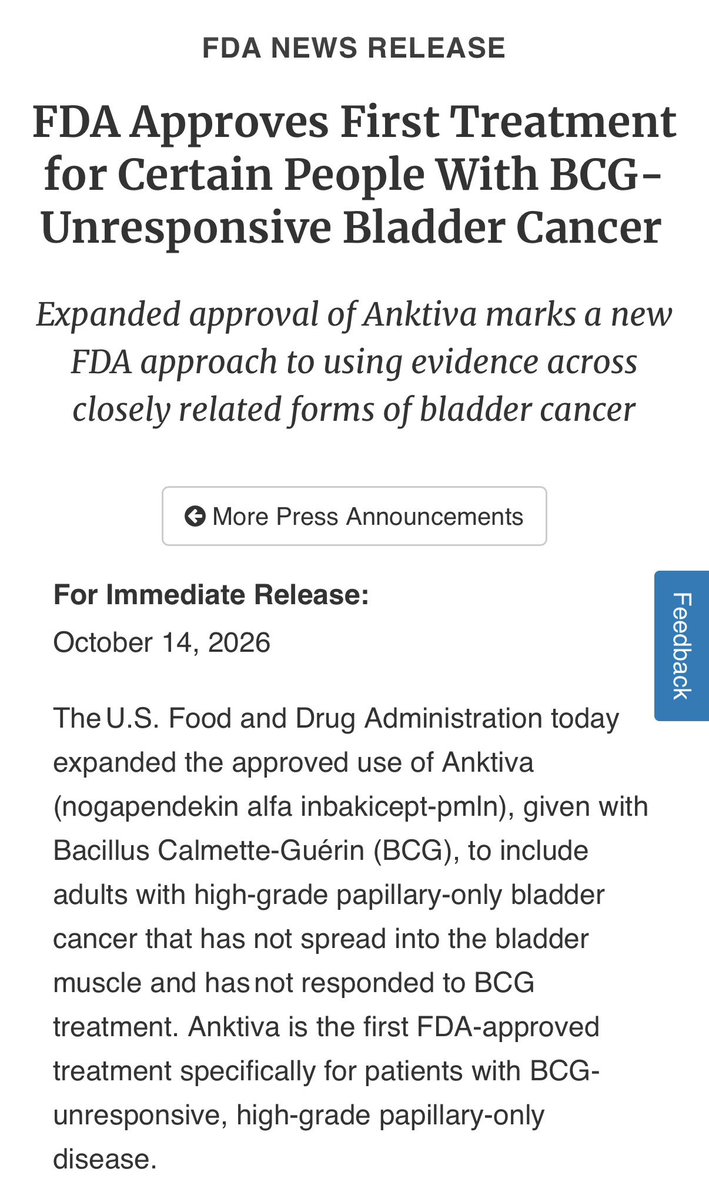
FDA Approves Anktiva for BCG Unresponsive Papillary Disease. This will be an interesting next few months as other companies seek similar pathway to approval. CIS/papillary buckets a thing of the past? Will certainly make for some good debates...
https://t.co/KK5DXkLkRy