One day after Qwen3.8-27B went live on mainnet, it is already serving paid traffic: a full coding session, served by a TensorCash miner and sold through @AskTillyAI, an independent operator on the network.
Every request came with a proof of which model did the work.
$qtc just got @f2pool, one of the oldest btc pools. the part nobody is saying: one pool, kryptex, mines 2 of every 3 quantus blocks, and f2pool's own dashboard shows it at 0.06% of the network rn
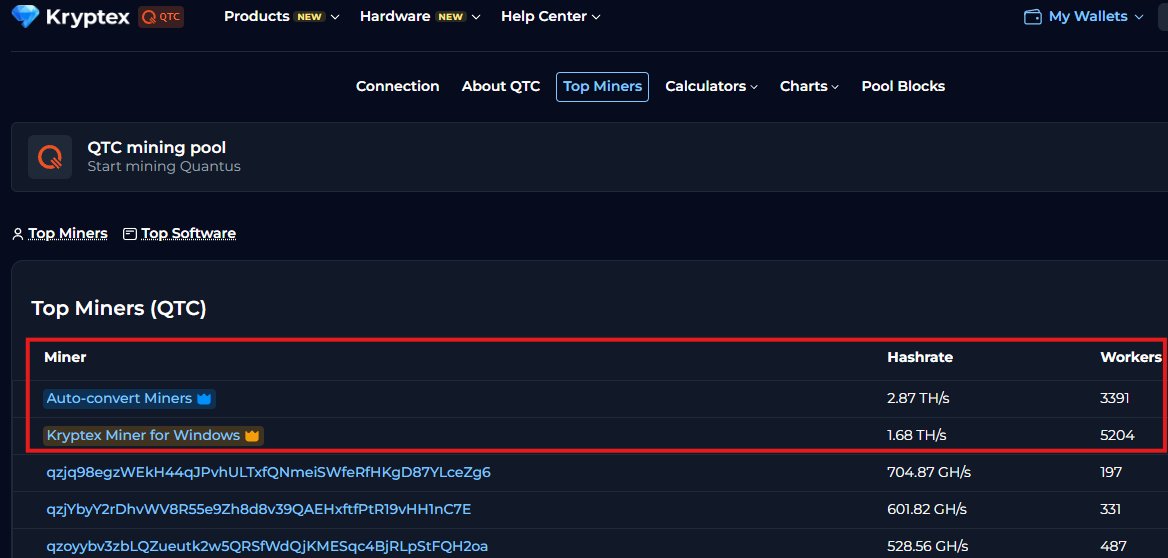
> tl;dr kryptex = 65.6% of blocks in the last 24h, top 2 addresses = 82.7%. f2pool: 21.68 gh/s vs a 37.12 th/s network, no block yet
receipts below:
how i know its kryptex: they dont publish their address, but they list every block they find at https://t.co/XnuPNDg8m2. i matched 146 blocks in a row (229,615 to 229,760): all 93 kryptex lists were mined by one address, all 53 it doesnt list were mined by someone else. zero exceptions (pic 1)
on the explorer its the same miner row after row (pic 2) https://t.co/7E7SiK8XgA
that address has mined 98.8k blocks since sep 11. encrypted address, only incoming activity (pic 3) https://t.co/PBdyyF0EOl
its share of all blocks:
- sep 20 to 30: 42.8%
- oct 1 to 7: 67.5%
- oct 8 to 14: 70.2%
- last 24h: 65.6%
the second biggest address takes another 17.1%, the other 32 miners split the rest
f2pool tweeted at 09:33 utc. since then: 1,130 blocks, kryptex 65.7%, not one new reward address onchain. the reason is on f2pool's own homepage: 21.68 gh/s on qtc vs 37.12 th/s network. thats ~3.5 blocks a day out of ~6,000
> f2pool's whole qtc hashrate rn = ~19 rtx 4090s
what f2pool offers (https://t.co/s6MVa4j9RA):
- 1% pplns, kryptex charges 3% on prop
- 0.1 qtc min payout, paid daily
- nvidia rtx 30/40/50 on srbminer or peakminer
why it still matters: the chain mints ~1,846 qtc a day, ~$205k at $111. today 2/3 of that runs through one operator. f2pool is the first big pool giving that hashrate somewhere else to go, and it starts from zero
for miners, per kryptex's own calculator: an rtx 4090 does ~1.15 gh/s ≈ 0.06 qtc a day (~$6.6)
@f2pool listing a post-quantum gpu chain 5 weeks after mainnet is a real signal. @quantusnetwork this is the decentralization story to push
the catch:
- a listing isnt hashrate. if miners dont switch, kryptex stays at 65%
- more pools = more organized selling. kryptex already auto-converts ~4.5 th/s of its miners to btc/usdt, ~12% of the network (pic 4)
- 1,846 qtc a day is ~21% of the $975k that traded on the main rhea pool in 24h, and you cant watch it onchain, payouts leave through the wormhole
- network hashrate is sliding: 43.3 th/s 7d avg vs 36.2 th/s 1d avg, per f2pool
so when you see "f2pool lists $qtc", now you know: for now its ~19 4090s, and the number to watch is kryptex's 65%. if it drops under 50% in the next weeks, the listing actually did something
where does it sit in 2 weeks?
Our Quantus ($QTC) mining pool is now LIVE! 🚀
@QuantusNetwork is a PoW public chain powered by post-quantum cryptography, with ZK for scaling.
⚙️ Algorithm: Poseidon2-Goldilocks
🖥️ Hardware: GPU (RTX 30, 40, and 50 series)
📖 Mining guide: https://t.co/oEyYO5LHWN
📝 Announcement: https://t.co/2hXLZsPLcj
Start mining $QTC at f2pool today! ⛏️
@coinvestasi Sesekali buat konten project crypto Quantum crypto bang , belum ada kek nya media indo yang bahas 🗿🗿
Tu project $Quantus harganya mahal tapi MC nya kecil bang 🗿🗿
I think @Tensorcash ( $TSC ) has a unique position in this space. It’s an AI PoW project that’s already quantum-resistant, has a Bitcoin-like token supply, and supports RWA and stablecoins. In my opinion, TSC is much better than other AI PoW projects
Have been diving deep down the quantum rabbit hole these past days, trying to wrap my head around the whole ecosystem both on the crypto side (PQ-secure assets) as well as on the equity side (quantum computing).
This thread will cover both landscapes.
Still very much in the process tho, so treat this as v0.1, the lists are not final, and if I'm missing a name or looking at something the wrong way, please tell me. CT hivemind > me alone.
Lets start with crypto: here's my map (mcap/FDV, 7d and 30d moves, distance from ATH):
1) Opt-in PQ on mainnet
- $NEAR ($7.6B, +15% 7d, +145% 30d, 72% off ATH):
The biggest chain where you can actually sign post-quantum today. Since the 2.13 upgrade on July 20th, any account can rotate to an ML-DSA-65 key with a single tx, same address, same assets. That works bc NEAR accounts were never tied to one key in the first place, which is exactly the design ETH and BTC wish they had right now. It's voluntary tho, so the number that matters is how many accounts actually rotate, and I haven't found it yet. NEAR also became the distribution layer for the whole theme, QTC trades on near(.)com. Just don't credit the full 30d move to quantum, intents and the issuance cut proposal are in there too.
→ DYOR: @nearprotocol
- $ALGO ($1.2B, flat 7d, +40% 30d, 96% off ATH):
The one I slept on. Algorand has the longest PQ track record of any major: Falcon-signed State Proofs since 2022, the first Falcon-authorised mainnet tx in Nov 2025, and since August native Falcon-1024 accounts, supported in Pera. You rekey an existing account and keep your address. What's not done is the chain itself: consensus still runs on classical keys, a PQ VRF paper is due early 2027 and "broad quantum resilience" is the goal for end of 2027. So your funds can be protected today, the network underneath not yet. Still further along than everything in section 3.
→ DYOR: @algorand
- $CKB ($82M mcap, $84M FDV, +26% 7d, +56% 30d, 96% off ATH):
Nervos has a structural edge here: the cell model lets any signature scheme live as a lock script, so adding a new one needs no fork. A SPHINCS+ lock is live on mainnet, audited, and usable through the Quantum Purse wallet. SPHINCS+ is hash-based, so CKB also sits on the right side of the Vitalik argument. Two caveats: the default lock is still secp256k1, so almost nobody is protected by default, and onchain demand is weak (~16.6K txs a day, no real DeFi TVL). Volume ran several times its normal level this week, that's the narrative trading, not the chain.
→ DYOR: @nervosnetwork
- $TSC ($26M, +8% 7d, flat 30d, 20% off ATH):
TensorCash is a weird one, in a good way. It's a Bitcoin Core fork where the proof of work is AI inference, miners run an open LLM and every answer comes with a proof. The quantum part: an ML-DSA-65 address type exists from block zero, opt-in. And the team is refreshingly honest that nobody has actually spent from one of those addresses yet. AI x PQ in one PoW coin is a fun combo, but volume sits on SafeTrade at under $100K a day. Watching, too early for more.
→ DYOR: @Tensorcash
2) PQ-native chains
- $QRL ($93M, +43% 7d, +71% 30d, 69% off ATH):
The OG. Live since 2018 and signing with XMSS from day one, a hash-based scheme, so security rests on hash functions only. That's the family Vitalik said he prefers in his October 7th post, which is a big part of why it caught a bid. The catch is what comes next: QRL 2.0 (Zond) moves to PoS and an EVM, and validators will sign with ML-DSA-87, a.k.a. lattice. So the chain people buy as the hash-based hedge is moving its consensus onto exactly the thing the hash crowd worries about. Zond is on testnet, audits were 50% done in June, mainnet date still TBD. And it's thin: ~$60K daily volume on a $93M cap.
→ DYOR: @QRLedger
- $QTC ($39M mcap, $801M FDV, +43% 7d, +187% 30d, 25% off ATH):
Quantus is a one-month-old PoW chain (mainnet 9 Sep) with ML-DSA signatures from block 0 and ZK privacy on top. Bitcoin-style 21M cap, Balaji led the last round, and it trades on near(.)com through NEAR Intents. The tech is real, but the price is a float story: only ~1.3% of the 21M cap circulates, so at the full cap you pay close to $3B for a chain with no measurable usage yet, and 27% of supply is a premine that starts unlocking in Sep 2027. It's also all-in on lattice, so it's the most exposed name if the AI-vs-lattice worry ever plays out.
→ DYOR: @QuantusNetwork
- $ABEL ($13M mcap, $20M FDV, +34% 7d, +37% 30d, 94% off ATH):
Abelian is basically the "what if Zcash, but quantum-safe" pitch: a PoW L1 with lattice-based crypto (built on Dilithium and Kyber per its own description) and a privacy coin where you choose the level, from full privacy to privacy with accountability. Post-quantum plus privacy in one asset is a combo almost nobody else has live yet. The problem is purely market structure: it trades on MEXC only, with a miniscule volume of around $20K a day. A few k moves the price, in both directions.
→ DYOR: @PQabelian
- $CELL ($2.6M, +25% 7d, +79% 30d, 99% off ATH):
Cellframe is a 2021-era L1 framework for building chains and services, with Falcon and Dilithium integrated and SPHINCS+ sitting in the SDK. It's 99% off ATH, so the market wrote it off long ago. What it does have is venues (Gate, MEXC, Pancake, Uniswap), which is probs why it's the micro cap that catches the bid whenever the narrative runs. I couldn't find any specific news behind the weekend pump tho, and for now I couldn't confirm from their docs which scheme is the default on mainnet either. So for me def a beta play until proven otherwise.
→ DYOR: @cellframenet
- $XNT ($1.5M, +119% 7d, +293% 30d, 37% off ATH):
Neptune Privacy is the purest hash-only story on the list: PoW, private by default, everything built on zk-STARKs and hash-based crypto, no lattice and no elliptic curves in the proofs. On paper that's the cleanest answer to Vitalik's argument. In practice tho, it's a community fork of Neptune Cash where the original cryptographers stayed with the other chain, while nobody (or at least not I) knows who actually runs XNT, and the codebase it inherited had two chain-level bugs within about six months. Given the low mcap and $50K daily volume, it's mostly a lottery ticket imo.
→ DYOR: @NeptunePrivacy
3) Announced, testnet or draft
- $BTC ($1.68T, -3% 7d, +8% 30d, 34% off ATH):
Bitcoin might be considered the reason this trade exists: most to lose, slowest to move. BIP-360 is the proposal everyone points to, a new output type that works like Taproot minus the key path, so your public key stays hidden while coins just sit there. That only covers the "long exposure" attack. The authors say themselves that it doesn't protect coins at the moment you spend, that needs actual PQ signatures. It's a draft, it needs a soft fork and there's no activation path. Meanwhile roughly 6.26M BTC sit in addresses with exposed pubkeys.
→ DYOR: BIP-360
- $ETH ($312B, -6% 7d, +1% 30d, 48% off ATH):
Ethereum deff has one of the most serious research efforts but also the longest timeline. Their own roadmap page says L1 upgrades "could be completed by 2029", and that migrating the execution layer (a.k.a. your wallet) takes years beyond that. Around ten client teams are already building post-quantum consensus clients in the meantime tho. So the work is real, but if you believe Drake's "months, not years" worst case, 2029 is not a comforting number. That gap between the roadmap and the fear is what's driving a lot of the other tokens on this list.
→ DYOR: pq(.)ethereum(.)org
- $TRX ($31.5B, -1% 7d, -2% 30d, 23% off ATH):
Probs the most underdiscussed one. Tron has been running PQ signatures on its public Nile testnet since 30 June, and not just for transactions: Falcon-512 and ML-DSA-44 for txs, block signing, node handshakes and smart contract verification. Mainnet needs a separate committee vote per scheme and wallets and exchanges on board first, no date. The cost is real, signatures are big enough to mean 10 to 30x more data per tx. But this is the biggest USDT chain out there, and it's the one name in this section the quantum bid hasn't touched at all.
→ DYOR: @trondao
- $ZEC ($22.2B, -2% 7d, +14% 30d, 59% off ATH):
Covered ZEC in the privacy post, so just the quantum bit: PQ signature opcodes are planned for January, hash-based, and only for the transparent side, where around 70% of supply still sits. The shielded pool needs its own separate migration. No activation date confirmed yet. Worth noting how fast that came together after the bunker mode week tho, the Zcash devs react quicker than most.
→ DYOR: @zcash
- $SUI ($4.6B mcap, $11.2B FDV, -9% 7d, +54% 30d, 79% off ATH):
The clearest dated plan among the majors. Native ML-DSA-65 accounts on testnet by end of 2026 and on mainnet in Q1 2027, plus hash-based vaults for cold storage this year. The part I like: you keep your address and the new key derives from the same seed phrase, so for the user it's a wallet update, not a migration. Nothing is live yet, audits are still running and the team itself calls the dates open. But if they hit Q1, Sui is one of the first majors with PQ accounts as a native feature.
→ DYOR: @SuiNetwork
- $STRK ($780M mcap, $1.05B FDV, +78% 7d, +260% 30d, 98% off ATH):
The leader of the trade, and the one where price is furthest ahead of facts. The base is legit: STARK proofs are hash-based already, and the roadmap swaps the remaining pieces (Pedersen hashes out, Falcon-512 consensus signatures in). The 2027 "first fully quantum-resistant network" target comes from Starknet's own posts. But the L1 move that sent it flying is something they're "actively considering", not something that can be taken as a fact. And the last phase depends on Ethereum's own PQ transition as long as it stays an L2. A 3.6x month prices in a lot of that.
→ DYOR: @Starknet
- $APT ($769M mcap, $1.07B FDV, +8% 7d, +44% 30d, 96% off ATH):
Aptos picked the most conservative option on the menu: SLH-DSA, pure hash-based, big signatures but no lattice assumptions. AIP-137 is accepted, so the design is settled. The honest part is in the proposal itself, which says there is "no urgency to deploy this on any of the networks" over the next year. So think of it as a fire extinguisher on the wall: ready when needed, not a catalyst with a specific date for now.
→ DYOR: @Aptos_Network
- $XTZ ($356M, -4% 7d, +26% 30d, 96% off ATH):
Funnily, Tezos did something nobody else has: it stood up a full post-quantum chain on a testnet (Quantumnet, 24 Sep). Not just accounts with ML-DSA-44, also hash-based block attestations aggregated with STARKs and a new data availability scheme. They even left their private transactions out bc those aren't quantum-safe. The devs are explicit that this is not a preview of a mainnet upgrade, each piece has to go through governance separately. Then again, Tezos governance actually ships upgrades, so I wouldn't dismiss it.
→ DYOR: @tezos
- $MON ($306M mcap, $2.6B FDV, -21% 7d, +10% 30d, 47% off ATH):
Disclosure, I'm long. Monad published its PQ roadmap on 28 Sep, nine days before bunker mode made it fashionable. Step one is about user funds: accounts add a quantum-resistant key and retire the old one while keeping the same address, so nobody has to move anything. A PQ version of the consensus is in development in parallel. All of it is design, none of it is live, and there's a major unlock on 24 Nov. The bet is simply that STRK did a 3.6x month on a similar-stage roadmap while MON is down 21% on the week.
→ DYOR: @monad
4) PQ vaults and infra
- $QONE ($0.5M mcap, $3.8M FDV, -8% 7d, -19% 30d, 29% off ATH):
Might be one for the Hyperliquid maxis. qVAULT is a non-custodial vault on HyperEVM that puts a second, Falcon-based signature on top of your normal wallet key, and afaik it's the only way to hold HYPE behind a PQ signature today. It only protects what's inside the vault tho, HyperEVM accounts themselves stay ECDSA. The product is more interesting than the token for now tho: half a million mcap, barely trades, and down while the sector ran.
→ DYOR: @qlabsofficial
- $NAORIS ($18M mcap, $120M FDV, -10% 7d, -15% 30d, 82% off ATH):
Naoris pitches a decentralised cybersecurity mesh for enterprises and governments, running on its own post-quantum L1 that went to mainnet on 1 April, invite-only for now still tho. What bugs me a bit is: everything I read says "NIST-approved cryptography" without ever naming the schemes specifically. For a project whose entire product is PQ security, that's the first thing I'd want spelled out. It's also bleeding in the hottest quantum month so far, with 85% of supply not circulating yet.
→ DYOR: @NaorisProtocol
- $QANX ($20M mcap, $25M FDV, -6% 7d, -5% 30d, 94% off ATH):
QANplatform is an EVM-compatible L1 aimed at enterprises. The idea is neat: a cross-signer that attaches a Dilithium signature to your normal EVM transaction, so you keep your wallet and still get PQ protection. But it has been testnet-only for a long time, mainnet is still not live, and the token didn't move while everything with quantum in the name ran. Might be the market telling you what it thinks about the timeline.
→ DYOR: @QANplatform
5) Narrative beta
- $ZK ($173M mcap, $336M FDV, +25% 7d, +66% 30d, 95% off ATH):
Disclosure, long this one too, but I'm putting it here on purpose. ZKsync's Airbender prover is STARK-based, so the "post-quantum by design" line is true for that layer. But the proof gets wrapped in a pairing-based SNARK before it lands on Ethereum, and accounts are plain ECDSA. Neither of those is quantum-safe, and there's no dated roadmap to fix them. So it's a catalyst trade around the 10/21 teaser, not a proper PQ thesis (yet). If that announcement covers the wrapper and signatures, it moves up a section.
→ DYOR: @zksync
- $AZTEC ($59M mcap, $205M FDV, +15% 7d, +39% 30d, 50% off ATH):
Aztec sits here for now, but it's the one in this section most likely to move up. Today its privacy runs on elliptic-curve based proofs, so nothing about it is post-quantum yet. But Zac said on the 9th of October that an Aztec-specific security post and roadmap covering the AI and quantum threats is coming, spent the weekend at a post-quantum cryptography conference, and confirmed a security and roadmap update for this week. He also called bunker mode hyperbolic and warned against rushing into untested crypto, so I'd expect a careful plan rather than a flashy one. With V6 heading to mainnet at the same time, that post is the next main catalyst to watch.
→ DYOR: @aztecnetwork
That's the token side. Equities in the next post.
Again: not final, still digging. What am I missing, and where am I wrong?
1/2
On TensorCash, securing the chain means running an LLM.
Every 256-token window gives a miner one attempt at the next block. With the chain setting the randomness, every block proves which model did the work.
With millions of attempts per block and only the winner getting checked, nobody knows in advance which one that will be, so every miner has to run the model they promised.
Still, every answer carries a record of each word drawn, enabling everyone to verify the model.
Inference that can be sold, verified and secures the chain at once.
@Hicmanov_ If you’re interested in Bitcoinstyle projects and quantum resistance,you should do some research on @Tensorcash It’s a PoWproject with a 21 million token supply,and it’s already quantum-resistant + Ai.The good news is that it’s still a new project,so you might find it interesting
Believing in TensorCash means believing that the outputs of AI models must be verifiable at scale.
Inference is slowly becoming a commodity, and that brings risk. When silver became common trade, it was mixed with cheaper metals, until assay and hallmarks became the standard.
An AI answer is even harder to verify. Unlike silver, it cannot be assayed. Looking at it tells you nothing about which model produced it.
TensorCash makes inference verification a core part of the protocol. No one has to wonder whether they were answered by the model they paid for.
In a world where AI is a commodity, we believe inference that cannot be verified is worth close to zero.
The best project I've found so far this cycle : TensorCash, the verification and settlement layer for global AI inference.
The game of ever evolving liquidity has meant 99% of traders are absolutely rinsed chasing FOMO KOLs , bundled claude coded slop and new narratives daily. Nowadays, there is barely any plays that go up more than 24 hours because every noob in here turned into a deployer and there's more devs than traders.
The game is solved, your make it days are essentially over. Most of you guys will NEVER even make a cent from this game, its obvious . Unless you're a top 0.01% trencher simply put u are not going to make it.
Even if you deploy ain't nobody going to buy your little coins, back to McDonalds applications unless... If you're like me and not interested in this dumb ass fortnite bundle PvP between 100 chains on 100 launchpads this may be the play for you. If you're tired of bundled memes, larp tech and launchpads on 123 chains and want something interesting to research, see tensorcash:native tensorcash.
=========== What is tensorcash:native and why are so bullish mr popseye? =====
Simply put, I look at the narratives in real life. Not some dumb Elon tweet, a zoo meme or whatever silly agent narrative ur KOL came up with on the spot to farm you. Rn its obvious the world's taken over by AI, AI AI, it's all you hear. The big part of AI that most people have to come to realise that’s important is inference.
Recently in crypto inference marketplaces have gone to 100m and projects that actually have real world implications built on blockchain are going to 5b + rn. POD is sitting at 300m FDV , VVV is at billions. Anything inference related deserves to have attention. The market and rightfully so is hungry for inference projects and legitimate ones at that.
In any work we do nowadays, we use AI, AI models, LLMs, everything NEEDS and will continue to need AI. That part is undebatable. However, the important part of these AI models is the inference that it uses. But as more and more providers, customers, teams, companies use these AI models, how can they be sure the inference they pay for is what they are getting. Eg claude has several different models with diff amount of tokens, how smart the model is (fable vs haiku). Any provider can just charge u for an expensive model and give u a cheap one (I don’t mean claude but its an example of how differing models cost different).
Actually its proven this is the case for almost half the time you pay for a model, you are being lied to and sold a cheaper one.
The AI model and inference LIE
Researchers auditing third-party API resellers found almost half of their fingerprint tests (45.83%) failed to match the advertised mode. Source: https://t.co/aBIhus6BWK .
TSC is a layer 1 blockchain that ensures these models are actually what you are paying for. It makes the underlying computation independently checkable. The computation can also serve a paying customer, allowing miners to earn service fees AND mining rewards from the same job. It's a permissionless L1 blockchain where miners, instead of wasting resources in brute forcing the next block, are running trained AI models, a process called inference, and compete for TSC
That gives AI providers more room to compete on prices, while still covering their hardware costs. For the buyers, verification gives a reason to consider an unknown provider: there is evidence of what ran, beyond the company’s name on the bill. It's a form of decentralization of inference, because you don't have to trust anymore, you can verify. (quoted from anapneo)
In summary
- Providers (datacentres, GPU operators, rotating BTC miners) sell AI inference
- Users (apps, agents, businesses) buy it via AskTilly and other marketplaces
- TSC sits underneath as the trust layer, proving the AI work you paid for was actually performed
- Clients pay fiat → AskTilly and other marketplaces buys TSC and pays miners → miners sell less → price up → mining more profitable → more miners, bigger network → more clients
Plenty of Web3 infrastructure projects build impressive technology but ultimately remain stuck inside Web3, waiting for someone to actually use it. TensorCash already has AskTilly being built around its verification infrastructure. AskTilly is being built by Enrico Ottavian, who spent 11+ years at Goldman Sachs and became a Global Head in macro/rates structuring before moving into AI markets.
Again , already there has been INSTUTIONAL players using tensorcash. Asktilly, by Enrico Ottavian ex Goldman Sachs and Samad Javadi ex morgan Stanley, https://t.co/EhFkhb7Txi is part the ecosystem with the network produces over $12M a month of inference at market prices, . https://t.co/OOwDNSJMOx a pool. It is of my opinion this continues to get more and more adoption from instituions. Not crypto native audiences because this is a project for real world catalysts not the poop broke world of web3.
On the technical side, Ismael Aadnan / Bob Labs is working directly around the TensorCash ecosystem and inference infrastructure.
So you've got a fairly unusual mix:
AI engineers +PoW/crypto infrastructure + Goldman structuring experience + Morgan Stanley+ institutional capital networks
There have also been conversations with some much bigger names
Again the target isn't crypto native audiences because this is a project for real world catalysts not the small broke world of web3 where we sit there waiting for the dev from the jungles of Vietnam or India to not rug us for 300 bucks.
Putting it simply:
> Provider: “I ran the model you paid for.”
> TensorCash: “Here's the proof.”
Personally at 20m circ and with very low emissions I look at other similar projects going to billions (and probably going higher) and I think this is an insane opportunity and actual tech to get behind for once. Prl rightfully so is getting big attention at token2049, so it looks like inference projects are getting buzz. Criniti just posted an article about AI x crypto. Again the target is tradfi and instituions.
This is solving a projects 300B+ dollar industry going into probably trillions soon at this rate with institutional clients already and continuing to show interest and similar projects already at billions. Imagine the blockchain that solves the biggest pain point for AI and customers and providers atm.
Remember olas at the start u had no one talking about it except two random accounts with 0 followers. Well similar here. There's definitely been some groups that have talked about it but realistically on X only one other person has found it and made a good thread. (borrowed a few quotes as he is so good at writing). https://t.co/SPYuhrbu5G
If you are interested in buying its only available on safe trade atm https://t.co/hniLJW4iox
I would also recommend using LIMIT orders, do not market buy as the orderbooks are thin and it takes time to accumulate. I would wait for a dip using limit orders. Please do not market buy click as the orderbooks are thin and get slipped hard.
There are other things about this but I need to write another thread as this got too long
https://t.co/ghcBbZY69n
New York, September 24th, 2026, Chainwire
The world is racing to rebuild how money settles. Konnex is making sure machines that move are part of it.
Full article:
https://t.co/TAvgIWoLXw
Monero's privacy rests on elliptic curves, so a quantum computer could one day unravel its recorded history.
Qnero rebuilds Monero's rules from hashes and lattices: every transfer shielded, RandomX mining. Testnet is live.
https://t.co/MLS39vujW5
October is a competition. The top Clipback clipper by verified views across all campaigns, Oct 1 to Oct 31, wins a $12,000 watch. Model revealed on the winner's wrist, not before.
Counted straight from Content Rewards. Winner announced Nov 1 with the numbers, shipping on us.
https://t.co/NVyiER7Rkt