@LifeSciVC@BiotechCH Insilico sits at <3B with its own suite of AIDD software, a novel drug-target program in Ph3, and dozens of candidates. Is the genius of Hassabis worth 50B?
I have a controversial take on today's Ivo CRL
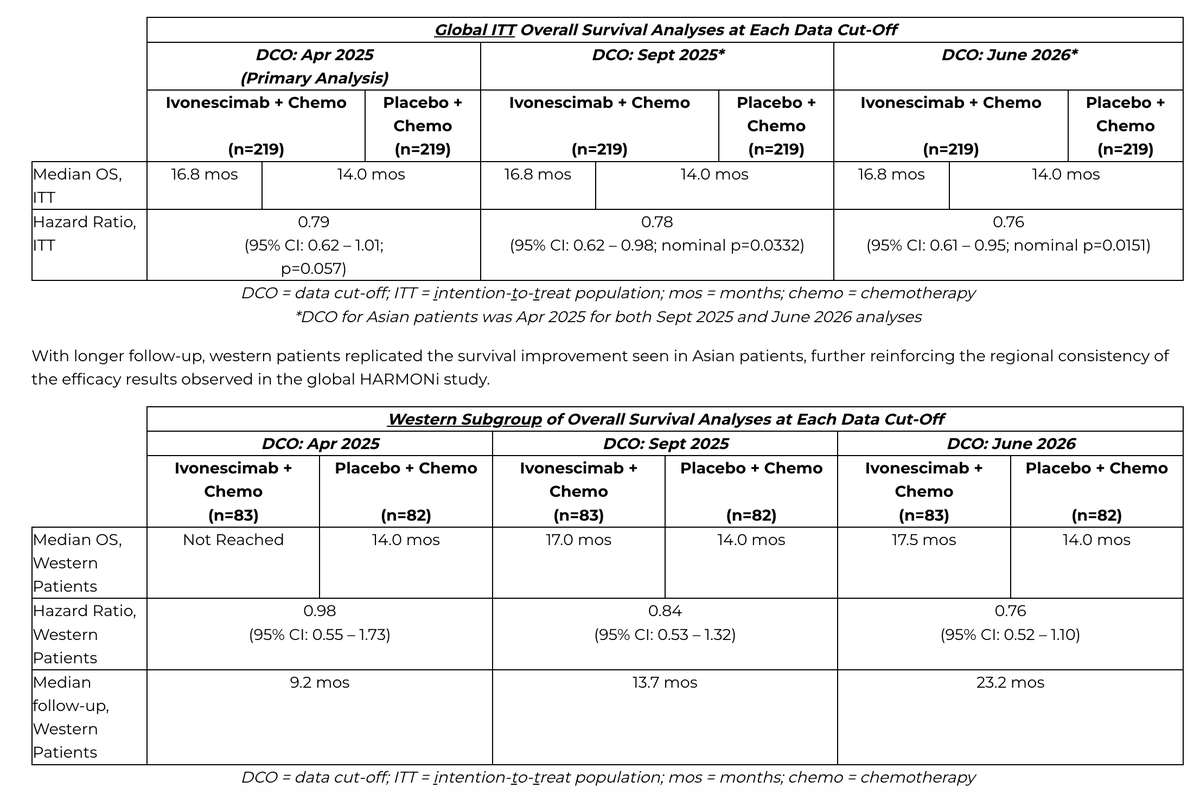
First, I think THIS CRL is warranted. $SMMT played a trick by pooling two cohorts with drastically different FU and asked regulator to approve altogether while the western cohort is yet matured (and China cohort is super-matured).
$ABVX $HELP $IONS OK I have to vent a bit. I don't understand how a biotech company can navigate first-in-human clinical trials and yet completely blunder the easiest part: communicating the data effectively in a press release.
You usually have one asset and/or one indication that matters. You have hundreds of millions, sometimes billions, of dollars of cash. You have an investor base with which you are in constant communication. You have sell side analysts who are constantly talking to you and asking you questions from investors that provide you some reference point on what matters to them. You also have an understanding of how your global and site PI have been thinking about the risk/benefit of the product. You also have the benefit of the FDA's communications as well.
You have 3-5 major data updates throughout your lifecycle as a company, from topline data, to updated data, to initial guidance and call on the drug launch, if you aren't acquired before then. These milestones materially impact how the world views the value of your highly speculative asset and company. This asset may have been in development for a decade or more. You've run a clinical trial burning hundreds of millions of dollars of cash to generate the data that proves to the world all of that blood, sweat and tears along the way was worth it and you are one of the few companies that have successfully developed a product that could be a massive commercial success.
And then you dump a steaming hot mess of a press release onto the market right before you plan to raise money. All that time and energy that went into ensuring the trial worked just got partially, or permanently, impaired because no one stepped back and determined what are the most important questions and concerns that an investor would be wondering about, and to address those questions immediately when they are reading the press release to ensure they aren't smashing the sell button before you have a chance to address them. At least halt the stock, that's why that functionality exists.
Let's talk about a few recent ones, starting with the most recent (today): $HELP. Ok, you have fantastic efficacy. That's great. And along the way, you have some SAEs. That's ok, lots of drugs have SAEs, and they will be weighed against your great efficacy. Even better, your SAE's look like they may actually just be manifestation of the underlying symptoms of the disease (i.e. depression and suicidal ideation). So who in the world thought it was a good idea to identify these SAEs as treatment-related, then leave it to the reader's imagination on the nature of these SAEs while the stock was unhalted???
Are these patients even still alive? You could have not disclosed them in the PR and disclosed all the detail in the presentation, and have been fine. You could have disclosed them in the PR and provided detail to help investors understand that these weren't catastrophic in nature. And yet you willingly did neither. And now you've created new narrative overhangs that have emerged in order to explain the share price movement even after it is disclosed the SAEs were not only common with this indication, but were one of the primary symptom manifestations of the underlying disease.
I have shorts over here that will try to hide Grade 5 liver toxicity events by not disclosing them and claiming they hadn't yet ruled out that the late 39 y.o. former physician didn't take up wild mushroom eating during his time on the trial, and yet longs will just throw out "oh yeah, there were a few serious drug-induced events but we aren't disclosing what they are...usually a bad sign right?? Just wait until we reveal to you what these things are...did they make our efficacy completely irrelevant?? Take a guess!" and then later on give details that made me question why in the world they would not have given that detail earlier before people obliterated their share price.
$IONS was another great example. sHTG was the only thing that really mattered this recent earnings. Their initial guide earlier this year was bizarrely high, then they guide down and provide no useful metrics to immediately understand that the launch is actually doing ok. Instead, we get a Rubik's Cube of select random datapoints that I have to make assumptions around to back into what the launch looks like, only to realize they've now completely swung the pendulum in the other direction and guided to a number that makes it seem to anyone looking at it at surface level like they're not going to get another incremental patient on drug in 4Q, rather just run-rate their prior quarter in patients. Every other company gives start forms, why am I having to back into projecting what I think are decent enough revs based on a mix of lives covered, % of physicians who prescribed drug to more than one patient, net pricing, assumptions on prior indication growth, and percentage of physicians who ate ham sandwiches while placing an order for the drug in their EMR?
$ABVX We've beaten this dead horse enough. But the list wouldn't be credible if it didn't exist on it.
I have offered to go under CDA and restrict myself to help companies I own to provide feedback on how to effectively communicate press release data, but the number of companies who take me up on it are quite small. Worse over, I know of instances where top holders will consult with the company in such a matter, and yet the PR is still a mess.
If your company is a 10% position in my fund, I'm going to care a LOT about how that press release is written, even if notionally I'm less than a large fund's holdings. If you are a .5% to 2% position, the incentive to really dig in and think about all ways that communication could fail is much smaller than mine.
Please stop screwing up the easiest part of drug development -- the promotion of your own asset, and relying on people to figure it out on their own. You'll find that in an era of increasingly short term horizon investors, the mistake may have more permanent consequences than ever before. And then pharma looks at the share price movement, reads the same PR, and comes to the same wrong conclusion about the reality of the situation.
@cremieuxrecueil@Biomaven Every acquisition they make you’ll see naysayers calling the sellers shitcos because they didn’t buy the consensus onco pick (see orexin agonists, psychedelics). They can afford to be innovative
I'm surprised how often frontier models make simple reasoning mistakes in Bio. Perhaps the lit is polluted?
I fear that the Benchmaxxing on Benchslop is impairing some bio-reasoning capabilities
Often when I open an AIxBio bench my head hurts. It feels like a lot of AIxBio benchmarks are LLM generated -> "expert" "reviewed" -> LLM benchmarked -> LLM "graded" -> LLM summarized. What are we accomplishing?
Good biological benchmarks are likely necessary for training frontier models. But, the details really matter.
One base, one atom, even one stereocenter can be the difference between a nasal decongestant and tooth-rotting psychotic stimulant
Steve Jobs died of cancer in 2011.
His son Reed is now running a VC firm with one goal: to make cancer non-lethal in his lifetime.
It's called Yosemite, and it's not a normal fund:
• Oncology only, which is ~40% of biotech
• Grants university labs no-strings-attached money to de-risk early ideas
• Builds about a third of its companies itself, with academics at places like Yale, Berkeley and Stanford
• Fund 1 backed 20 companies. Fund 2 is oversubscribed, above its $350M target, with AbbVie and Amgen as partners
Asked what his father would tell him today:
"Stay on the path… This is a long-term play that is going to take my whole life."
And the hardest part, in his words:
"I'm an impatient guy… But the discipline is knowing that that is what this really takes."
Patience isn't a personality trait. It's a decision you keep making.
Surprise 1: Anthropic acquired a one-person biotech
.
.
.
Surprise 2: that person is me
Surprise 3: I’m here to tell you all about it
Yes, this is what you think it is; after 6 yrs of increasingly loose anonymity: the Professor Oak reveal post
…and yes, it has gotten so boring around here that I’m literally doxxing myself to spice up the timeline
-------
Ok, allow me to introduce myself. My name is Cody Tranbarger. I mostly tweet, but occasionally find time to dabble in drug dev & starting/building biotechs. My past lives span the VC, crossover, startup continuum; Prof Oak has been my way of keeping a digital foot in those worlds, despite having my physical feet planted elsewhere.
The past 18 mo, ‘elsewhere’ was Mithril Medicine, a co. I founded to develop bsAbs for LAMA2-CMD & other ECM-related genetic diseases.
Mithril was born out of hands-on building with @MikeNGladstone, @JasonPaulRhodes, @LifeSciVC, & team @atlasventure. Somehow, I made enough half-decent calls along the way (even a broken clock is right twice a day, eh?) to convince them Mithril/I warranted a small seed. While I can hardly rationalize such an outrageously cavalier bet, I’m grateful for it, & I'd partner with Atlas again in a heartbeat.
In typical AV fashion, Mithril’s primordial form was virtual, decentralized, & ultra-lean. This stage tends to be short-lived, but for Mithril, it worked surprisingly well, for surprisingly long, thanks in part to the rapid maturation of the AI tools I used liberally.
Eventually, Mithril became a bit of an experiment itself - to find the upper bound of how far it could scale as a single operator + a bunch of Claude (+ a stellar bench of part-time consultants).
In parallel, I started spending time with @nc_frey, @an1lam, & @CoefficientBio team; and promptly experienced, for the 1st time, AI at the frontier. Soon thereafter, Mithril stopped looking like an experiment, & started looking like a preview of an entirely new operating model.
From that spark came “Pipeline-in-a-Person.” The idea immediately resonated when we shared it here back in April; and it was central to the shared vision that led to Anthropic’s acquisition of Mithril, & my joining the team.
Why join Anthropic? Three reasons.
(1) For Mithril, the programs continue, with more resources & infrastructure behind them, and as much Claude as I can put to work.
(2) For me, the chance to start several more programs, & find out how many one person can actually run in parallel - an almost unprecedented luxury for a curious drug hunter.
(3) For our mission, a path to institutionalize & scale this new way of working, then put it in the hands of all of biopharma, all over the world - which, candidly, I find the most energizing.
Will AI x Bio cure diseases? Unequivocally yes, imo… but not by the route that gets the most airtime. Rather than timeline acceleration & compression, I see orchestration & parallelization as today's low-hanging fruit.
Most drug hunters see a handful of go/no-go calls in a career, & spend entirely too much of the rest trading emails (my inbox can attest).
Give them the bandwidth to run several programs at once, and the time to focus on scientific judgment, and I’m willing to bet they’ll make better calls. And at scale, better calls translate to more drugs, higher hit rates, broader patient impact, & likely, a disease or 10 or 100 cured. I couldn't be more excited to build toward that future @AnthropicAI.
Finally, a heartfelt thank you to BioTwitter/X. The end of anonymity is bittersweet, but if anyone’s earned a proper introduction, you all have.
It’s difficult to overstate how much this app has done for me: a decade of education, plenty of friends, many job opportunities, several mentors, a few investors, even a co-founder (fmr). It was the generosity of this community that inspired me to start posting 6 years ago, after just as many years lurking. I hope I’ve been able to pay it forward, in my own small way.
But, to be clear, Prof Oak isn’t going anywhere. Same beat, same themes, and now, a front-row seat to drug development at the frontier. Stay tuned for dispatches from the trenches; and remember...
Gotta Cure 'Em All
Let’s compare the state of protein structure prediction circa 2017 to the virtual cell today:
Structure prediction c. 2017:
- deep learning working on sequences (eg seq-to-seq, transformer) and other modalities like images and point clouds (PointNet). Mapping a sequence to a heavily constrained point cloud was entirely feasible.
- Protein Data Bank (PDB) was 46 years old with data mapping amino acid sequences to structures and sequence databases existed with close evolutionary neighbors to these sequences so we knew what positions covary (more info about the seq->struc map).
- Anfinsen’s 1972 Chemistry Nobel for showing a protein’s native structure is the free-energy minimum of its sequence, ie the sequence->structure map is largely deterministic / sequence is a sufficient statistic for predicting structure.
So the problem was well-defined: learn the map seq->struc, which we knew must exist (Anfinsen), and use deep learning which we knew works, on data we had in hand (PDB + homologous sequence data which contain all the necessary signal about the inputs & outputs of that map).
Edit: AF is still impressive and required advanced engineering.
The virtual cell today:
- no agreed definition
- predicting future “cell states” from past states + perturbation is underspecified; what is a “cell state”? What is a perturbation?
- all measurable choices for cell state (eg scRNAseq, multi-omics, imaging, phenomics) are very lossy and almost all methods require destroying the cell to take the measurement (can’t measure multiple time points)
- we have no evidence that any measurable past “states” (which we can’t even define) form a sufficient statistic for future states (can’t rule out the influence of unobservables; no Anfinsen result).
- the only map we know must exist is physics, which is intractable to simulate at cell scale.
- we have the wrong data to learn this undefined state+perturb->state mapping. Even if we take a narrow stance on the inputs/outputs like state = RNA levels & perturbations = single gene knockdowns, the mapping is heavily environment dependent and we have no way to reduce “environment” into a feature vector without losing (most) information.
AlphaFold had to learn a map we knew existed, from data that captured the inputs and outputs of it. The virtual cell is a map we can't define, that may not exist over observable states, and our data captures neither inputs nor outputs fully. These are categorically different initiatives and project risk is worlds apart.
@rlacombe Biology already has a Bitter Lesson—it's that clever ideas based on clever readings of the literature and clever simulations based on the data we have so far are of negligible value compared to going and getting good data from real biological systems on your specific question.