Britain restored the gold standard in 1821, pegging sterling at £3 17s 10½d per troy ounce, and the following decades gave you one of the most instructive experiments in monetary history: falling prices coexisting with explosive real growth.
Prices fell. Roughly 50% between 1820 and 1850 by some price indices. The textile mills of Manchester kept expanding. Railway track mileage in Britain jumped from virtually zero in 1820 to over 6,000 miles by 1850. Real wages climbed. The orthodox panic about deflation, the kind you still hear from central bankers today, would have predicted stagnation. Instead you got the industrial revolution, accelerating.
The mechanism is simple once you strip away the Keynesian fog. Deflation under a gold standard reflects genuine productivity gains: producers squeeze more output from the same inputs, and prices fall because goods become cheaper to make. This is healthy deflation, not demand collapse. The cotton spinners of Lancashire caused falling yarn prices through innovation.
Sound money advocates have always stressed this distinction. Falling prices from productivity growth reward savers, keep capital costs honest, and force businesses to earn their profits through efficiency rather than inflating their way to margins.
The British experience between 1821 and 1850 is an inconvenient data point that modern central bankers quietly ignore: a hard currency, shrinking prices, and the fastest sustained economic expansion the world had yet seen. Simultaneously.
Railroads were once 63% of the entire US stock market.
Not 63% of transport stocks. 63% of everything listed.
The history of concentration, in order:
– Tulips, 1637. A single bulb traded for the price of an Amsterdam canal house.
– South Sea Company, 1720. Shares went from about £128 in January to above £1,000 by summer, then back near £150 by December.
– US railroads, 1840s. 63% of US market cap.
– Utilities, telecom and industrials, 1929. 36%.
– Nifty Fifty, 1972. 40%.
– Japan, 1989. 44% of global equity.
– Dot com, 2000. 41%.
– AI Big 10, today. About 40%.
Every one of them was built on something real. Railroads did compress a continent. The internet did rewire commerce. Being right about the technology was never the thing that protected you.
The tulip story is also less clean than the legend. Modern research found the economic damage was modest and the ruin was mostly literary.
The bubble was never in the idea. It was in how many people decided to own the same idea at the same time.
There is another way to interpret what is happening in crypto right now, and it is considerably less comfortable.
The industry has a volatility problem.
Real volume is declining. Directional participation is thinning. Implied volatility continues to compress. Cheap puts are being sold, call demand remains weak, and entire sessions increasingly feel mechanically pinned.
That matters because crypto depends on movement.
Volatility creates opportunity. Opportunity creates trading. Trading generates revenue for exchanges, market makers, arbitrage desks, derivatives platforms, miners, funds, and the broader ecosystem.
Remove volatility for long enough and the machine begins to starve.
At the same time, reported volume on some lower-tier exchanges increasingly appears disconnected from observable liquidity. Enormous headline volumes coexist with shallow books, limited price impact, and little visible organic flow. If a venue reports billions of dollars in activity while contributing almost nothing to genuine price discovery, it is reasonable to ask what that volume actually represents.
Economically meaningless volume does not solve a liquidity problem. It conceals one.
And that brings us to liquidations.
MSTR selling and miner flows may have acted as marginal spot supply during the recent move. Options positioning added another source of compression: persistent put selling pushed implied volatility lower while weak call demand limited upside convexity.
Near expiry, that creates an interesting setup.
As large short-put positions decay, dealers may need to unwind the underlying hedges associated with them. If dealers are short delta against those positions, that unwind requires buying back underlying exposure. In a thin market with stretched positioning, the resulting flow can become a meaningful source of demand and potentially contribute to a vanna-driven move.
Crypto, however, introduces another variable that traditional markets largely do not have: enormous vertically integrated exchanges sitting directly inside the liquidation mechanism.
This is where the questions become more uncomfortable.
Our working hypothesis is that liquidation flow may not always reach the open market at the moment it is generated.
Under certain conditions, liquidated positions may instead be absorbed, internalized, or effectively warehoused before the resulting inventory is eventually transferred back into the market.
To be clear, this is a hypothesis based on observed flow patterns. It is not proof of exchange misconduct.
But the tape repeatedly produces behavior that deserves scrutiny.
We have observed unusually large liquidation prints following extremely small BTC moves, sometimes without any corresponding movement in the mark or index price that would intuitively explain the reported liquidation event.
At other times, BTC moves thousands of dollars through obvious leverage zones and the expected liquidations barely appear.
Then, on a much smaller move, enormous liquidation prints suddenly arrive.
Why?
If reported liquidations were always the immediate mechanical consequence of leverage, margin thresholds, and mark-price movements, their timing should broadly correspond to the underlying price action.
Sometimes it does not.
One explanation is data noise.
Another is that large amounts of leverage were established shortly before those moves.
But there is a third possibility worth considering: some of the reported liquidation flow may represent inventory created earlier and only later transferred back through the market.
That distinction matters.
Imagine a large forced-selling event.
Instead of allowing the entire liquidation to hit the order book immediately, a sufficiently capitalized venue or liquidity provider absorbs part of it. Binance itself—or an affiliated or independent liquidity provider with a sufficiently large balance sheet—could theoretically warehouse substantial temporary inventory.
The leveraged trader disappears.
The inventory does not.
Someone now owns the other side.
And whoever owns it eventually needs an exit.
That inventory could remain off-market until liquidity improves, then be distributed gradually—or released more aggressively when market conditions make doing so advantageous.
Under that model, liquidation flow stops being only a consequence of price.
It becomes a potential source of future price pressure.
The recent rally makes this possibility particularly interesting.
Contrary to the idea that the move produced unusually little liquidation activity, published data eventually showed an extraordinary liquidation event despite BTC moving only roughly 6–10% and without an obvious fundamental catalyst commensurate with the reported magnitude.
Compare that with the decline.
On the way down, the market moved through increasingly stressed leverage conditions while convexity in perpetual contracts collateralized by altcoins and other crypto assets was likely becoming extreme. The liquidation engine should have become increasingly sensitive to further downside.
Yet the cascade eventually stopped around $58K.
The market absorbed the pressure.
Now, following a much smaller percentage move, we see liquidation figures of historic magnitude.
That asymmetry deserves attention.
What exactly are these liquidation figures measuring?
And when is the underlying inventory actually being transferred into the market?
Suppose short-liquidation inventory was accumulated somewhere between roughly $60K and $70K. Whoever absorbed that flow would have considerable flexibility over when and how to distribute it.
At higher prices, that inventory becomes profitable.
Now consider what happens when volatility disappears.
Trading falls.
Volumes contract.
Open interest stagnates.
Retail engagement fades.
Perpetual activity declines.
Spreads generate less revenue.
The casino goes quiet.
For exchanges and market-making infrastructure whose economics depend heavily on activity, prolonged low volatility is an exceptionally poor environment.
Which raises an uncomfortable question:
Who benefits when volatility suddenly returns?
Almost every major participant in the trading infrastructure benefits from renewed activity.
If a large venue or liquidity provider is sitting on liquidation inventory, releasing even a modest amount into an unusually thin market could create disproportionate price impact.
Top-tier market makers recognize liquidation-driven flow quickly. They widen spreads, reduce exposure to toxic flow, and capture the liquidity that remains.
Lower-tier venues can then be swept through arbitrage.
A relatively small originating flow can propagate across exchanges and create a much larger visible move.
Price moves.
Liquidations print.
Volume spikes.
Social media wakes up.
Traders return.
FOMO starts rebuilding.
The machine gets fed again.
None of this proves manipulation.
But the economic incentives are difficult to ignore.
For a dominant derivatives venue, a market that remains permanently dormant is commercially unattractive. Volatility is oxygen for the business.
That leads to the larger question.
Suppose the recent move was, deliberately or structurally, useful for clearing remaining short-liquidation inventory while generating enough movement to reactivate traders.
What happens if it fails?
What happens if price moves, liquidation figures explode, everyone watches—
—and nobody comes back?
No sustained FOMO.
No meaningful spot demand.
No major expansion in open interest.
No recovery in organic volume.
Then the problem is larger than whether BTC trades at $70K or $80K next.
It would suggest that volatility itself is losing its ability to attract fresh capital.
And that would be deeply bearish for the trading ecosystem.
Because manufactured activity cannot substitute for genuine participation indefinitely.
You can print volume.
You can subsidize liquidity.
You can create leverage.
You can liquidate leverage.
You can recycle inventory.
But eventually somebody has to genuinely want the asset.
Which brings us back to the inventory question.
If short-liquidation inventory accumulated around $60K has now largely been cleared, what happened to the enormous amount of long-liquidation inventory generated during the decline from roughly $120K toward $58K?
Who absorbed it?
How much remains?
At what average price?
And most importantly:
At what price can that inventory be profitably returned to the market?
If part of it was effectively backstopped around the March lows, inventory associated with the $60K region may already be largely resolved.
But inventory accumulated around $70K–$80K could present a different problem.
If substantial long-side inventory still needs to be distributed, traders establishing fresh longs between current levels and $80K may not necessarily be front-running the next bull market.
They may be providing the liquidity required for legacy inventory to exit.
That is the darker interpretation.
Every rally attracts fresh buyers.
Fresh buyers create liquidity.
Fresh liquidity creates an opportunity to distribute old inventory.
Then the market can move again.
The critical question is whether this is simply the natural consequence of an exchange-mediated liquidation system—or whether market structure has become concentrated enough that the largest venues can effectively influence when inventory is absorbed, when it is released, and therefore when volatility emerges.
At that point, the discussion is no longer only about market structure.
It becomes a discussion about market control.
And if declining organic volume means increasingly violent volatility events are required simply to keep participants engaged, the industry should be asking a more fundamental question:
Are we watching a healthy market clear leverage—or a shrinking market repeatedly harvesting the traders who are still willing to participate?
And if the latest injection of volatility cannot restore sustained participation:
Are we watching liquidity return—or watching the remaining liquidity being extracted before it disappears?
Food for thought.
Satire, obviously... but can any of you say with a straight face that with the way the world is going we *won't* see this sort of thing in a few decades (or sooner)?
We tell young people in our society that end of the rainbow is retirement at 65.
We ought to tell them that "there is going to be this short but beautiful golden window from roughly age 3 to roughly age 12 where your kids are not only easy (comparatively to bottles & diapers), but are going to be these beautiful little creatures and it will pain your heart to be away from them for too long. So, prepare in your 20's, financially and career wise, to build that flexibility into that chapter of your life".
You don't get another shot at living the "golden window". And, for me, leaning hard into that golden window has made everything else in my life feel fairly insignificant in comparison. I have made plenty of mistakes as a father, but what I won't have is the regret of having been distracted and absent from these formative years. In some cases, that has required financial sacrifices (declining a particular career opportunity that would have required relocation), but I personally have zero regrets.
I also hear from some ambitious & successful people with a 4 year old that say "I've lost my ambition, I am so immersed in fatherhood". At least for me, and a number of my friends, it comes back. You can't keep an ambitious person down and if you have the fire, hanging at a playground on too many Tuesday afternoons is going to feel like torture after too long.
My three boys are approaching 13, 11 & 9, and it's much different than 7, 5 & 3. This summer, for example, they slept until 11am and I hard an unencumbered 6am-12pm to work (being on PT helps), then got another great window 7-11pm, but was able to be present in the heart of the day, then weeks when they were at basketball camp, etc. It gets easier, your time frees up again (there's a sadness to that too), but I'm back to working as intensely as I did pre-kids just because my day to day presence requires fewer hours than it did before (also, my wife is just superbly wonderful). And that is the beautiful gift of entrepreneurship (or at least my sort of business), the ability to deliver still a high level of output but work that around your life rather than the opposite.
TLDR, grind before, and grind after. Prepare for the golden window.
Farmer explains the story behind the demonization of raw milk:
"They put a lot of dairies in cities next to distilleries. They would be fed the same grains from the distilleries, made these cows extremely unhealthy.
These cows got tuberculosis... disease was rampant. The pasteurization process made this milk drinkable without killing you."
He explains why the dairy industry is more responsible for milk related infections than raw dairy farms.
"The chief fear from drinking raw milk is E. Coli... when the cows eat a lot of grain, their rumen becomes acidic. They have evolved to withstand the acid in their rumen, so now when we consume it, the acid in our stomach doesn't kill it"
"The reason we're in this position with raw milk being demonized... mostly it's money. There's a lot of money in the dairy industry. They have sway with the media, with state and federal governments. It's a large industry with a powerful lobby."
This is very Unusual.
We saw crazy decoupling this week with crypto and stocks going in completely opposite directions.
Total Crypto market cap is up +13% after adding $291 billion.
Meanwhile US stocks erased -$1.4 Trillion in the same period with S&P 500 falling -1.83%.
🚨 THERE'S NO STOPPING JAPAN'S ECONOMIC CRISIS
Japan's 2-year bond yield just hit 1.692%, its highest level in 31 years. It was negative in early 2024.
That's a rise of nearly 170 basis points from below zero in just two years.
The 5-year is at 2.173%, also a 31-year high, and the 10-year is at 2.929%, a 30-year high. The entire curve is repricing at once, not just the short end.
Japan already carries debt worth around 205% of GDP, while Q2 GDP growth came in at just 1.1% annualized versus 2.0% expected.
Rising debt, weakening growth, a falling currency and higher borrowing costs are all hitting Japan at the same time.
It is the worst combination a country can face.
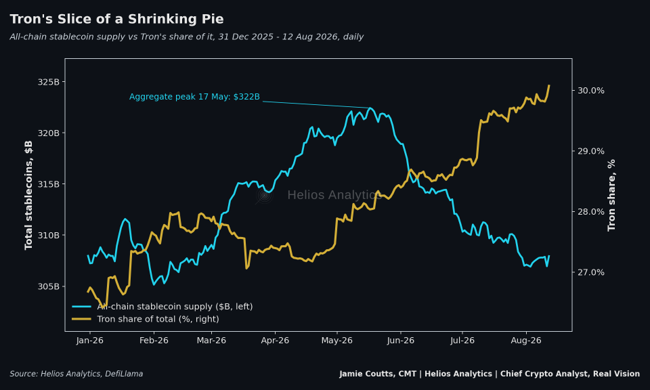
Despite the Stablecoin narrative, the pie has shrunk in recent months. Yet for Tron its still growing. Aggregate stablecoin supply across all chains peaked at $322B in May and has fallen 4.4% to $308B. Tron's stablecoin base rose 2.7% over the same three months to a record $92.2B, and its share of all stablecoins hit 30.0%, up 3.4 points year-to-date, the largest share gain of any chain. Ethereum gave up 5.5 points.
There will be more banks in Europe settling in Chinese currency and also using the efficient CIPS system, abandoning the old and Us-controlled SWIFT.
Join my venture to set up a new bank in Europe that will take advantage of these major developments presently.
Minimum 200k, qualified investors at this stage. Mail me at [email protected]
China does not need to conquer Europe to increase its influence. Trade has always been far more powerful than political speeches because supply chains create relationships that governments eventually find difficult to unwind.
The ugly truth about why .5% of men make it and most live sh!t lives...
Is that you can't work or motivate yourself to success.
You have to create a metaphoric gun to your head with a very real mental bullet. An outcome that is up there with death.
Let me explain:
You won't see growth in your life... personal or in income... from motivation. You can't willpower it either.
You will see it when you've endured enough pain that you have truly had enough and refuse to stay as you are.
Most men only stop drinking when it makes their life unbearable.
Most men only choose to take big risks and become successful when they reach a breaking point from the work they are stuck in.
I for example NEVER wanted to be an entrepreneur growing up. It wasn't till I was 22, broke and stuck and hating my job, that I literally couldn't live any longer in my current situation. I didn't want to build a business. I had to. My life was unbearable due to where coasting had gotten me.
Only when "at any cost, I can't live like this anymore" becomes your motivation will you see huge growth.
The way to achieve this is by removing what numbs you. The things that stop you from looking in the mirror and going "what the fucking fuck."
The cheap dopamine, cheap thrills, booze/pot/junk that leave you foggy and unclear. The things that let you feel okay, despite your life being very much "not okay" if you actually look it in the eye.
Most men never do this. They never look at the things they CHOOSE accept about themselves. Poor health. Poor habits. Awful results in everything.
They just open a beer, load up a video game, scroll social media and bury it. This is because looking at how ugly you are is hard. The best way to ensure you stay metaphorically fat and disgusting is simply to not look in the mirror.
You have to look at who you truly are and feel such disgust that you will no longer tolerate staying where you are.
Without this you will only get temporary bursts. You will only make do on willpower, which is finite.
Something close to a gun to your head must be created in your mind. You must vehemently reject who and what you are to the point that it keeps you up at night.
Then you'll simply make whatever you want happen.
This is why most men never unlock their potential till they hit rock bottom. Most, despite WANTING success, are always in a numb state of "mostly" comfortable. The years then pass, they get old, nothing changes.
Whatever it takes to trigger this. Do it.
The answer isn't a self help book. It isn't researching and admiring other role models. It isn't envisioning a better life and mapping out daily steps to get there.
It's unbridled-unholy-rage as a result of where your life choices have gotten you.
This won't sustain you forever....But shit damn...It will guaranteed get you over the initial hurtle and to the point where "love of the game" will carry you.
Like I said before, it usually comes down to removing everything that is distracting and numbing you so that you are forced to look at yourself for who you truly are.
My discussion on how to decolonise the world, just as the digital controls aim at re-colonisation.
Istanbul, Decolonisation Forum, May 2026.
https://t.co/9EsDfgENIJ
The problem in Western countries is that the central planners are getting their way: They're allowed to kill thousands of banks, concentrating their power, creating too-big-to-fail banking giants and killing the middle class whose small firms need small banks to obtain funding.
Bitcoin then and now:
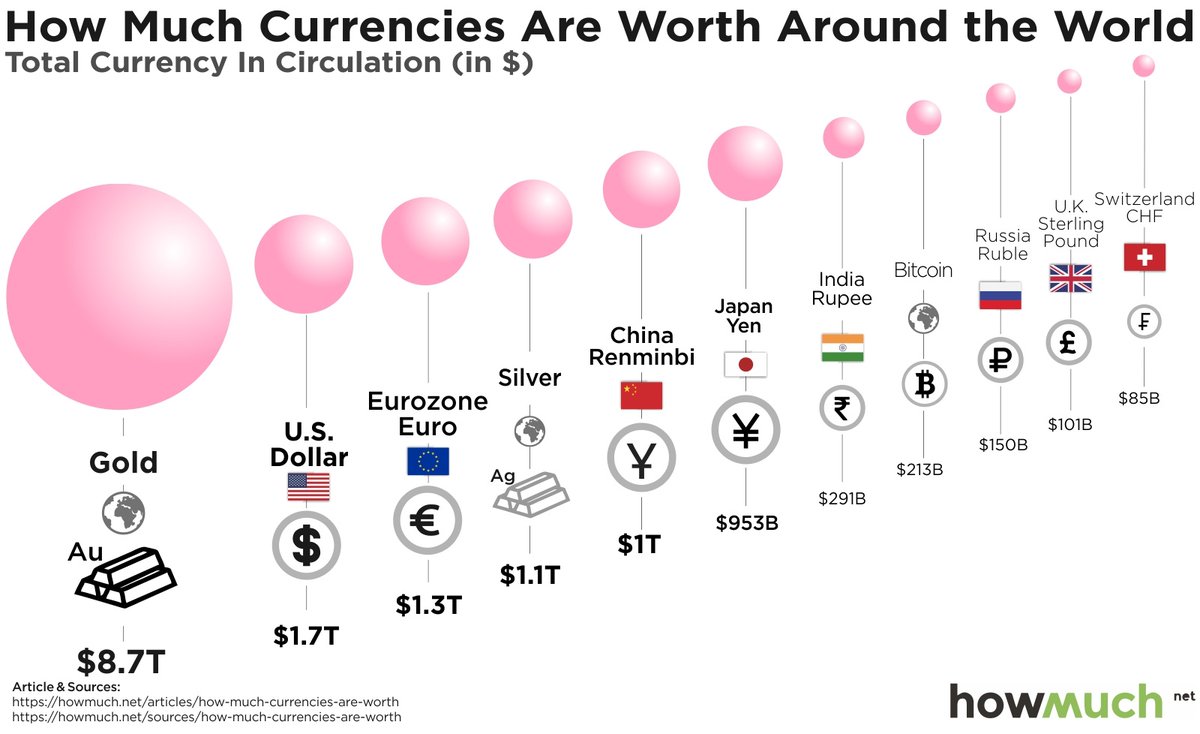
I've updated the 2020 chart to today's estimated rankings. Bitcoin has lapped the Yen and Rupee and is closing in on the Euro, which has fallen from 3rd to 5th. You can see why the European Central Bank is so anti-Bitcoin. Once Bitcoin surpasses the Euro, the Euro will simply be another currency on the periphery of the global economy.