Excited to share our paper on somatic variant calling in HLA genes and genes related to antigen presentation across a cohort of 136 patients with diffuse gliomas published in @CIR_AACR: https://t.co/5NWRoGjXva
A thread ...
#Bioinformatics#Immunology#CancerResearch
Did you make a cool #OpenScience tool using Brain Map? Submit it to our community tools page!
Tools should use Brain Map resources, extend the use of data, provide new ways to access and analyze data, or support educational use.
Learn more and submit:
https://t.co/BvJKbMhS1a
It's great to see my first paper of the PhD published in @NatureBiotech! https://t.co/uMnJ6Z1g3C. This describes our scRNA-seq method, scITD, for analyzing how the transcriptional states of multiple cell types are linked across patients. A few highlights from the paper:
Finally published. In this paper we showed that despite heterozygous exonuclease deficiency of pold1 has a minor effect on the germline and somatic mutation rate. Homozygous deficiency increase mutation rate by 2 orders of magnitude and causes cancer https://t.co/fFBK2eeMo8
ENJOY READING:
A Human Tonsil Atlas @ImmunityCP
Proud to present our @humancellatlas work generating an "Atlas of Cells in the Human Tonsil" at #singlecell resolution and 5 modalities.
Thanks @ERC_Research and superstar-teams @cnag_eu and @idibaps.
https://t.co/6Kxt74TUXv
Aneuploidy is a defining feature of cancer cells, but is it also present in healthy normal tissues? In our paper out today on @NatureGenet, we report hundreds of mosaic chromosomal alterations (mCAs) found in diverse tissues from #GTEx. A thread (1/7)
https://t.co/JtzP7d1oRL
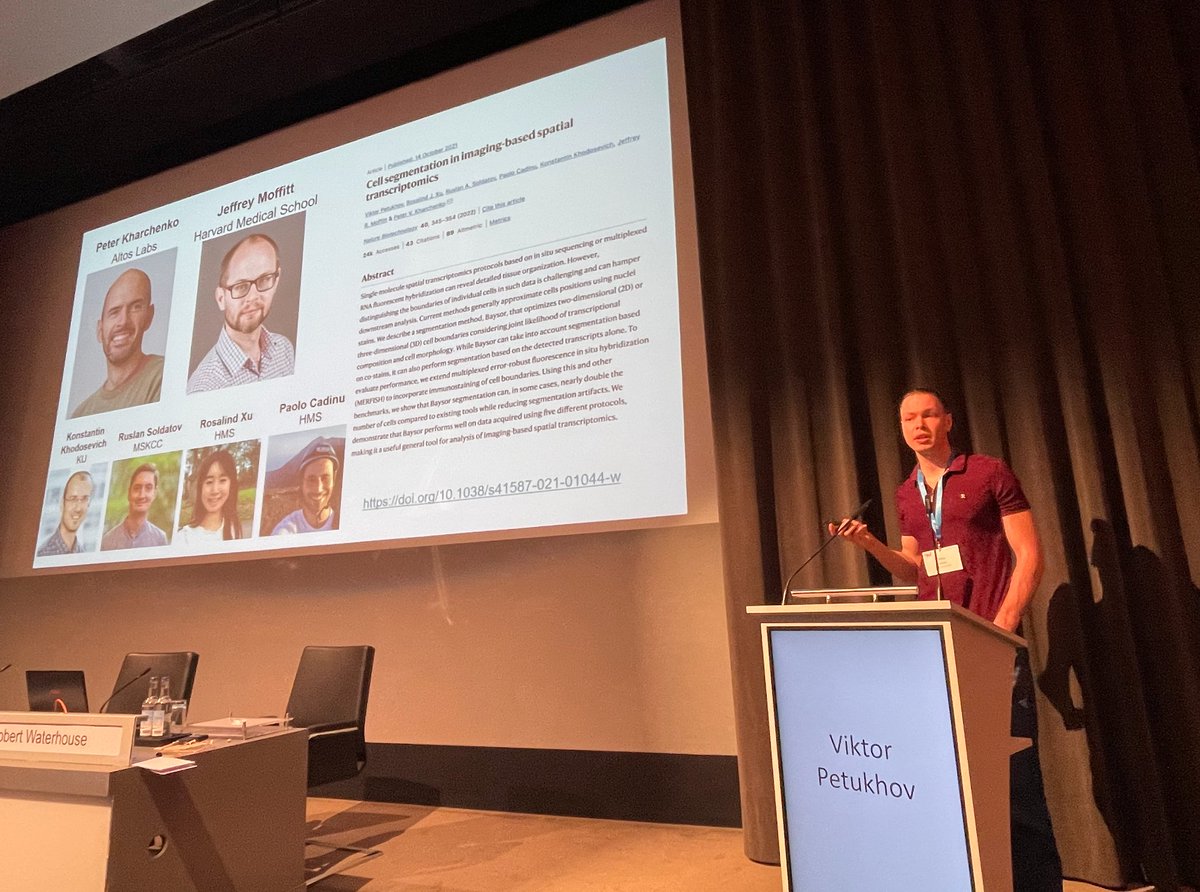
@PetukhovViktor Viktor Petukhov @PetukhovViktor talks about his winning paper, 'Cell segmentation in imaging-based spatial transcriptomics', published in
@NatureBiotech
It deals with the problem of false individual-cell signals from neighboring cells. See: https://t.co/jOmhalDMkA
#BC2Basel
@shyam_lab For really high impact, coupled ODEs and nonlinear dynamics might do the trick. Say "goodbye" to Manhattan plots, and "hello" to bifurcation diagrams and Mandelbrot sets. :)
⌛️Time's running out to sign up for our #Bioinformatics#hackathon, Aug 30-Sept 1! Dive deep into SV, somatic & mosaic variants, graph genomes, and more! Prizes for best teams!
Registration closes 3pm CT Friday!
https://t.co/d62ywPB7hj
Major, fatal errors found in the data and methods of a 2020 paper in @Nature, including millions of reads mis-identified as bacteria. The "cancer microbiome" in this study was simply not there. @abrahamgihawi@elapertea@YuchenGe1@JenniferLu717 https://t.co/z5Aja84kiR
@shyam_lab@nicholas_navin@hoffman_steven@ItaiYanai@TiroshLab@KeystoneSymp I still think you'd need matched genome sequencing at a significant depth (A) to confidently call variants and (B) capture all the heterogeneity at play. Why? Even long-read scRNAseq is sparse and still the error-rate is too high, especially for somatic variants.
It was a tour de force just generating a draft human pan-genome @HumanPangenome, but some suspected and some utterly bizarre things about the human genome have been revealed using these 47 different human reference quality genomes.
Great thing to learn from experts: Variant calling and benchmarking in an era of complete human genome sequences
Congratulations! @GenomeInABottle@sedlazeck
https://t.co/SrKa9C3mwf
Need to design gene panels for targeted spatial transcriptomics technologies? Read our new pre-print “Gene panel selection for targeted spatial transcriptomics” https://t.co/dwVbbVjgqm. In this work, we developed a computational method, gpsFISH, to perform such gene panel design.