On Scott Adams.
A man finds, to his astonishment, that he exists. After the elation of childhood wears off, he asks, who am I, why am I here, how does this work? These are hard questions, so after a brief struggle, he selects a readymade answer and goes about the motions of life.
Scott Adams was not such a man. He was a live player, ever curious, intent on figuring out this simulation that he found himself in. From first principles, Scott unraveled, understood, and ultimately controlled his own reality. He hacked himself with affirmations, others with persuasion, the world with simultaneous sips. He explained people as moist robots, two movies happening on one screen, his world as Gods’ debris. He carved a personal mission to “be useful,” and made us all better writers, public speakers, and persuaders. He preached the footwear theory of motivation, the Adams Law of slow-moving disasters, the skill stack, systems over goals, and of course, the Dilbert Principle.
Besides cartooning, philosophizing, and teaching, Scott rose to the occasion and displayed, “the one virtue that cannot be faked” - courage. Scott had the courage to speak honestly as he saw it - about Trump, about his nation, and about his time, even though it cost him friends, audience, money, and his ticket to polite society. Scott had true courage, the kind that makes you unpopular, the kind that is always and everywhere in short supply,
At the end, as any hacker of reality, Scott covered all of his bases - he left as a Buddhist, a Christian, and a player in the Simulation.
Scott, we didn’t get enough time with you, but you were a mentor and a marvel. You were useful and you were courageous. You were incompressible and indivisible. One of a kind, and generous with your drawing, writing, and speaking. Unlike your squealing critics in the chattering class, you will be read generations from now.
On this earth there are many long-lived hells but no lasting heaven. Each heaven must be created and nurtured, ex-nihilo, from mind and from mud. Scott, you created a small heaven for us all, and to a larger heaven you go.
A man finds, to his astonishment, that he no longer exists. He asks why, what it was for, and how will the new reality work? When the rest of us get there, we’ll find Scott, ever useful, ready to explain, having figured it all out.
Notes:
• First line paraphrasing Schopenhauer.
• Courage quote via Taleb.
Good take
My guess is
- demand for intelligence is near infinite
- but 80% of workloads will be running on 99% cheaper models within 12-18 months
- 20% of workloads will still run on latest gen models where IQ maxing is important (scientific breakthroughs, higher level ochestrator agents?)
- rough analogy might be what % of macbooks or gaming PCs sold have the maxed out specs for CPU/GPU, prices are falling much faster than Moore's law here though
- this leads me to think the limiting factor will be energy and compute, not better models
At Coinbase we're working hard on routing prompts to cheaper models where appropriate, and in some cases have been able to keep costs roughly flat, while token usage continues to grow exponentially.
Siddhartha Bhaiya was the North Star of Indian Equity Market. He was one of the greatest Fund Managers. He was the first one to call out the valuation Bubble. Perhaps the first one to stop taking new clients and new money as he wasnt able to find the right opportunities at the right price
His company Aequitas Investments has a phenomenal record in providing returns to their clients. They only have ~150 clients and their current AUM is 3500 crores. They didnt launch multiple schemes to eyewash the subscribers.
They have just one scheme called Aequitas India Opportunties Fund which is benchmarked against Nifty 50. The fund has given 40% returns in 1 year, 28% in 2 years, 42% over 5 years and a staggering 33% since Inception.
He was rarely on TV channels promoting his fundhouse. He had nothing to promote when he had stopped talking new clients. Whenever he came on Air, he shared Wisdom. A man of Morals, Man of Integrity and the Man who called spade a spade. Indian Investors miss Siddhartha Bhaiya. We all miss him.
@AequitasL - Thanks for taking his legacy forward.
Irregularities of ₹15 lakh crore tells you more about the competency of the regulator than the character of the company. This level of scam breaks the trust of people in the markets altogether.
You can’t outwork the whole world. There’s always going to be someone somewhere willing to work as hard as you. Someone just as hungry. Or hungrier.
Assuming you can work harder and longer than someone else is giving yourself too much credit for your effort and not enough for theirs. Putting in 1,001 hours to someone else’s 1,000 isn’t going to tip the scale in your favor.
What’s worse is when management holds up certain people as having a great “work ethic” because they’re always around, always available, always working. That’s a terrible example of a work ethic and a great example of someone who’s overworked.
A great work ethic isn’t about working whenever you’re called upon. It’s about doing what you say you’re going to do, putting in a fair day’s work, respecting the work, respecting the customer, respecting coworkers, not wasting time, not creating unnecessary work for other people, and not being a bottleneck. Work ethic is about being a fundamentally good person that others can count on and enjoy working with.
So how do people get ahead if it’s not about outworking everyone else?
People make it because they’re talented, they’re lucky, they’re in the right place at the right time, they know how to work with other people, they know how to sell an idea, they know what moves people, they can tell a story, they know which details matter and which don’t, they can see the big and small pictures in every situation, and they know how to do something with an opportunity. And for so many other reasons.
So get the outwork myth out of your head. Stop equating work ethic with excessive work hours. Neither is going to get you ahead or help you find calm.
[The Outwork Myth — It Doesn't Have To Be Crazy At Work, 2018]
31 May 2020:
I was on the road, staring at failure at the start of my 40s.
1 June 2020:
6 years back, on this day I started my journey of building Raise (@RaiseTheBarHQ) from zero.
The day before, I held a fancy title of Founder, Managing Director and CEO of a financial services company, was an industry pioneer and a leader, built and scaled a product that redefined how India invested online, that made mutual funds popular, and introduced direct mutual funds to the masses. Built a venture that managed few billions dollars and was possibly valued as much as.
Next day, I had nothing. No titles, No power. No team. No salary, No stocks. Practically made no money from the venture I gave everything to for 3 years to make it a grand success. Founders like me are emotional fools & immature beings who trust easily and take a word as a word, only to realise one day - the world doesn't work the way one thinks it works.
Tried to raise money from venture capital, which I thought would be a easy thing to do but it was not. Almost every VC out there rejected me. Few influential people made raising capital a bit difficult. Many VC & partners who promised term-sheets, stopped responding to emails / chats or just backed out.
All of this happened during peak COVID times. I was staring at failure at the start of my 40s. I had no idea what the future would hold for me. Job was never an option, I am too practical and also much of a straight-talker to survive in a corporate life. I had started up 3 times earlier, and was more or less a failure. Somehow gathered courage to start-up again just because giving up again was never an option.
Times have changed since then!
Today we are a team of ~650+ builders and believers at Raise.
Only thing we care about is building the best consumer experiences across all the products we are building - @DhanHQ@ask_fuzz@Upsurge_club@Stratzy_HQ@FilterCoffeeHQ and few more ventures in insurance, wealth and investing that we are building.
5 years back value of everything was Zero. Today for whatever it means, Raise is a unicorn valued at USD 1.2 Bn. At some point, I was offered good money as some sort of settlement which of course I never took. This is why I say that as founders, some of us are emotional fools who keep taking chances even after losing it all!
Looking back, even after this crazy journey and tons of luck by my side, I am still more of an emotional & introvert founder fool. We are still in our early days of building and are far from where we want to be.
Once again, there's no inspiration or gyan here for anyone. Tu tera dekh le bhai, yahaan mein khud bhagwan ke bharose pe hoon..
I post this just as a reminder to myself - never forget where & how we started from.
More importantly to express my gratitude to all those who stood by me and supported us in my tough times - as co-founders, team members, colleagues, believers, supporters, cheerleaders, well wishers, investors, friends and most importantly as our customers.
Thank you, I wouldn't have made it till here without you 🙏
there are two ways people try to see themselves as special:
1) I am special because of the outcomes I achieve
2) I am special because of the way I see the world
we can call the first one achievement orientation, the second one perspective orientation
achievement orientation can produce amazing results, but it also leads to this clenching "my self-worth is in what I'm able to make happen". attachment to external outcomes, competitiveness, constant chasing the horizon... all big risks
perspective orientation is softer but risks never actually doing anything. "I'm so smart, I have so much potential" and then nothing happens. it's the smug superiority of inaction. you get to feel satisfied with who you are, but it's detached from any real contact with reality
what I want to offer here is a third path. I think this path is the most difficult, the most honest, and the least compromising. it's the engagement orientation
in short, it is this: "I distinguish myself in the quality of attention that I bring to what I do"
it's not about the external outcomes, because those can come from luck or manipulation. it's not about having the perfect perspective, because that can lead to naval-gazing. it's about: are you showing up, as best you can, in every single moment?
are you going to failure with perfect form? are you present & attentive with the people you love? are you meeting yourself with compassion and honesty, over and over?
the thing is that we KNOW when we're not bringing the highest possible quality of engagement to our life. we can feel it. so if that becomes our bar, our metric, then there's no shying away from it. you know when you're being the person you want to be, you know when you're not
the achievement & perspective orientations give us somewhere to hide. the engagement orientation does not. "we can do no great things, just small things with great love." humility + presence + honesty
and through the humility required, we escape the trap of needing to be special. it IS about aspiring to be our highest selves, but if it's just about engagement, there's no big award, just a quiet, consistent commitment
Sam Altman on the advice he wishes he received earlier in his career
“One of the other things I learned that I wish I had gotten advice on early in my career is ‘ask for what you want.’ You will get told no a lot, but sometimes it will work. And I think you see a lot of entrepreneurs shoot themselves in the foot because they don’t ask that person to quit their job and come join them. They don’t ask this big company to do a deal with them. And they’re just not aggressive enough.”
Sam continues:
“Being willing to ask for what you want and be somewhat aggressive are really important characteristics of being an entrepreneur. People don’t want to fail. They don’t want to be told no. They don’t want to end up in some crisis.”
The other thing he learned in his career is that each crisis gets less. scary than the one before it:
“There are a lot things that really go wrong, and they feel like company-killing events. And they feel like there’s no way you’re going to survive because the crises are really bad. And the thing you learn is that you generally do survive these and the world doesn’t usually end. And even if in the moment something happens and you have no idea how you’re going to get around it, you eventually figure out a way. On the 19th major crisis, you’re like: ‘well, I survived the first 18. I’ll probably get through this one.’ And you kind of just do.”
Source: @ycombinator (Sep 2016)
@riteshmjn@sahilnandu@DrJohnVervaeke Think we are at the stage, where it's really good with propositional, still getting better at procedural (automating workflows), will get good with participatory once we move to physical AI and humans will always dominate the perspectival forms of knowing
@riteshmjn@sahilnandu@DrJohnVervaeke in his lectures talk about four distinct levels of cognitive processing: Propositional (knowing facts), Procedural (knowing how to do something), Perspectival (experiencing a point of view), and Participatory (being immersed/interacting with an environment)
24.7% - Arsenal’s possession average (24.7%) was the lowest by a team in a UEFA Champions League final on record (since 2003-04), as well as their lowest in any match under Mikel Arteta where they had 11 men on the pitch throughout. Reactive.
Clocked it. Liverpool should go for Iraola. Thats the true Klopp successor.
LFC don’t need too many layers (I.e. possession structure, build up ideas etc.) - just run more than everyone else, get a lot of shots off & press well - that approach then synchronises with Anfield
Chronic debaters are lethal to new ideas for the same reason pessimists are. They sound smart because they’re good at finding flaws before anything has had a chance to work.
Deep inner suffering inevitably arises when the human person is reduced to performance, consumption, or a statistical datum. Many young people today live under the yoke of expectations to perform, immersed in an exasperated competitiveness that generates anxiety, fear of not measuring up, and disorientation.
Great initiative for the startups by the bank which is technically another startup 🍀
https://t.co/ZVosxLkwcA
Of the 1.2 Lakh startup accounts in India ~20K are with IDFC (1/6th Market share)🌸
#IDFCFirstBank#FirstWings
No Recommendation 🙏
Kicking off Mumbai Tech Week with the one and only @Dev_Fadnavis.
We spoke about LLMs, AI agents, responsible AI, AI policy & more.
Yes, this was the content of the fireside chat with the Maharashtra CM :)
@harshjain85
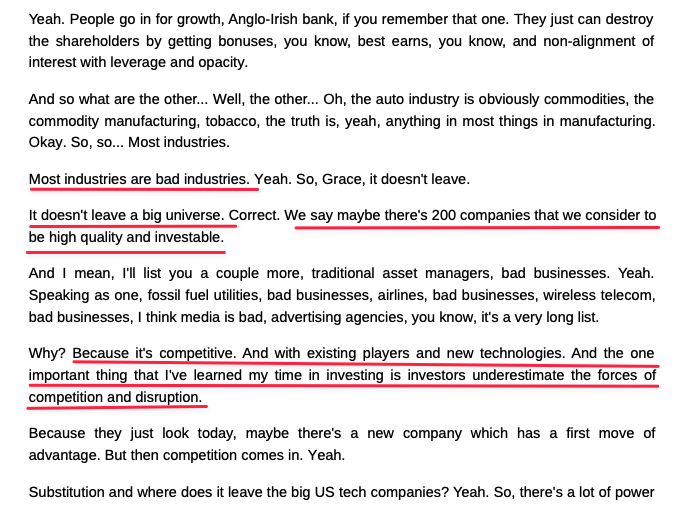
The Chris Hohn podcast w @NicolaiTang1 was amongst the most interesting transcripts I have read of late (Pair it with the FT article on Chris Hohn).
Chris Hohn is a legendary investor, runs the most profitable hedge fund in the world, with a hyperconcentrated portfolio (15 cos across $77b AUM) selected for their pricing power (ability to price above inflation).
What I found interesting was their extremely constrained top of funnel (TOFU) of 200 companies that are quasi-monopolies or have limited competition / high barriers to entry. Nalanda in India has a similar constrained TOFU of 75-80 companies (filtered via ROCE, durability of revenue, ease of understanding, and governance). As w TCI / Chris Hohn's investing strategy, they too try to hold for ever.
I dont think all great investors have such hyperconstrained TOFU but interesting to have these explicit filters.
Wondering if an Indian fund tried to mimic Chris Hohn / TCI strategy what companies they would identify. Some candidates from my side (Happy to correct if you think otherwise)
- IEX / MCX
- GMR Airports
- Indigo (TCI doesnt do airlines but perhaps in India)
- ITC? (though only in Tobacco)
Others? Curious what seasoned public mkt investors think of these and other names?