After many years of effort, deliberation, excitement, angst, joy, and Wednesday afternoon lab lunches, our group's first manuscript on cachexia, led by Venise Jan Castillon, Amy Xie, and really our whole lab https://t.co/PizrA8NyaU @NatureMedicine
After a long wait, tangermeme is out @naturemethods!
tangermeme implements the primitives of genomic sequence-to-function modeling with efficient, tested, and composable functions.
I use it every day in my work, and I hope you find it useful too.
https://t.co/q0ESzJF3fJ
My lab is now hiring two postdocs to lead biobank-scale disease genomics discovery and PheWAS, and develop AI/ML/LLM approaches to predict genetic variant function. Strong programming skills, a solid publication record, and a human genetics background are required. Please share.
My lab is now hiring two postdocs to lead biobank-scale disease genomics discovery and PheWAS, and develop AI/ML/LLM approaches to predict genetic variant function. Strong programming skills, a solid publication record, and a human genetics background are required. Please share.
Reposting: My lab has an open postdoctoral position to lead large-scale gene association and PheWAS in major biobanks and develop AI/ML models to predict genetic variant function. Strong programming skills, a solid publication record, and human genetics background are required.
A postdoctoral position is open in my lab to lead large-scale gene association and PheWAS in major biobanks and develop AI/ML models to predict genetic variant function. Strong programming skills, a solid publication record, and a background in human genetics are required.
A postdoctoral position is open in my lab to lead large-scale gene association and PheWAS in major biobanks and develop AI/ML models to predict genetic variant function. Strong programming skills, a solid publication record, and a background in human genetics are required.
🧬 New study in Bioinformatics Advances: "GDIv2: Improving variant selection from human exomes"
Explore the paper: https://t.co/JVQ4lao5Pl
Authors include: @zhangpeng1202, @ItanLab
1/ Thrilled to share a Perspective that summarizes 30 years of work from the many labs studying the human genetic and immunological causes of infectious diseases: https://t.co/jdgw3gOWl9
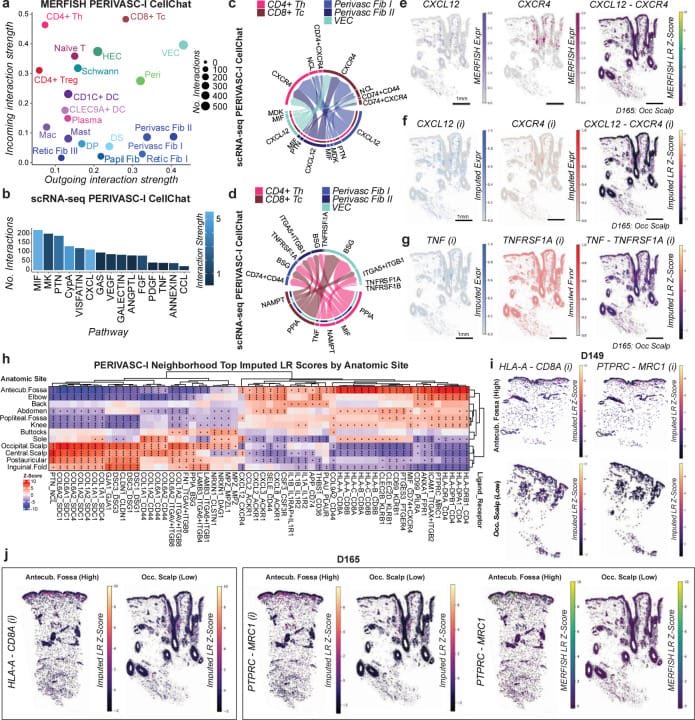
New @Nature Genetics paper mapped human skin at single-cell spatial resolution across 15 anatomic sites and 1.2 million cells — and the headline finding deserves attention:
Anatomy is encoded in cell states, not just cell types.
A fibroblast in your scalp and a fibroblast in your palm are both fibroblasts. Same cell type, same surface markers. But their gene expression programs are tuned to their location. The body doesn't just sort cells into the right places — it writes positional information directly into molecular state.
This has been hinted at in vitro for years (fibroblasts cultured from different body sites retain "positional memory"). What Ji lab did is put spatial context back in. Using MERFISH across 22 donors with matched sites, they could distinguish whether anatomic differences reflect cell abundance, cell state, or neighborhood architecture — and the answer is all three, operating together.
The cell-cell communication finding is equally striking. TNF emerges as a key regulator of immune-fibroblast crosstalk in a perivascular niche that resembles organized lymphoid tissue — right in the skin. When those neighborhoods break down, you get disease.
This points directly at one of the hardest unsolved problems in building single cells foundation models. Most single-cell models treat cells as isolated units — a transcriptomic snapshot divorced from where the cell lives and who its neighbors are. But biology doesn't work that way. A cell's state is partly a function of the signals it receives from adjacent cells, the extracellular matrix it sits in, and the tissue niche it belongs to. Spatial context and cell-cell interaction aren't annotations on top of the biology — they are the biology. Any virtual cell worth the name will need to internalize that. Atlases like this one are what that training data looks like.
Press release : https://t.co/Q0xNeRHD8y
Paper: https://t.co/ItEGlJmIGV
Check out our new paper! 🧐
A high-coverage Neandertal genome confirms small, isolated populations, Denisovan admixture, and extreme population structure accelerating differentiation, with levels matching the most divergent humans today.
https://t.co/UpugSLw7rq
Latest thoughts. Today in @JExpMed. We are disomic individuals genetically. Transcriptionally we need not be. Here I discuss what we know about this and propose Theory of Personal Evolution. @KidsAtColumbia@ColumbiaMed https://t.co/zTLo7lZ6gB
1/ We are thrilled to announce that our American branch of the Laboratory of Human Genetics of Infectious Diseases (HGID) will relocate to @UTSWMedCenter in Dallas, Texas, effective July 1, 2026 J
Excited to share our new paper in @NatureChemistry!
Building on our Rare Codon Recoding (RCR) work @ScienceMagazine, we developed a multi-rare-codon strategy enabling the simultaneous incorporation of up to 5 distinct ncAAs in mammalian cells!
https://t.co/tLp3wZTQ9U
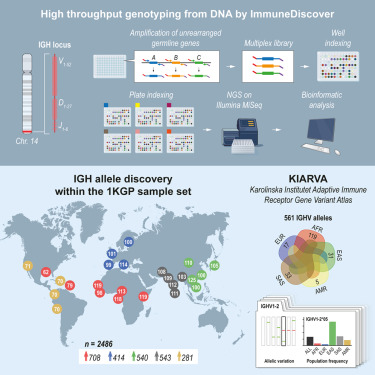
Ultra-high-throughput IGH genotyping of 25 global populations reveals population-biased allelic diversity and homozygous V and D gene deletions @ImmunityCP
https://t.co/evPNaYuA6c @NillaKH@karolinskainst
At @GoogleDeepMind, we believe AI is the ultimate catalyst for science. 🧬
The best example of this has been the AlphaFold database (AFDB) of protein structure predictions which has been used free of cost by more than 3.3 millions researchers across the world!
Today, in collaboration with @emblebi, @Nvidia and @SeoulNatlUni, we are expanding the database by adding millions of AI-predicted protein complex structures to the AlphaFold Database. To maximise global health impact, we’ve prioritised proteins that are important for understanding human health and disease, including homodimers from 20 of the most studied organisms, including humans, as well as the @WHO’S bacterial priority pathogens list.
Read more here:
https://t.co/RZGq8vrIPS