System exit.
Has your digital leash become too short?
Freeland Store is almost here.
Card. eSIM. VPN. Virtual numbers.
One wallet. USDT TRC20.
This is not a theory. This is your tool.
https://t.co/dvAQTH6ERC
i see huge potential in software as content.
software used to be expensive and time-consuming to build, so text became the go-to format for content marketing, and video came later.
but with AI, software now costs almost nothing to build, and you can create a huge number of products very quickly. these products let you engage with your audience on a much deeper level than traditional content.
i've identified 3 levels:
- curiosity: when you create something that isn't particularly useful but is simply interesting. how much is my Twitter account worth? what kind of CEO am I? how much money have I missed out on? how unique am I? it's a proven viral model. people don't really need these things, but we're all a little vain. spending a few seconds finding out how impressive we are is something almost everyone wants to do, even if the result won't change anything.
- engagement: when interacting with software is so interesting that you keep wondering what's coming next and can't stop. a game where you beat opponents using prompts. a website full of puzzles and Easter eggs. talking to an AI version of your idol. these experiences don't necessarily solve problems or provide much practical value either, but we don't get that many truly unique experiences in our lives. when someone puts real creativity into something, it can be incredibly engaging. sometimes it's the technology itself that surprises you. especially if you're not deeply involved in tech. having a voice conversation with an AI version of your favorite singer that actually thinks like them can create a surprisingly strong emotional reaction.
- solving small problems for free: in the past, this would have been called SaaS, but that model makes less sense for simple tools now that anyone can build them with AI at almost no cost. that's why I see much more potential in creating small, completely free products, some of which can be open source. you solve a real problem and provide value, and in return you get reach and an audience. your users become your ambassadors because people naturally want to share something that's both useful and free.
we also have tons of people vibe coding and building products with zero users. meanwhile, there's a huge group of content creators who know how to get views but still rely on traditional formats and struggle to monetize their reach.
bring these two groups together, and both sides win. vibe coders get users, while creators get content and attract a higher-quality audience that engages with them on a completely different level.
i strongly believe in this thesis, and i hope to start creating even more value this way myself soon.
@PaulKlayVC@jointhebridge@recursecenter Everyone likes to believe they're exceptional. Far fewer are willing to put that belief to the test.
Perhaps the real question isn't whether you're capable of something extraordinary, but whether you're brave enough to find out.
if you're exceptional and want to see what you're really capable of, these places were built for people like you:
- @jointhebridge (8 weeks in SF for 50 non-US founders. housing, food, workspace covered. up to $250k. applications close EOD)
- @recursecenter (free 6- or 12-week programming retreat, in NYC or remote. no teachers or curriculum)
- @AsteraInstitute (12–18 months, $125k–250k salary, up to $2m project budget. public-interest research. closes jan 7)
- @HertzFoundation (up to $250k over 5 years for eligible applied science PhD students)
- @joinstationf (for unconventional founders in paris. no degree needed)
- @spc ($400k for 7% plus $600k committed for your next round. 8-week in-person bootcamp)
- @1517fund (backs dropouts and renegade scientists. $1k idea grants up to $1m deep-tech checks)
- @thielfellowship ($250k over 2 years, no equity. for people 22 or younger who leave school to build)
- @zfellows (1 week, $10k at a $1b cap. no age limit, rolling applications)
- @tylercowen (fast, no-equity grants for unconventional ideas worldwide, from age 13)
- ewor (virtual-first founder fellowship, up to $600k. closes nov 30)
- @neo ($40k equity-free and 3 months in SF for undergrads)
- @theresidency (3-month live-in residency for deep tech founders. $120k SAFE plus compute. w27 closes nov 29)
- @hf0 (live-in residency for repeat founders in SF. batches start january and september)
- @EUeic (up to €2.5m in grants plus equity for eligible european startups)
i made a list of young people who aren't famous yet but are already doing things that seem impossible at their age @Cosign
- @ericzhu (17). Raised $2.3M for Aviato from a high-school bathroom
- @suhasasumukh (18). Sold AI app at 15, now co-founds LocalHost accelerator
- @hoomanrenezhad (18). Building green rare-earths (Solcoa)
- @zach_yadegari (19). Coded Cal AI (fitness app) ~$30M ARR, sold to MyFitnessPal
- @hannahsgao (~19). OpenAI ML intern (Memory/Personalization). Stanford CS student
- @0xSigil (22). Stanford dropout, now CEO Conway Research (AI hiring)
- @mickeyhardy (22). Grew Arcadia marketing agency 2,900% in 3 years
- @jacksondenka (23). Founded Azura (cross-chain trading)
- @covacut (24). Joined OpenAI Sept’26, ex-Spotify AI/Product. Stanford CS MS
- @FerdiDabitz (25). Co-founder Augustus (programmable clearing bank)
https://t.co/QSCOs5oTxk
@PaulKlayVC Everyone wants to find exceptional people. Yet most judge them by the same degrees, titles, and credentials as everyone else.
How amusing. You're searching for people who think differently, while refusing to look beyond your own expectations.
@PaulKlayVC You wanted financial freedom. They sold you another casino and called it a revolution.
But while you were staring at charts, others were quietly building ways to move, protect, and control their own money.
Perhaps it's time to remember what crypto was supposed to be about.
i mapped 65 projects across 6 areas where crypto is already solving real problems.
payments, banking, prediction markets, trading, real-world assets and financial privacy.
here's what you should know about each one:
1. financial infrastructure. international payments still involve intermediary banks, currency conversion fees and settlement delays. stablecoins allow businesses to move dollars globally, 24/7, often within minutes and at lower cost. this is particularly useful for cross-border B2B payments, payroll and emerging markets with limited access to dollar banking. by september 2026, stablecoin supply had reached ~$306b, and traditional payment companies were acquiring the infrastructure needed to integrate them. Stripe bought Stablecoin, a stablecoin issuance and payments API, for ~$1.1b, Mastercard acquired BVNK in a deal worth up to $1.8b. @zerohashx and @FireblocksHQ provide institutional infrastructure. @conduitpay, sphere_labs and muralpay focus on business payments. @YellowCard_App, @Transak and @moonpay connect crypto with local currencies and payment methods. @tempo, @Plasma are building blockchains specifically for payments.
2. neobanks and crypto cards. stablecoins make it easier to hold and receive dollars internationally, but most merchants still don't accept them directly. crypto cards solve this by converting digital balances into traditional card payments, while neobanks combine dollar accounts, transfers and spending in one application. Visa reported more than 160 stablecoin-linked card programs in 2026, with payment volume growing nearly 200% year over year. @RedotPay reported ~$423m in monthly card spending in october, making it one of the largest tracked programs. @KASTxyz, @BleapApp, holyheld are building stablecoin-based banking products. @ether_fi, @gnosispay, @MetaMask, @EthenaPay connect self-custodial wallets with everyday spending. raincards, @baanxgroup provide card-issuing infrastructure, and @krakenfx is expanding into consumer payments through Krak.
3. prediction markets. traditional forecasts rely on surveys, experts, and statistical models. prediction markets take a different approach: people trade contracts tied to future outcomes, with financial rewards for accurate predictions. as new information comes in, prices adjust to reflect changing expectations around elections, economic indicators, and other uncertain events. in Q3 2026, prediction markets generated $189.7b in notional trading volume, up 65.6% quarter over quarter. @Kalshi, a CFTC-regulated exchange, leads by reported volume. @Polymarket remains one of the largest platforms internationally. @predictdotfun, @limitlessdefi, opinionlabsxyz are competing in onchain event markets. MyriadMarkets integrates predictions into media. @sx_bet and @Overtime_io focus on sports.
4. perpetual exchanges. derivatives let traders hedge positions, speculate on prices and gain exposure without owning the underlying assets. perpetual futures remove contract expiry dates. at the same time, onchain exchanges offer 24/7 access with blockchain-based collateral and settlement. by november 2026, around $9.7b in open interest was recorded across 50 tracked perpetual exchanges. @HyperliquidX led with ~$5.4b. @Aster_DEX, @Lighter_xyz, grvt_io, edgeX_exchange, @paradex compete on execution, liquidity and trading infrastructure. variational_io uses request-for-quote trading. @GMX_IO uses liquidity pools. @JupiterExchange, Drift Protocol operate in Solana's ecosystem. @verantaxyz, @Ostium extend leveraged trading into currencies, commodities and other real-world markets.
5. real-world assets. traditional securities and investment funds depend on custodians, intermediaries and settlement systems that can make transfers and collateral management expensive. tokenization allows ownership interests to be recorded and transferred on blockchains, potentially making settlement faster and assets easier to use in financial applications. tokenized real-world assets reached approximately $39b by september 2026. @BlackRock launched BUIDL through @securitize. FTI US, @Ondo, superstatefunds, Spiko_finance, @OpenEden_X offer tokenized treasury or money-market products. @centrifuge, @maplefinance focus on credit, @figuremarkets connects blockchain infrastructure with lending. @backed_xyz tokenizes equities through xStocks. @plumenetwork builds infrastructure specifically for RWAs.
6. privacy payments. public blockchains expose transaction histories, balances and transfers, which creates problems for businesses paying suppliers, companies running payroll and individuals who want to keep their finances private. privacy protocols use cryptography to conceal sensitive information and still allow transactions to be verified. by november 2026, around 4.93m ZEC, or 29% of issued supply, was held in shielded pools and @railgun_project had ~$102m in TVL. Zcash, Monero focus on private digital money. @TornadoCash, @0xbowio provide transaction privacy through different approaches. @aztecnetwork, @zama are building infrastructure for confidential smart contracts. @fluidkey, @payy_link, @intmaxIO focus on private payments. as more businesses start using stablecoins, protecting commercially sensitive financial information will become increasingly important.
@PaulKlayVC For years, crypto rewarded people for convincing someone else to pay more for something with no real value.
Perhaps it's time to stop asking how much a token can pump and start asking what problem it solves and how much revenue it generates.
What a revolutionary idea.
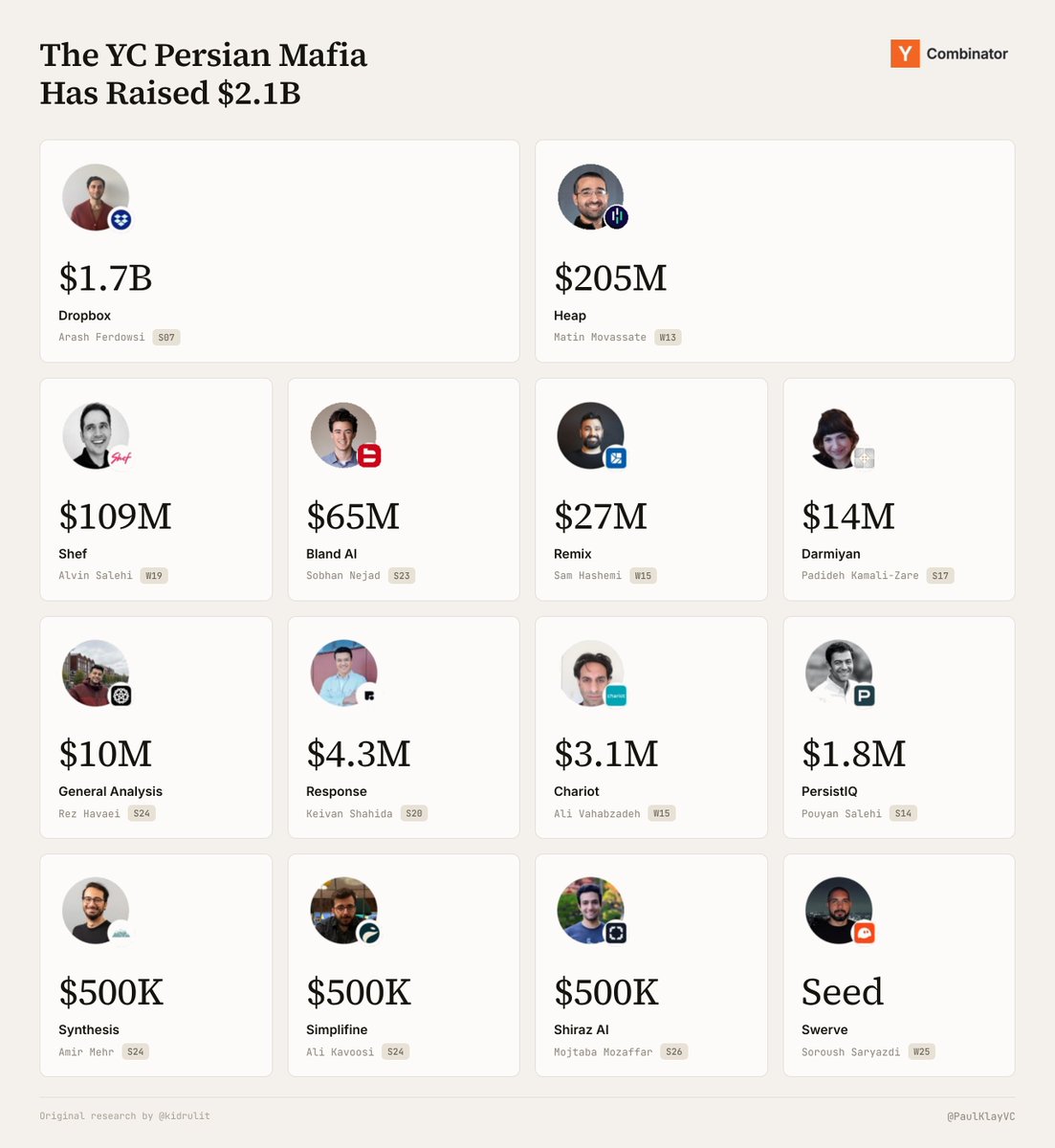
iran may be one of the most under-scouted technical talent pools in the world.
35% of university graduates in iran are in science and engineering, according to the latest WIPO data. that puts iran 9th globally on this indicator, based on 2021 data.
the country's performance in international competitions is impressive:
- math: iran ranked 14th out of 117 countries at the 2026 international mathematical olympiad, winning 2 gold, 1 silver and 3 bronze medals.
- physics: all 5 members of iran's 2026 international physics olympiad team won medals: 3 gold and 2 silver.
- programming: Sharif University won bronze at the 2019 ICPC world finals and was the Asia West champion in both 2024 and 2025.
so where would i look for this talent?
1. Sharif University of Technology. probably my first stop for software, AI, robotics and engineering. its competitive-programming record is especially strong, with a bronze medal at the 2019 ICPC world finals and repeated success across West Asia.
2. University of Tehran. one of iran's leading universities, with strong programs in engineering, computer science and scientific research.
3. Amirkabir University of Technology. a highly selective technical university in Tehran with a strong engineering focus.
4. Iran University of Science and Technology. another place worth scouting, particularly for engineering and applied technical fields.
beyond universities, i'd pay close attention to iran's olympiad teams, ICPC contestants, and students who move abroad for master's and PhD programs.
there's clearly a lot of technical talent coming out of iran. the opportunity is to find it before everyone else starts looking.
@PaulKlayVC I've always admired the Iranian people. Their creativity, resilience, and ability to build despite everything.
What a strange world we live in, where a country's political situation can make millions of talented people invisible to the rest of the world.
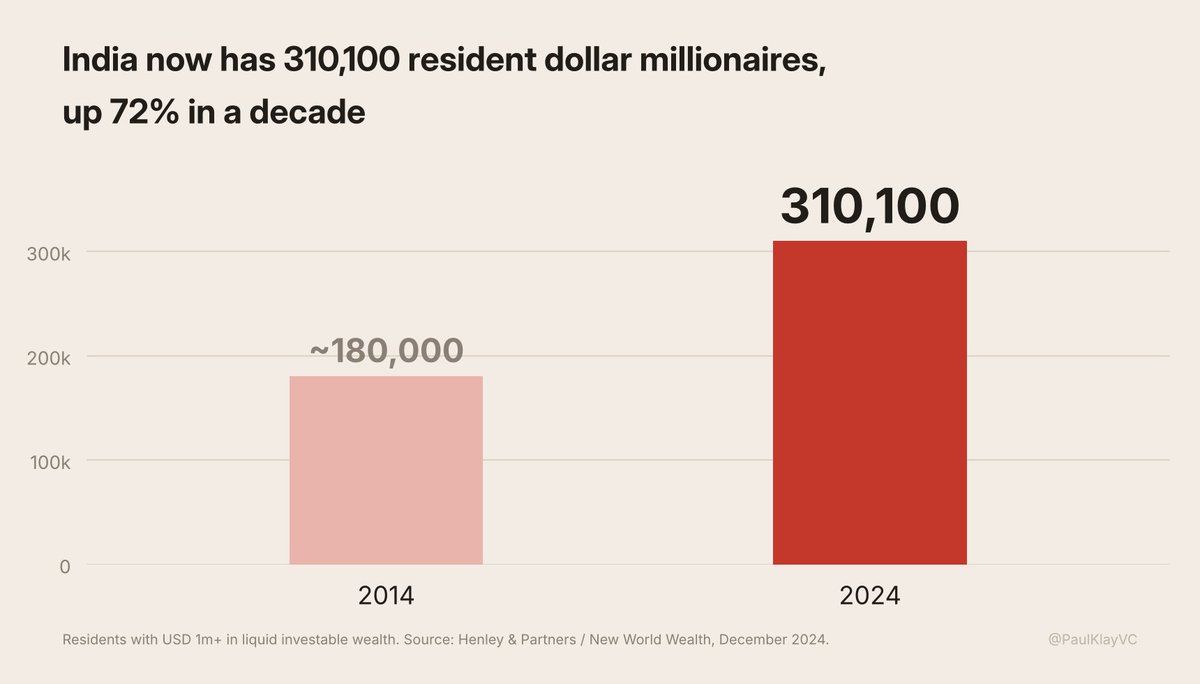
recently, i introduced someone i know to a team for a potential partnership. within the first minute of their call, he texted me: "they're Indian, they have no money. waste of time."
another person wrote in a founders' group chat: "i can only work with young people as an advisor. everyone should have their age visible."
so many people miss out on huge opportunities simply because they believe things that aren't even true.
i get that these opinions might come from past experiences. but being open-minded is a much better approach, and when it comes to business, it's actually more profitable.
of course, that doesn't mean making the same mistakes over and over. the problem is taking one characteristic and using it to judge an entire group of people.
a couple of bad experiences don't define everyone who shares a certain background, age, or nationality.
there are much better ways to evaluate people and decide who to work with.