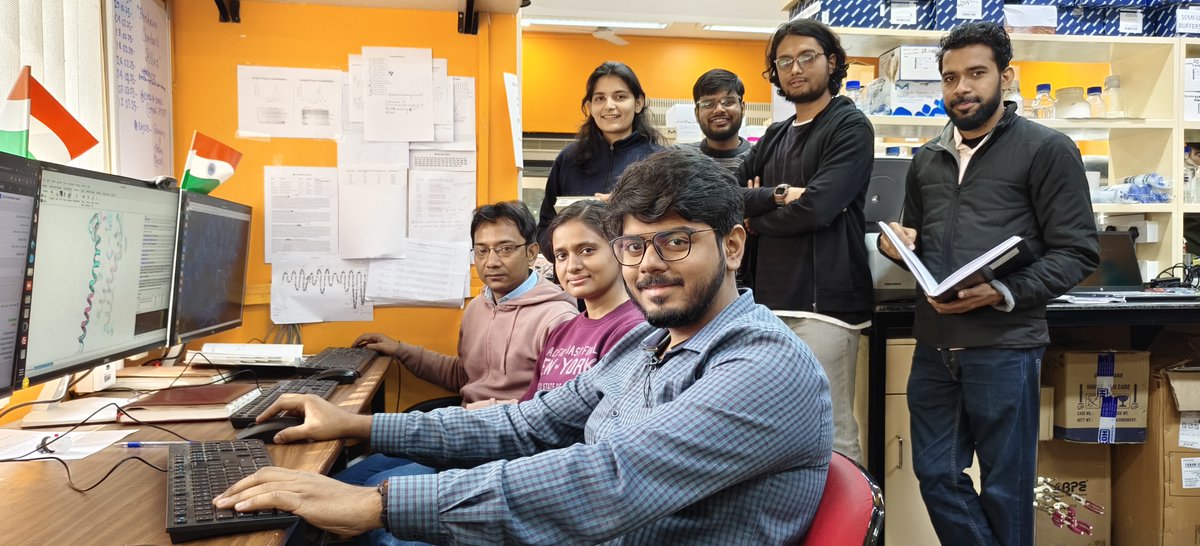
Super excited to share our work in @NatureComms ! 🎉
From diverse ligand recognition & species-specific pharmacology to a conserved five-point switch driving C3aR activation-we had a lot of fun decoding this receptor!
Curious? Do give it a read! 🔬
https://t.co/cXKXiDHXCn
🥳 Huge preprint 🔔 Today we share something our group has been working toward for a long time, led by
@LucasMoriniere We asked can we predict which receptor a phage targets from its genome sequence alone? For most phages, we couldn’t. So Lucas set out to do something crazy!
🚨Preprint! From my PhD “Genome delivery of a contractile tailed phage and its superinfection exclusion mechanism”. We use #cryoEM to study the genome ejection of the #phage T4, revealing how the tape measure protein regulates the process @NMITaylorLab
https://t.co/syOhafWv7g
Thank you, Katrin (@biozentrum) for a great summary of our paper!
You can also check out this "Behind the Paper" written by @ATejadaArranz:
https://t.co/U92SJ1xQe1
Congratulations!! Shirsha Saha for being selected for the highly competitive International Birnstiel Award for Doctoral Studies in Molecular Life Sciences carried out under mentorship of Prof. Arun Shukla
https://t.co/Cb2WERkyLd
@MehtaFF@BSBEIITK1@IITKanpur
Exciting news! We're thrilled to announce the six outstanding laureates of the International Birnstiel Award for Doctoral Studies in Molecular Life Sciences 2025!
🏆Congratulations to all awardees and honourable mentions! 🎉 1/ ➡️ https://t.co/yyFVrN93V5
It was such an incredible learning experience with this phenomenal team @ParishmitaSarm2@SudhsM7@NashrahZaidi 🙌
And to my guide- the incredible, truly inspiring, one and only @arshukla 🌟 forever grateful for your mentorship & support!
🚀✨
Excited to share our recent publication on a biosensor that provides insights into the conformational diversity of receptor-bound β-arrestins and offers a tool for advancing our understanding on β-arrestin signaling. https://t.co/0vvMYdf6Qh
Congratulations to Anne Spang @SpangLab for being elected as a new #AAASFellow 2024 by @aaas ! The world’s largest scientific society recognizes her outstanding contributions to the field of cell #biology and #biochemistry. @biozentrum @unibas_en
https://t.co/EFCnqhqEZN
Delighted to share our latest work on the structural visualization of small molecule recognition by CXCR3 and uncovering of dual-agonism in the CXCR3-CXCR7 system published in Nature Communications!! https://t.co/847ImqIm2Y
In mitochondria, respiratory supercomplexes (blue) pump protons across crista membranes to create an electrochemical gradient, fueling adenosine triphosphate (ATP) synthase (pink) to regenerate ATP—the energy currency of life.
Now, cryo–electron tomography captures these supercomplexes in their native organization, illuminating how the coordinated action of these molecular machines drives life’s fundamental energy conversion.
Learn more this week in Science: https://t.co/2hN9Vb6Sf0
Molecular machines enable efficient energy production in mitochondria. Using cryo-electron tomography @bengeliscious and @FlorentWaltz have gained insight into the architecture of mitochondria at unprecedented resolution. @ScienceMagazine@snsf_ch
https://t.co/iN0gBc1NSQ
Huge congrats to Heng Zhou & Jagannath Maharana @the_rajem on being awarded the prestigious Humboldt @AvHStiftung Fellowship! Jagannath will investigate the causes of inherited cardiomyophaties & Heng how certain bacterial Tc toxins target and enter host cells #cryoEM#cryoET
Thank you, Katrin, for a great news article:
Damaged but not defeated: Bacteria use nano-spearguns to retaliate against attacks
https://t.co/LDJYx5zZDq
And the @SNIunibas for producing this video summary:
https://t.co/K8N7mBFZ77
Poke bacteria with a sharp needle and they poke back in just a few seconds!
Congratulations to Mitchell (and others) for this analysis of Pseudomonas #T6SS assembly in response to membrane damage!
Collaboration with Rod Lim's lab @biozentrum + @SNIunibas!
https://t.co/bWRCZTsgmE
Researchers from IIT Kanpur's Department of Biological Sciences and Bioengineering have successfully visualized the atomic structure of CXCR2, a key receptor implicated in cancer progression and respiratory disorders. Published in Molecular Cell, this discovery opens up new possibilities for targeted therapies for diseases such as COPD, asthma, atherosclerosis, and pancreatic cancer. The team utilized advanced cryogenic-electron microscopy (cryo-EM) to explore how CXCR2 interacts with multiple chemokines, revealing a "lock-and-key" mechanism that explains how CXCR2 recognizes and activates these proteins.
This breakthrough provides a foundation for designing next-generation therapeutics aimed at specifically targeting CXCR2 to reduce its role in inflammatory diseases and cancers. With support from various grants, the research team is developing small molecules and antibodies targeting CXCR2. These potential therapeutics are set to undergo lab and animal testing, bringing IIT Kanpur closer to pioneering innovative treatments for cancer and respiratory diseases.
The research team at IIT Kanpur consisted of Shirsha Saha, Saloni Sharma, Manisankar Ganguly, Nashrah Zaidi, Divyanshu Tiwari, Nabarun Roy, Nilanjana Banerjee, and Ramanuj Banerjee. This study also involved collaborative efforts with researchers from the University of Tokyo, Japan, including Fumiya Sano, Hiroaki Akasaka, Takaaki Kobayashi, Yuzuru Itoh, Wataru Shihoya, and Osamu Nureki, as well as Andy Chevigne from the Luxembourg Institute of Health, Luxembourg.
Professor Arun Kumar Shukla, the lead investigator, emphasized that the findings offer a blueprint for designing targeted therapeutics to inhibit CXCR2. Supported by grants from the DBT Wellcome Trust India Alliance, SERB, ICMR, and the LADY TATA Memorial Trust, this work is set to reinforce IIT Kanpur's commitment to advancing global biomedical research.
To red the full paper, visit:
Molecular basis of promiscuous chemokine binding and structural mimicry at the C-X-C chemokine receptor, CXCR2: Molecular Cell.
@India_Alliance@DeptHealthRes@MolecularCell@Shashimediabran
#KeyDrug #Receptor #CancerResearch #RespiratoryDisease #Treatment #biomedical #therapeutics #atherosclerosis
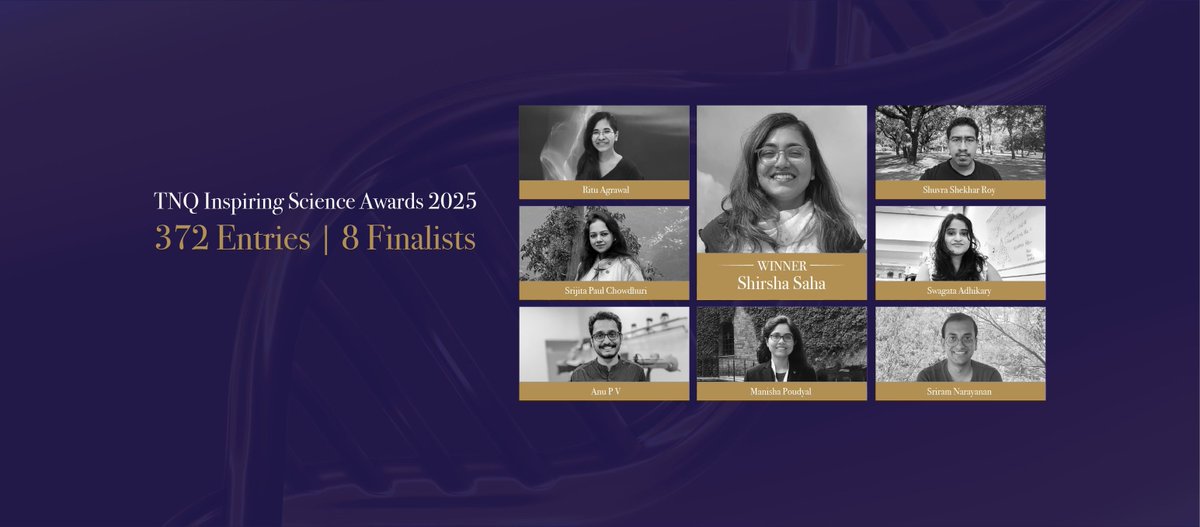
We are super-excited to announce that @saha_shirsha, a graduate student in our laboratory @IITKanpur, is selected as the overall winner of the TNQ Inspiring Science Award, 2025!!! Many congratulations, Shirsha!!! We are so proud of you!!!
#Amazing#Students#Proud#Mentor
Excited to share our latest findings on CXCR2 chemokine receptor promiscuity, revealing that a conserved motif in both the receptor and ligand governs the selective binding of multiple ligands to a single receptor.
Congratulations to everyone involved.
https://t.co/yEbeZ0E806