Huge fan of the work @TaraSadjadpour has been doing all summer! For the newcomers to Physical AI: targeting 3 distinctly different hardware morphologies (even in sim) and getting full sim2real on the fullstack arm+hand deployment for @SharpaRobotics hand...that takes dedication.
Excited to see more of this from the controls/learning dream team at @UCBerkeley EMBER, @he_siming, @ckwolfeofficial, @JitendraMalikCV, Shankar, Claire &co!
@HaozhiQ & @LeaMue27, keep rockin' it at FAR/@UChicago, and @AIatMeta respectively!
🎉 Workshop on Sim-to-Real-to-Field: The Science of Transfer is coming to #CoRL2026 in Austin! Our CFP is now open — with a $1,000 Best Paper Award generously sponsored by @tensrinc .
🔗 https://t.co/W8O36OQiez
Three data sources are popular for robot learning today (1) Humans tele-operating robots (2) Humans acting as humans doing tasks (3) Robots acting in the "safe space" of a simulator. Happy to share this work from UC Berkeley which shows the power of (2) combined with (3). Visual imitation followed by trial and error is a good recipe for robots as it is for human children. Whither tele-op?
We have a huge news to share today!
Today we are unveiling the first truly accessible RL robot - welcome Microduck
A 25 cm tiny open-source biped with 15 actuators and packed with sensors (camera, speaker, LiDAR, NFC, bluetooth, wifi, etc) that you train yourself with reinforcement learning.
It's also playable out of the box with more than half a dozen fun and playful pre-trained policies to have it walk, sit, crouch, roller-skate, pick up objects with its articulated beak, and recover on its own.
And all for less than $400.
See all the details, play with the simulator and order it at: https://t.co/n1Btgs6vKw
(video with sound on 🔊)
Introducing S1, our new foundation model that learns from one example.
It can be taught 10-minute long tasks that it has never seen before, from one video prompt without any fine-tuning.
Watch S1 operate in real-time via in-context learning:
We can think of this as the robot analogue of RL for thinking, optimizing for good "thoughts" through trial-and-error. The surprising thing is that it's so fast, learning in under a hundred real-world trials.
Website: https://t.co/APpoOIsXB2
Paper: https://t.co/50dkjqN8y3
Released on @berkeley_ai blog, new work from Jakob Bjorner, @a_lidayan, @satvikgolechha, @kartik_goyal_ & @alsuhr. As task horizons grow, LLM contexts can’t scale forever — ABBEL trains agents to maintain graded natural-language belief states instead of drowning in history … 🐻📄
https://t.co/Vau1yLEjq0
Autoresearch just left the sandbox and entered the embodied world.
We are excited to introduce 𝐄𝐍𝐏𝐈𝐑𝐄: a system that drops frontier coding agents onto a fleet of real robots and hands them the entire loop:
reset the environment → search the literature → implement ideas and build the infra → train and deploy → self-verify → analyze the logs and rewrite the code → repeat, until the policy is reliable in the real world. No human in the loop.
Guided only by the robot's self-proposed, heuristic-based success signal, the agents hill-climb to 99% on dexterous real-world tasks: organizing pins into a box, seating GPUs, tying zip-ties.
We envision the bottleneck in robotics shifting — from building smarter algorithms to building the closed physical feedback loops an agent can finally turn on its own.
🔗 https://t.co/3tL2ArGo3v
From @NVIDIA@CMU_Robotics@Berkeley_AI
🧵
Really excited to open source a new project: Omnigent, a meta-harness for AI agents.
It lets you build multi-agent coding and custom agents, sitting above Claude Code, Codex, Pi, and agent SDKs to let you compose them. It also adds live collaboration and rich control policies.
Can we build generalist robots with zero teleoperation? Come participate in the discussion and weigh in at our ICRA'26 workshop, BeyondTeleop, starting at 8.45 am CEST today (June 5th)!
📍 Strauss 3
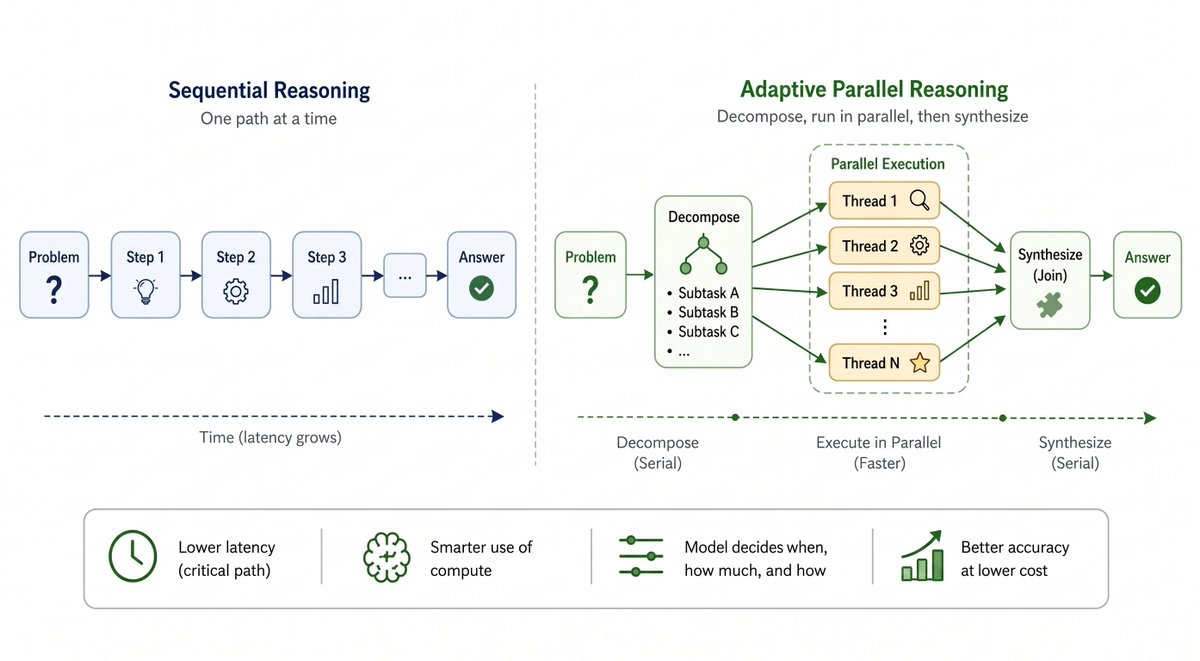
Longer chain-of-thought = slower inference, more context rot, and ballooning compute.
So what if the model could decide for itself when to go parallel?
Our new BAIR blog breaks down Adaptive Parallel Reasoning (APR) — the next paradigm in inference-time scaling. 🧵
Berkeley CS Graduate Entrepreneurs (CSGE) is back with the annual Spring Mixer on May 8th! 🌉
Join us for a night where research meets startups, featuring an exciting panel with @sarahookr, @ericzelikman, and @NaveenGRao!
RSVP early to save your spot:
https://t.co/mCIuYuQozv
We developed a simple, sample-efficient online RL technique for post-training image generation models. We see it as a possible steerable alternative to CFG, driven by any scalar reward, including human preference.