Many photonics names are down 30-40% from their highs.
A great time to revisit the photonics value chain and best positioned businesses:
Layer 1: Materials & wafers
• $GLW
• $AXTI
• $IQE
• $AIXA
• $AMS
Layer 2: Core photonic devices
• $IPGP
• $COHR
• $LITE
• $LASR
• $SIVE
• Layer 3: Components & modules
• $AAOI
• $MTSI
• $FN
• $VIAV
• $LPTH
Layer 4: Systems & equipment
• $ASML
• $BESI
• $ASM
• $LPKF
• $MKS
Layer 5: Test, metrology & yield
• $CAMT
• $FORM
• $AEHR
• $ONTO
• $VIAV
The deep dive below covers these layers and companies in much more detail, along with many visuals to help you understand the technical concepts.
Enjoy!
With Micron earnings last week absolutely smoking all estimates and putting up truly insane numbers, the timeline is once again asking if this is the top of the memory cycle.
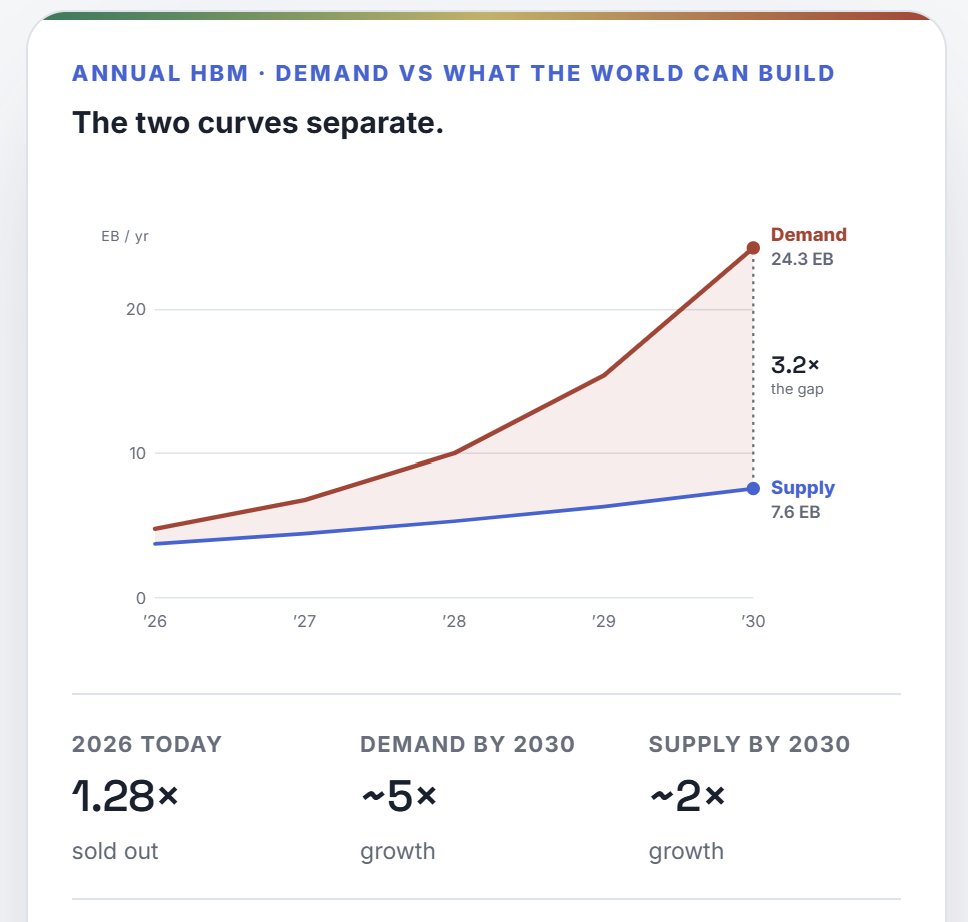
I sat down to do the work, and it seems we are in for a much longer shortage than the market believes.
A few key numbers:
1. Token demand is projected to 24x by 2030.
2. HBM supply is projected to double by 2030.
3. HBM demand is projected to 5x by 2030.
There’s a massive structural supply/demand imbalance in the market, and it’s actually growing not shrinking.
Link to read the full free report below.
We only write 1-2 primers a year because we want them to be durable. It’s simple to publish something market relevant for 6 months, but our goal is a piece you can return to years later and still derive value.
Our Robotics primer meets that standard.
https://t.co/qPSAXaLgYN
Bill Ackman literally gave a 44-minute masterclass that explains money better than any business school.
1. Starting early is the single biggest advantage you have. If you save $10,000 at age 22, never add another penny, and earn 10% a year, you have $600,000 by retirement. wait until 32 to start, and the same money only grows to $232,000. The decade you lose at the beginning costs you more than any decade later because compounding does its heaviest lifting at the end.
2. The return rate matters even more than most people grasp. That same $10,000 at 22 earning 10% becomes $600,000. At 15% it becomes over 4 million. At 20%, the rate Warren Buffett has achieved, it becomes 25 million. Einstein called compound interest the most powerful force in the universe. Ackman's lecture is essentially a demonstration of why.
3. Avoiding losses matters as much as chasing returns. if you reach for a 20% return but lose half your money every 12 years from bad decisions or a rough patch, your 25 million collapses to 1.8 million. Buffett's rule one is never lose money. Rule two is never forget rule one. the math of recovery is brutal, so protecting the downside is not caution, it is strategy.
4. Debt is safer, but the upside is capped. Equity is riskier, but the upside is unlimited. In the lemonade stand example, the lender who put up $250 earns a steady 10% and gets paid back first if the business fails. the equity investor who put up $500 earns over 100% if it succeeds but gets wiped out if it fails. The equity holder earns more precisely because they took the risk the lender refused.
5. The risk that matters is permanent loss, not price movement. most people think risk is the stock price bouncing up and down every day. Ackman says ignore that. the real risk is whether you will permanently lose your money. Short-term volatility is noise. the question that matters is whether you get your capital back with a return over the long run.
6. Avoid startups and complicated businesses. You do not need 100% a year to build a fortune. you need 10 to 15% over a long period. so skip the lemonade stands and unknown ventures. Invest in public companies that are established, liquid, and have to clear real hurdles before going public. If you cannot understand how a business makes money, avoid it no matter how good its track record. Ackman cites Enron, a business almost nobody actually understood.
7. Invest in a business you could own forever. if the stock market closed for 10 years, you should not be unhappy holding it. Coca-Cola is his example. easy to understand, sells a syrup and earns a profit on every drink, the population keeps growing, and it is nearly impossible to disrupt with new technology. McDonald's is another. People have to eat, the food is cheap, and they keep growing. find a business you would be comfortable holding through anything.
8. You want products people are loyal to and will pay a premium for. People buy generic flour and sugar without caring about the brand. but they want the Hershey bar, the Cadbury bar, the see's candy specifically. you do not want to sell a commodity that anyone can sell cheaper. You want something unique that customers refuse to substitute even at a 20% discount.
9. Low debt is a safety feature. In the lemonade stand example, $250 of debt was manageable. But if it had been $1,000 and the business hit a rough patch, it could have gone under and wiped out the shareholders. Find companies with little debt or so much profit relative to their interest payments that a bad year cannot sink them.
10. Barriers to entry protect your returns. You want a business that is hard for someone to compete with tomorrow. Coca-Cola's market presence is so strong that you expect to get a Coke at any restaurant. Pepsi has coexisted with it for decades, but neither can put the other out of business. If a competitor can show up next year with a better version and steal the customers, the business is not worth owning long term.
11. The best businesses are immune to outside factors you cannot control. Coca-Cola has survived 120 years through world wars, nuclear weapons, and every kind of crisis, and each year it makes slightly more money. You want companies that do not depend on commodity prices, interest rates, or currency moves. A business that keeps earning regardless of what is happening in the world is the kind you hold forever.
12. Low capital intensity is one of the most underrated qualities. The worst businesses require massive reinvestment to grow. The auto industry has to build enormous factories and buy machine tools before selling a single car, and those tools wear out. GM's stock barely moved over 40 to 50 years for exactly this reason. Coca-Cola, by contrast, sells a formula and collects a royalty. American Express takes a few percent of every dollar spent on its card. a business that earns a royalty on other people's capital is one of the best things you can own.
13. Pay down debt and build a cushion before you invest. If you have high-interest credit card debt, paying it off is a guaranteed return equal to the interest rate. same logic, to a lesser degree, with student loans at 6 or 7%. and you want 6 to 12 months of expenses in the bank so that losing your job tomorrow does not force you to sell. You can only handle market volatility if you do not need the money.
14. Be a buyer when everyone is selling and a seller when everyone is buying. The natural human tendency is the opposite, a lemming-like instinct to sell in a crash and buy in a bubble. people sold into the 1987 crash when they should have been buying. The only way to resist this is to be financially secure enough that the money at risk does not affect your life, so you can withstand the swings without panicking.
15. The stock market is a voting machine in the short term and a weighing machine in the long term. Ben Graham's idea, which Ackman repeats. short-term prices reflect the whims and emotions of investors. long term, prices reflect the actual value of the underlying businesses. If you buy good businesses at reasonable prices and hold them while they grow, you make money over time as long as you are never forced to sell at the wrong moment.
16. A stock is just a bond where you do not know the coupon. Flip a price-to-earnings ratio over, and you get an earnings yield. A stock at 10 times earnings is a 10% earnings yield, which you can compare directly to a 3% treasury. the difference is the bond's coupon is fixed and the stock's coupon, its earnings, moves up and down. Ackman wants an earnings yield higher than a treasury that will also grow over time, so he does not need to be right about explosive growth to earn a good return.
$INTC Lip-Bu Tan: Bottleneck investor
"The investment side, I ways look at where is the bottleneck? What are you trying to solve? For example, I invest in companies like Credo $CRDO or Astera Labs $ALAB, is this interconnect becoming the bottleneck? Because speed becomes more important in interconnect in the cluster, so I think optical becomes very important. Look at Jensen, he invests in almost every company that's photonic."
Gavin Baker, CIO of the $6.5 billion fund Atreides Management, revealed at Sohn 2026 how he makes money on tech and AI
the man who previously managed $17 billion at Fidelity and posted one of the best returns in the industry
in the interview he explains why the AI cycle is only just beginning, which chip is the most underrated right now, and why the shortage of power and chips is actually a plus for investors
bookmark it if you follow tech and AI, real insights here from a man who manages billions ↓
David Tepper on the classic trap of trading against liquidity:
"i'm constructive because of the easing right now but i'm also miserable because of the levels. nothing's cheap anymore... but i'm not fighting the fed."
a lot of traders blow up their accounts by trying to short all-time highs. they look at overheated sectors, see insane multiples, and bet on a crash just because things look way too expensive
Tepper’s logic explains why that's a mistake: liquidity always beats valuation
the market can be completely detached from reality, and a bubble can stay stretched way longer than you can stay solvent. if central banks are pumping money and cutting rates, fighting that momentum is just financial suicide
your logic might tell you the prices are stupid. but the ultimate rule of survival is simple: never stand in front of the money printer
bookmark and watch the talk below
Can someone supply me the hybrid bonded HBM4??
"HBM4 leans on hybrid bonding even harder, so Adeia's IP gets more critical exactly when those contracts hit the table."
This is a brilliant report. The State of the AI Economy by @exponentialview
- $110B real AI revenue over 12 months, after removing double-counting. so $1 spent on Claude is counted once, even if part of it later flows to Amazon or another infrastructure provider.
- $175B current annualized run rate, showing fast acceleration. Measured by end-customer spend, not supply-chain pass-through revenue. Excludes China, internal AI savings, ad uplift, consulting, and systems integration.
- Growth running roughly 3x faster than mobile or internet adoption waves.
- The pace of revenue formation has sharply accelerated. New $1B revenue now arrives in under 2 days, versus 180 days in 2023.
- Enterprise AI has moved beyond pilots, but deep company-wide rollout is still early.
- AI earnings-call mentions reached 31% of tracked S&P 500 firms.
- Only 20% of tracked firms made quantified AI impact claims.
- Hyperscaler AI revenue roughly covers AI infrastructure depreciation for now. GPU economics depend heavily on 6-year compute life assumptions.
Other AI infrastructure gets modeled over 14 years.
- Token price cuts do not automatically reduce revenue.
- Every 10% token price cut drives 12-18% more token usage.
- AI demand looks price elastic, meaning cheaper AI expands usage faster than prices fall.
- Power availability and data-center costs remain major limits on future scaling.
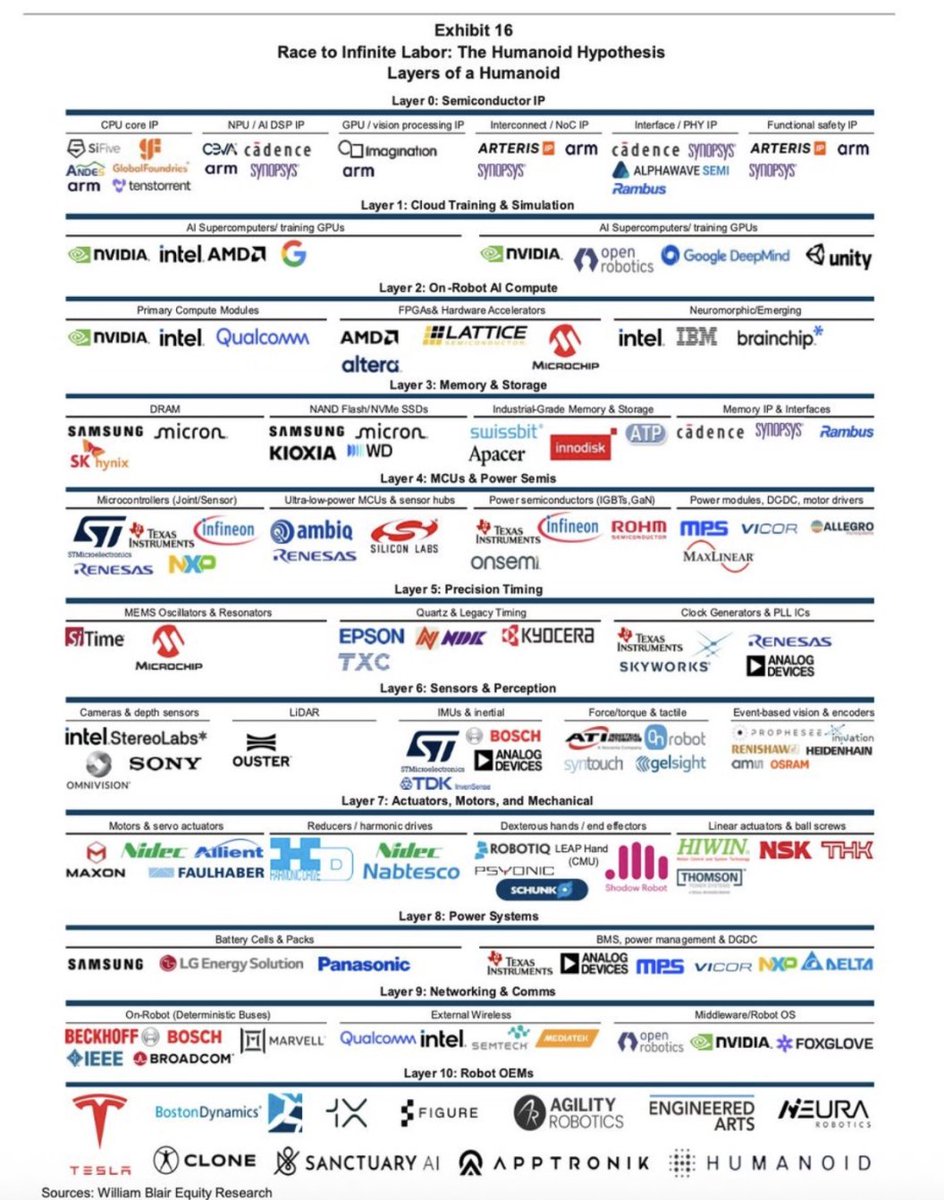
William Blair lists @ousterlidar as the sole LiDAR vendor for humanoids and includes StereoLabs as one of the four 3D camera vendors, alongside Intel, Sony, and the Chinese company Omnivision. $OUST
Given that William Blair is one of the underwriters for SpaceX, their analysis carries significant weight.
Full report: https://t.co/ID4VlOvxwW
Credit: Christrini
I genuinely don't understand why everyone isn't using this yet
Andrej Karpathy, a co-founder of OpenAI, posted a simple idea that hit 16 million views: stop using AI to write code, use it to build a second brain.
You point Claude Code at a folder, drop in any source, an article, a transcript, a PDF, and Claude reads it, links it, and files it into a living wiki of everything you know. It compounds like interest, the more you feed it, the smarter it gets.
Here's the whole thing:
> Install Obsidian, create a vault, open it in Claude Code
> Paste Karpathy's wiki idea file and tell Claude to build it
> Claude makes three folders: raw for sources, wiki for its pages, a CLAUDE.md that runs it
> Drop any source into raw and say "ingest this"
> Ask questions across everything, forever
Five minutes to set up, and you never start from a blank chat again.
Full step-by-step guide with Claude and Obsidian, link below.
Bookmark this
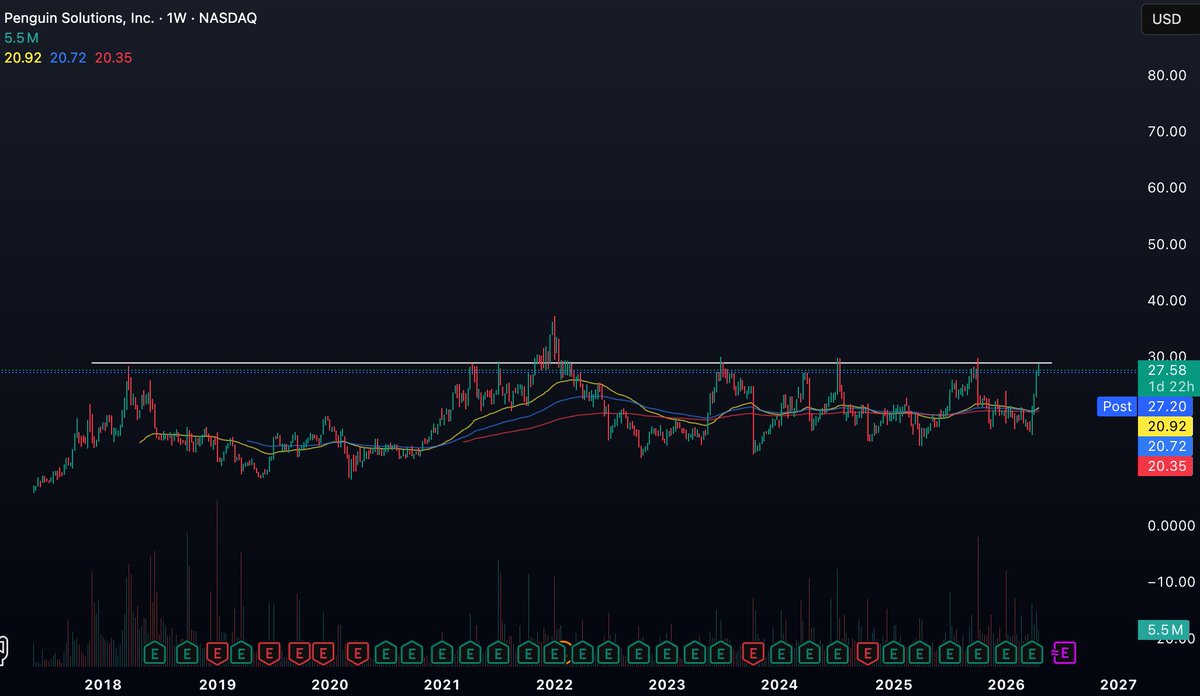
Took a position in $PENG before the close
Here is my thesis:
Just last month at NVDA GTC Penguin solutions introduced their "MemoryAI KV Cache Server"
In their recent earnings call, this product was immediately guided to be 50%+ of their entire revenue this quarter and entire year from the demand!
At surface level their revenue looks like it’s declining, but their quality of revenue is improving, as reflected in their margins.
Their CXL cache server will be their growth engine going forward as it solves arguably one of the biggest problems in inference today, memory constraints. This segment alone is growing 63% YoY for them.
Modern LLMs have outgrown the available memory on standard GPUs. Their cache server use CXL tech to add 11 TB of memory per AI cluster.
This allows companies to run massive models with huge lengthy tasks that require a lot of memory at a fraction of the cost of buying more GPUs.
As we move from training to inference, this memory expansion tech will become the new standard for the industry.
My favorite part is the current valuation…
Trading at only 1x sales and a 11 fwd P/E while management just doubled their growth guidance! If you’re familiar with the semi industry this is peanuts!
Also, the chart looks very attractive at the moment as it looks primed to break out of their 8 year base as they go through this inflection point for their company rerating from a boring LED legacy business to an AI infrastructure play.
CXL (Compute Express Link) is an open high-speed interconnect standard built on PCIe. It adds cache coherency + memory semantics so CPUs, GPUs, accelerators, and memory devices can share pooled memory with low latency.
Why the hype: AI training/inference hits the "memory wall." CXL enables memory expansion, disaggregation, and pooling across servers — boosting utilization, cutting waste, and scaling huge models more efficiently. Real deployments (esp. Type 3 memory) are ramping in 2026.
Key ecosystem names: Astera Labs (ALAB) for controllers, Marvell (MRVL), Credo; memory (MU, Samsung, SK Hynix); CPUs (AMD, Intel).
Still early but gaining real traction in AI/cloud infra. Speculative upside for associated players, but competitive & adoption-dependent. Not financial advice.