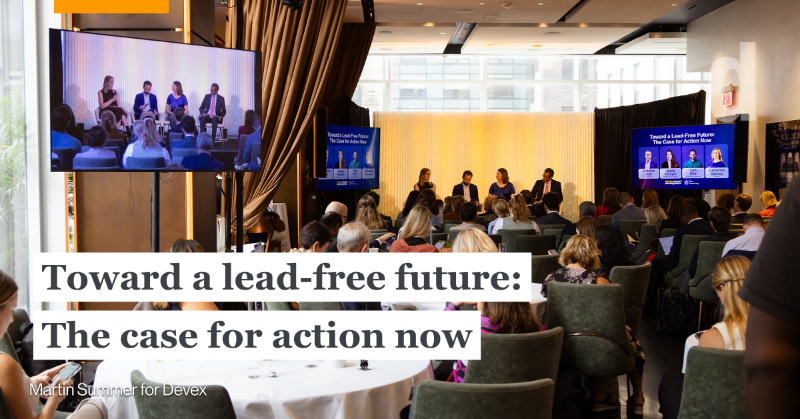
Lead poisoning affects 800 million children each year but receives very little global attention and funding — that needs to change.
Read key takeaways from experts from @open_phil, @Stanford, @UNICEF, and more on the sidelines of UNGA 80 👇
Sponsored by @open_phil
The developed world has eliminated leaded fuel and lead in paint. @c_don7, @notanastronomer and James Hu explain that it will be surprisingly easy to do this in the developing world too, and why doing so matters.
https://t.co/ty5P4w66kG
"Many global health problems are thorny and difficult. Lead, unusually, is not one of those. We already know how to reduce lead exposure. Rich countries have already done it."
Great new @WorksInProgMag piece by @C_Don7@notanastronomer and James Hu
New in the NYT: pesticides like paraquat cause >100k deaths to suicide per year, and means restriction works - following bans in China, their pesticide suicide rate fell ~60%. Props to @jsnwden and @GiveWell for their early work here; @open_phil is proud to continue it.
1/6 Our Global Health and Wellbeing staff often use back-of-the-envelope calculations, or BOTECs, to estimate a grant’s potential impact. A 🧵 on some real-life examples from OP grantmaking:
🚨 Lead research grants 🚨
Please share!
New @CGDev call for research proposals on reducing lead poisoning in the developing world. Three broad areas:
1. Sources: where is the lead coming from
2. Impacts: measuring harms from lead
3. Solutions: evaluating policy tools
GiveWell revisited its cost-effectiveness estimate of GiveDirectly unconditional cash transfers: we think they're 3-4x more CE than we'd previously estimated, & about ~30-40% as CE as our marginal funding opps.
Blog: https://t.co/wK6AJE3Ckp
Main analysis: https://t.co/deK4X5gPhA
You: High-impact research ideas to help understand and mitigate the global burden of lead poisoning 👍
🤝🤝🤝🤝🤝🤝🤝
Us (@Cgdev): An RfP with up to $1 million total to get your big ideas off the ground 👇
https://t.co/aSY4UQUuVM
"Today, USAID, UNICEF and @open_phil are... launching the Partnership for a Lead-Free Future... We’ve mobilized more than $150 million — more than 10 times the current global investment each year."
Launch event today 7pm UK / 2pm ET - watch at https://t.co/fkoLXqdpez
Today at #UNGA79, 2pm ET
@UNICEF & @USAID are convening public and private partners to launch the Partnership for a Lead-Free Future.
The Partnership will address the scourge of lead poisoning in children in low-and-middle income countries, where over 90% of the global harm from lead occurs.
Join the dialogue to create a #LeadFreeFutureForEveryChild on https://t.co/3Jsdmw0M6y
The new EU Commission must lead the way in tackling the lead poisoning epidemic.
@CGDev experts propose the Commission should:
🇪🇺 Pledge to end lead poisoning within the EU
💶Invest in new tech
✅Improve regulation
And more:
https://t.co/u8Nw1F6Ey9
@albrgr We (@RethinkPriors) recently re-checked the evidence on this on behalf of @GiveWell: the conclusion remains: "There's no quantitative evidence of nets leading to depletion". Details here: https://t.co/2wwz30tcPP
I’ve read a lot of stuff about #mpox already that is wrong or at least confused. And it’s not that surprising. The situation is pretty complicated and confusing. I tried to disentangle a few things for @NewsfromScience here (thread to come later):
https://t.co/ml5cGYOHfJ
In 1995, treatment options for HIV were completely transformed.
I made this chart with data from the NCHS, showing the impact of highly active antiretroviral therapy (HAART).
It profoundly improved the survival of people with HIV & reduced the risks of passing it on to others.
Antiviral pandemic preparedness could avoid $28 trillion in global losses. This is the result of work by @SPRIND in the innovation challenge of @UChi_MSA on eliminating the market failure that plagues the development of novel pandemics drugs. How? Read on in this thread 🧵
Wow, that went well...Twice-Yearly Lenacapavir or Daily F/TAF for HIV Prevention in Cisgender Women | New England Journal of Medicine https://t.co/tL3YxX0tmB
The new Chancellor could boost UK GDP by 4.4% with this one simple trick...
In our latest briefing, @luciacoulter@leecrawfurd & Tammy Tan highlight the economic and social cost of childhood lead poisoning, a hidden epidemic which costs the UK 4.4% of annual GDP.