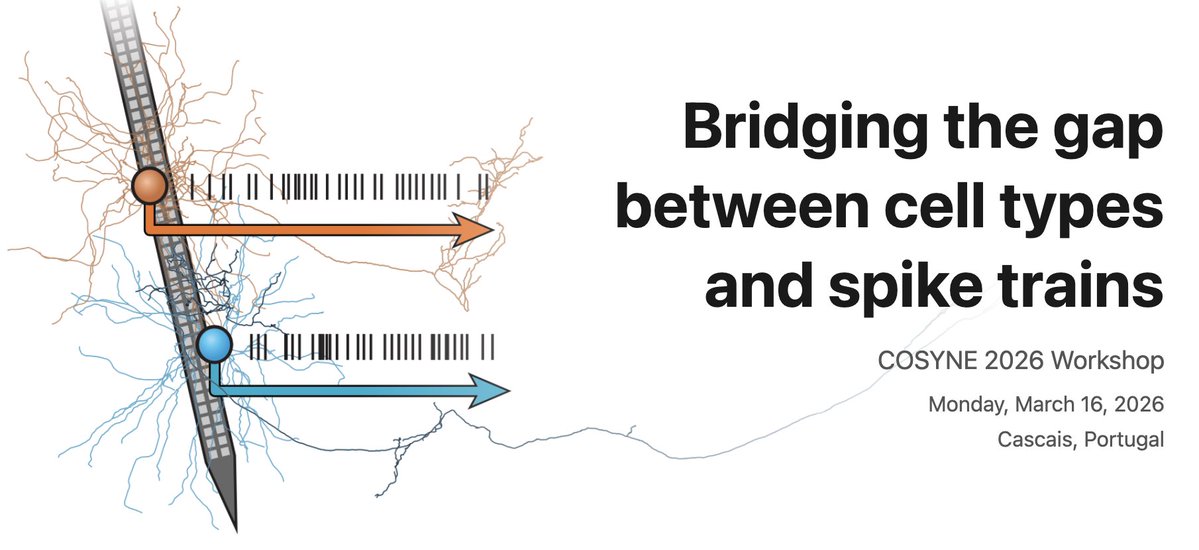
Josh Siegle and I are thrilled to be chairing the first workshop on "Bridging the gap between cell types and spike trains"! We see this as the key link between population-level descriptions of dynamics and real mechanistic understanding from cell types. https://t.co/BP2xsBcCFT
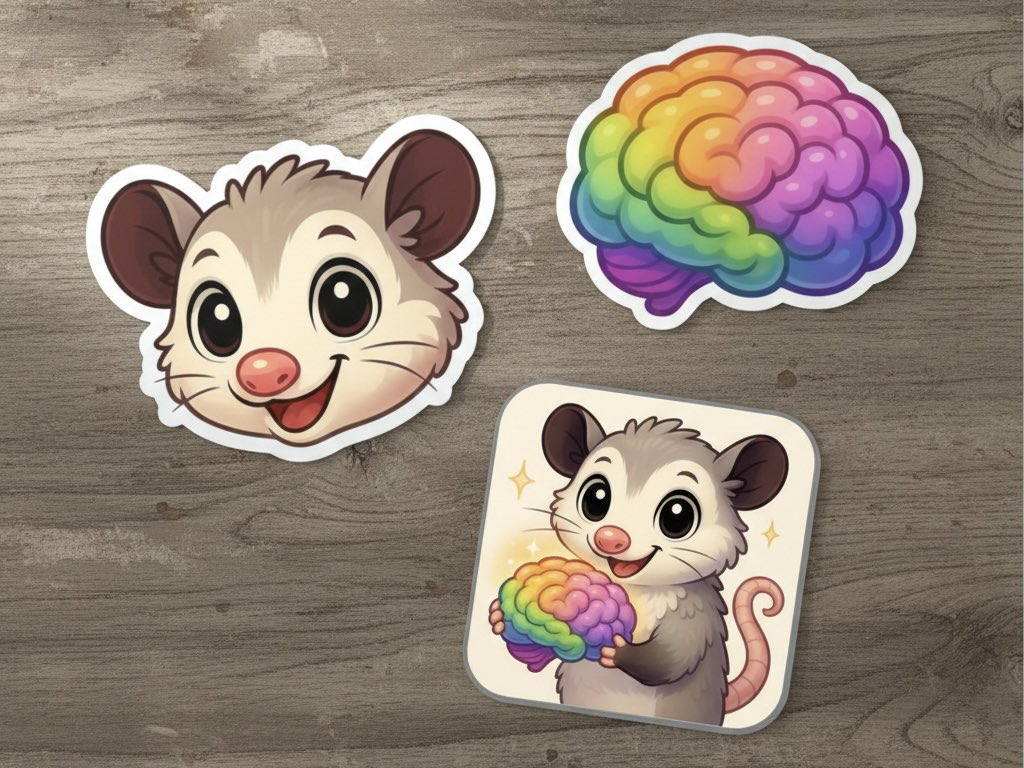
I’ll be presenting POSSM at #NeurIPS2025 tomorrow, together with @averyryoo. Come by our poster for cute stickers and to chat about neural decoding, BCIs, and foundation models for neuroscience! 🧠🤖
🗓️ Dec 3rd
🕚 11:00 am – 2 pm
📍 Poster #2000 Exhibit Hall C,D,E
Excited to share our #NeurIPS2025 work: NuCLR, a framework for learning neuron-level representations 🧠 These embeddings capture the biological identity of neurons and work out-of-the-box on new animals; no finetuning needed 💃 This offers some of the first evidence that large-scale neuroscience models can truly generalize across animals.
Paper: https://t.co/eYl4gyBLLi
Code: https://t.co/L2MXrHmqiQ
If you are at NeurIPS in San Diego, come find us at Poster Session 5 (11am-3pm PT, Exhibit Hall C,D,E, # 2107) 🎉
1/x 🧵
I’m excited to share that I’ve started a new company: Constellation.
Our thesis is simple: the next frontier of AI will be in modeling human experience in all its richness: brain🧠, body🧍and environment 🌐
I’ll be at NeurIPS with my co-founder
@Biofall. We're hiring, DM me!
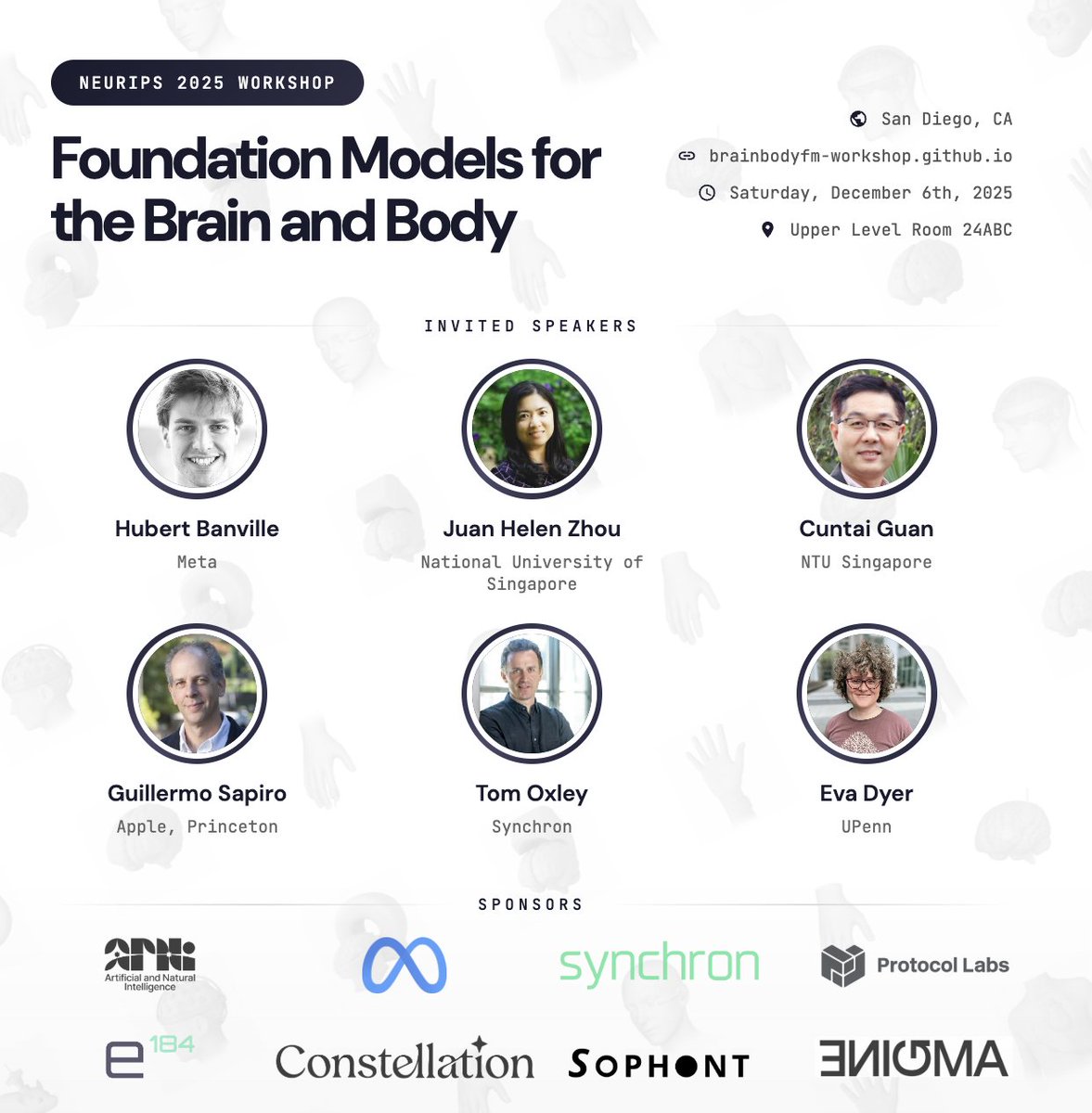
The Foundation Models for the Brain and Body workshop is happening this week at #NeurIPS2025 🏝️🧠
We have an amazing lineup of keynote speakers, spotlight talks, posters and demos.
We can’t wait to welcome everyone on Saturday!
How can we make progress in developing a general model of neural computation rather than a series of disjointed models tied to specific experimental circumstances, ask @evadyer and Blake Richards @tyrell_turing in the latest entry in our NeuroAI series.
https://t.co/jeioTlLunB
First paper from the lab https://t.co/yvuD1t7oYQ! Long story short: @ezeyulu00, @AmartyaPradhan, @DKoveal and I developed a method using injectable nanoparticles to turn mice into…constellations in motion.
Looking forward to a visit from @evadyer on Thursday! Eva is working at the forefront of the intersection between machine learning, neuroscience, and neuroAI 🧠
Come check out her talk and learn more about her work here: https://t.co/ow9HAdJ80E
What will a foundation model for the brain look like?
We argue that it must be able to solve a diverse set of tasks across multiple brain regions and animals.
Check out our preprint where we introduce a multi-region, multi-animal, multi-task model (MtM): https://t.co/eaC4jyFsBN
Meet the @GeorgiaTech experts who are helping unlock the future of #AI. These experts will share their latest research findings in machine learning on the world stage at @icmlconf (July 21-27).
Tech experts are part of 40 teams with new research, and the institute is the lead organization on 22 of the teams.
Explore the work now through interactive 📊 charts and news highlights from @GTCSE:
🔗https://t.co/JM2PkdyJfe
This might be the secret to breaking through the next plateau in deeper reasoning, planning and retrieval capabilities for AI agents 🤔
LGGMs (large generative graph models) are on the rise! While @Adobe and @intel were first at it with LGGMs, researchers at @GeorgiaTech have trained their own model called GraphFM (links below).
It’s important that more progress is made on this front to improve causal grounding with graph-based retrieval, DAG generation for LLM Compiler like planning mechanisms and for graph-based self-discovery + continual learning agents with graph-based CLIN to further enhance reasoning, decision-making and environmental grounding for AI agents.
Existing implementations of knowledge graph generation (like with GraphRAG) rely on LLMs to define entities/relationships which isn’t always accurate... moving to LGGMs may finally unlock the potential of graphs for many of the use-cases outlined above.
Excited to see some infrastructure providers in the next 6-12 months start scaling and offering these kinds of models which I think will play a critical role in making agents substantially more reliable when combined with similar design patterns as linked to below - and especially when combined with optimization frameworks like DSPy and Agent Symbolic Learning. Have a feeling that domain-specific SGMs (small graph models) or frameworks to build your own SGMs for distributed agentic systems will be next to come…
Read for yourself, connect the dots and thank @divyyansha1115, @mehdiazabou, @vinam_arora and @evadyer for their amazing work! 🔥
GraphFM by Georgia Tech: https://t.co/8IcsLGU4Tu
LGGMs by Intel & Adobe: https://t.co/gCtYqT8dTo
LGGM Code, Demo & Datasets: https://t.co/F0ji0UE5Bu
Self Discover: https://t.co/OQDCN0GLeT
CLIN: https://t.co/bvpPjyvl0K
LLM Compiler: https://t.co/SwgHdFaNpW
DSPy: https://t.co/HCGXwnBSXh
Agent Symbolic Learning: https://t.co/NPUNANQWia
Excited to share our Graph Foundation Model, 🌐 GraphFM, trained on 152 datasets with over 7.4 million nodes and 189 million edges spanning diverse domains.
🚨 Check out our preprint for GraphFM where we test how our model scales with data and model size, and show efficient finetuning on new datasets.
Link: https://t.co/dfmJWMILMv
Be a content creator for the Neuromatch NeuroAI course! We're looking for people to write tutorials on transfer learning and RL in PyTorch over the next 3 weeks. If you want to help build this amazing course, DM me for details or fill out this app: https://t.co/eMZDvL3PRY
Cosyne Workshop Alert! On Tuesday March 5th, @chethan and I are proud to bring you:
Understanding Neural Computation using Task-trained and Data-trained Networks.
https://t.co/k0wmgwz1C3
Have you ever done a dense grid search over neural network hyperparameters? Like a *really dense* grid search? It looks like this (!!). Blueish colors correspond to hyperparameters for which training converges, redish colors to hyperparameters for which training diverges.
Today, I am very proud share what we have been working on for the last 14 months. ✨
Introducing Aya -- a new state-of-art for massively multilingual models. 🔥🎉
"Why the simplest explanation isn’t always the best" - commentary with @evadyer highlighting how dimensionality reduction does not usually give us what we want. https://t.co/I3TqIjI8ta "Major Achievement: Dino scatterplot in paper" unlocked.
How can we extract insights from behavior modulated by multiple complex factors? 🐭🪰🤖🏃
Check out our #NeurIPS2023 Spotlight Paper where we present a SSL method for learning multiscale representations of behavior! @mlatgt@GoogleDeepMind
Link: https://t.co/vXurLycHXj 🧵
Neural spiking data and Transformers are a tricky match. Temporal segmentation and tokenization are the crux. Together with an all-star team, we figured out a scalable sol. The results are exciting: training and transferring on multi-sessions, multi-subjects neural decoding tasks