Proton is now publicly calling Windows spyware over the Global Device ID that Microsoft uses for every Windows installation. They say users never consent to the GDID, can't remove it, and that reinstalling Windows only partially helps since Microsoft keeps the old records.
The company found exactly one mention of the identifier in all of Microsoft's public documentation.
Every Windows installation carries a Global Device ID that Microsoft can hand to law enforcement, and a federal complaint against an alleged Scattered Spider hacker just showed it defeating a VPN.
Per the FBI affidavit, Microsoft records tied one GDID to the creation of an ngrok account used in a May 2025 jewelry retailer breach, then gave investigators the device's full IP history. Cross-referenced against the suspect's Apple, Snapchat, and Facebook logins, the VPN didn't matter.
The story of Alliance alumni @raincards (ALL7) from zero to $2B valuation.
0:09 Rain’s growth
0:23 Rain’s office tour
1:35 Rain’s company values
2:46 Alliance’s move to NY
3:40 Why NY after Stanford
4:23 Rain’s founder meeting
5:55 Office amenities
7:00 Rain’s agentic use cases
8:00 Rain’s customers
9:01 How Rain started
9:45 Why starting niche is better
10:35 Danny Meyer story
11:46 The talent arbitrage of NY
12:45 Alliance’s influence on Rain
13:53 The difficulties of scaling
15:13 The serendipity of NY
15:38 Finding partners in NY
17:00 The future of Rain
18:15 How startups win
The next cohort of 18 startups graduates next Tuesday on Alliance's Demo Day. Apply at https://t.co/v29WpAluLH
High-end carbon fiber used to be one of the classic chokehold materials used against China.
Japan dominated it.
The West controlled it.
China was expected to buy what it was allowed to buy and stay dependent where it mattered.
But sanctions and blockades have a funny habit.
They do not always stop China.
Sometimes they teach China exactly what it must master.
Now Chinese-made carbon fiber can pull a 10-ton truck with one strand, enter aerospace materials, high-end manufacturing, sports equipment, and strategic industries.
This is the pattern again:
They tried to keep China at the low end.
China climbed into the material layer itself.
Black gold is not just carbon fiber.
It is another chokehold turning into domestic capability.
Visualization of the ✨entire✨ Hyperliquid gossip tree - by @hydromancerxyz
See how data flows on Hyperliquid chain - which validator sentries send data to whom. Check multi-peered market maker (presumably) nodes and non-validator peers
only on https://t.co/QLHruYrYZl🔮💧
Everything I know about @Lighter_xyz Strategy (so far)
The launch of Robinhood Chain has revealed enough details about Lighters growth strategy that a picture is starting to form.
"...enabling users to trade perpetuals and tokenized stocks on a new Lighter instance built for Robinhood Chain, using USDG as its quote asset.
This is the first step toward Lighter Domains: independent Lighter instances with separate execution, sequencing, blockspace, and liquidity. That separation is intentional, allowing markets to serve different ecosystems, partners, and regulatory requirements."
https://t.co/KIUwKmKm95
Domains are architecture for regulatory compliance. The intentional separation (per-partner liquidity, sequencing, blockspace) is what a regulated distributors need - walled instances it controls, on its own ledgers, in its own quote asset, without commingling with offshore perp flow.
"Long term, Lighter Domains are designed to preserve this separation where it matters while enabling future connectivity through proof aggregation and verified messaging."
Lighter core is a zk rollup, so separated Lighter instances can later be re-unified for liquidity via proof aggregation. The magic of ✨zk cryptograpgy✨ and represents an architectural edge that
- no other perp has
- perfectly positions Lighter to be the backend perp service provider for the compliant US marketplace
Lighter's business model becomes B2B2C: Lighter becomes the perps/matching engine behind other people's distribution. In the same way Coinbase wants to be the backend crypto exchange for trad brokerages too slow to innovate, Lighter wants to do the same for perpetuals. Robinhood is partner #1, and a huge vote of confidence for Lighter tech and brand.
Listening to Vlad on the Lighter Q2 investor call, they alluded to further undisclosed partnerships in the works after Robinhood.
The regulatory bet: US perps clarity from the CFTC is coming; Johann essentially confirmed Robinhood wants perps in the main app when it does. If Lighter holds the licenses it seeks, and is already the incumbent engine inside Robinhood's stack, it's positioned to be the back end when the main app, switches on. It’s worth noting Robinhood is a part of the DTCC Tokenized Stocks working group and the pilot includes Russell 1000, ETFs and treasuries eligible to be tokenized.
Perp + tokenized stocks combo completes the picture: A perp is a synthetic instrument. A perp ontop of a real underlying spot market of a tokenized asset is a massive evolution for what a perp exchange can do.
With tokenized stocks live on Lighter, you get the first fully internal spot/perp basis trade for equities - both legs, one quote asset, one margin account. Cross-margining spot against perp natively produces max capital efficiency, and from there the design space opens up: strategies, assets, and ratios recombine into instruments that don't exist yet.
A 1+1=3 moment for tokenization and perps.
Vlad on the Q2 investors call said we can expect tokenized stocks to be inside the main Lighter core instance as early as this week (I suspect he's referring to Robinhood Stock Tokens, which are already spreading across the Ethereum ecosystem) - so hopefully this future is here sooner rather than later.
Good speed on that ethereum:0x232ce3bd40fcd6f80f3d55a522d03f25df784ee2
$650m market cap btw
In case you missed it, there's a full-blown war between KAST and EtherFi happening right now.
Here's a summary of everything that happened:
1. @MikeSilagadze (EtherFi CEO) QRT’d a post from @0xVishnya about a fee comparison and basically said EtherFi has the best product, but weaker marketing.
2. @raagulanpathy (KAST CEO) then quote-tweeted Mike’s post with a screenshot of $ETHFI price.
3. Mike fired back and called out KAST Terms of Service, basically saying that they work against their users.
4. So far, KAST or Raagulan have not responded.
Whose side are you on?
Hidden fees suck, especially when two cards look similar until you actually use them.
Here's the list ranked by extra cost vs the best observed rate, based on experiments from @0xVishnya ↓
Highest
@oobit | ~5.4%
@KASTxyz | ~2.7%–3.3%
Medium
@Plasma | ~1.8%
@RedotPay | ~1.5%
@wirexapp | ~1.4%
@xplaceapp | ~1.0%
Lowest
@useTria | ~0.6%
@krak | ~0.1%
@coca_card | ~0.0%
@avici | ~0.0%
@ether_fi | ~0.0%
You can also use https://t.co/hrGMfpX1BA as a go-to tool for checking whether a specific crypto card is available in your country, anon ;)
most neobanks will not survive the next 18 months.
not because demand disappears. $245M in top-ups in a single week proves demand is the least of your problems, they will die because of what they built underneath:
i review compliance infrastructure for a living since 2017. here is the full map of what actually holds this market together, layer by layer, and who is powering each one right now
cards
your card program is a three-party compliance relationship: you, your issuer, and the network. the network's enhanced due diligence sits on top of your issuer's requirements. if either loses confidence in your stack, the card stops. not slowly. overnight
@binance lost Visa in Europe July 2023. lost @Mastercard in latam two months later. gone by December. @ready_co gave non-EEA users one hour's notice in June 2026 when their issuer relationship broke. one hour
what the network actually wants to see: account-level OFAC and sanctions screening, not batch, not periodic, continuous. a transaction monitoring system that produces real alerts. a KYC layer defensible across every jurisdiction you operate in. one audit trail running through every product the customer touches
Starlingbank had a system that produced zero individual sanctions alerts for six months. £29M fine. that is the floor
the infrastructure powering this layer right now: @raincards (Visa and Mastercard principal member, BIN sponsor for 200+ programs, one API for issuance, compliance, FX and onchain settlement), @pomelo_latam ($160M raised, powers bbva , santander , @Bancolombia , @WesternUnion , Binance across latam, just launched global stablecoin card across 150+ countries), @marqeta ($383B processing volume in 2025), @lithic, @GalileoFintech, @unit_co_, @treasuryprime, @Adyen, @Stablecoin@eldoradoio@Uglycash
the compliance layer that makes the issuer relationship survivable is what @blend_money is built around: screening, audit trails, per-jurisdiction reporting, the infrastructure that keeps the card program intact at scale
on and off ramps
every ramp is a compliance event before it's a UX event
on-ramp: you are opening a new account. source of funds, identity verification, risk scoring before a single dollar moves
off-ramp: withdrawal with a clean audit trail, documented source of funds, per-jurisdiction reporting. this is where most teams underinvest because users don't see it. regulators do
best practice: per-account screening on every transaction, not customer-level screening on signup and never again. your banking partner will pull a sample during their quarterly review. if the trail isn't clean per transaction, you find out at the worst moment
the infrastructure powering ramps right now: @moonpay (eliminated fees on stablecoin onramps, enterprise stablecoin services live), @Transak (published the Q2 2026 compliance cliff report, most serious public documentation of what payment companies need before july), @Stablecoin (acquired by Stripe for $1.1B, trust charter approved february 2026), @belo_app@AlchemyPay, zerohashx, @Bitso , @RipioApp@daimo@dakota_xyz@RampNetwork@tazapay
earn
(im biased here just a little bit)
the most misunderstood compliance surface in the stack
shared vaults feel like a product architecture decision. they are actually a legal structure decision. commingled user funds create fiduciary exposure, insolvency complexity, and a direct failure point in any serious institutional diligence process
the question that kills shared vault structures is simple: show me the ledger entry for user X's balance. if the answer requires reconstructing it from pool accounting, you don't have an answer
best practice: isolated per user from day one. each account its own ledger entry. yield calculated individually. never commingled. this isn't conservative. it's the only structure that survives the question above from a banking partner, a regulator, or an institutional LP doing diligence on your cap table
this is the architecture @blend_money runs. isolated accounts, clean ledger, never commingled
for the institutional layer on top: @noon_capital brings the DeFi stack diversification and insurance coverage that makes yield products viable for institutions. diversified protocol exposure across @MorphoLabs, @eulerfinance, @pendle_fi, tokenized treasuries, CLOs and private credit. insurance gating on every deployment, no capital deployed without coverage. that is the version that survives institutional diligence
the broader earn infrastructure: @opentrade_io (RWA-backed yield-as-a-service, bank-grade legal structure with bankruptcy-remote SPC, powers Littio, Kredete, Criptan), @OndoFinance, @maplefinance, @goldfinch_fi, @SuperstateInc
in europe, MiCA Article 50 prohibits interest on euro-denominated stablecoins. the compliant path runs through tokenized T-bills and RWA wrappers. yield from an underlying asset, not from the stablecoin itself. whoever builds this first owns european earn
cashback and rewards
every rewards program with monetary value has reporting obligations
(ps @itstuyo set the new standart here: buy now pay maybe)
the cleanest structure: rewards funded from interchange revenue, paid in a regulated stablecoin, accounting that reconciles per user per period, tax-reportable from day one in every jurisdiction
paying rewards in your own token introduces volatility risk for the user and securities classification risk for you. the question "is this a security?" becomes harder to answer the moment the token fluctuates and users expect returns
compliance screening, the layer underneath all of it
most teams assemble this reactively. something breaks, a regulator asks a question, a banking partner flags a transaction. then the compliance stack gets built. that is the wrong order
the teams that survive build it preventively. before the card. before the ramp. before the earn product. one continuous audit trail across every product the customer touches
the point tools doing parts of this well: @chainalysis (blockchain analytics, OFAC and sanctions screening, regulator-accepted in US, EU and UK), @elliptic, @trmlabs, @Sumsubcom (KYC, AML and Travel Rule in one integration, MiCA and FATF ready), @ComplyAdvantage, @notabene_id, @sardine, @unit21inc, @jumio, @Onfido
but point tools create point gaps. your KYC vendor does not talk to your transaction monitoring. your transaction monitoring does not feed your sanctions screening. your sanctions screening does not generate the audit trail your banking partner needs to read. every gap is a reconciliation problem you find at the worst moment
what @blend_money built is the integrated layer. AML screening, OFAC checks, KYC, transaction monitoring, per-jurisdiction reporting, all running together as preventive infrastructure before a single user touches a product. not a compliance dashboard bolted on top. the foundation the card, the ramp and the earn product sit on
IDmerit's February 2026 breach of approximately 1 billion records made this clear: your compliance infrastructure is now a counterparty risk decision, not just a regulatory one
the right order of operations
1) screening and transaction monitoring, then issuer relationship, then card
2) source of funds framework, then ramp, then volume
3) isolated ledger, then earn product, then institutional partners
4)interchange accounting, then rewards, then retention
teams that invert this order ship faster in year one and rebuild in year two. sometimes year two doesn't come
the $245M is not a card story. it's not a yield story. it's a survival story
the neobanks still standing when this market hits $2.45B will be the ones that figured out compliance is not the last thing you build. it's the only thing that lets you build everything else
WaveCrest taught this lesson in 2018. Wirecard taught it in 2020. Ftx in 2022. Binance in 2023. Ready in 2026
the lesson does not change. only the names do.
In Casino, the Japanese “billionaire cheapskate” K.K. Ichikawa - who wins $2 million at the Tangiers before Sam Rothstein sabotages his flight home and lures him back to the casino - was based on real Tokyo real-estate mogul and legendary high roller Akio Kashiwagi.
Known as “The Warrior,” Kashiwagi was one of the most notorious baccarat whales of the late twentieth century, reputedly playing over “$30,000 a hand” and nearly bankrupting several casinos. And like Ichikawa, he was also infamously cheap, reportedly taking “free soap, shampoo and towels” from luxury hotel suites.
However, the real-life Sam Rothstein, Frank “Lefty” Rosenthal, never crossed paths with Kashiwagi. Their stories belong to different eras: Kashiwagi’s gambling spree peaked in the late 80s and early 90s, long after Rosenthal had been barred from the casino industry.
The showdown between Ichikawa and Rothstein in Casino was instead loosely inspired by Kashiwagi’s infamous high-stakes clash with real-estate mogul and future U.S. president Donald Trump.
In February 1990, Donald Trump flew Akio Kashiwagi to Trump Plaza in Atlantic City, put him up in an ocean-view penthouse, and reserved a private baccarat table just for him. Kashiwagi arrived with $6 million and received another $6 million in credit, but after two days he left up $6.2 million.
Unwilling to accept the loss, Trump lured Kashiwagi back on terms that made it almost impossible for him to win again. He offered an informal “freeze-out” agreement: Kashiwagi would bring $12 million to the table and play until he had either doubled it or lost everything.
Knowing the odds would eventually swing back in the house’s favor over a long enough session, Trump counted on Kashiwagi being unable to resist the challenge. He took the bait. And after a brutal weeklong marathon of high-stakes baccarat, Kashiwagi went from being up millions to facing a staggering $10 million loss.
However, Kashiwagi’s real troubles were only just beginning.
After the Japanese asset-price bubble exploded, Kashiwagi’s company, Kashiwagi Shoji, buckled under the strain of its highly leveraged real-estate loans and collapsed as land values cratered. It’s also widely believed that he defaulted on high-interest debts connected to yakuza groups.
On January 3, 1992, the 54‑year‑old developer was found dead in the kitchen of his home, stabbed repeatedly with what investigators believed to be a samurai sword. To this day, his murder remains unsolved.
Chinese innovation in patient care is changing lives.
A smart mobile lift system allows bedridden patients to be safely transferred to bed or toilet without physical strain—reducing caregiver burden and restoring dignity
Sometimes reality is crazier than science fiction. This is the international space station, carrying humans, passing between my spot in the desert and the moon.
This video was slowed down significantly, as the ISS was only in my field of view for about 150ms
Unloading trucks with robots! 📦
Bastian Solutions has developed a mobile robot system that automates high-volume, floor-level unloading of trailers.
Let's have a closer look at how it actually works!
The robot seamlessly drives itself in and out of trailers and docks without any fixed infrastructure.
This system picks up cases via an extendable conveyor, lifts them using a retractable mast, and accurately places them inside the trailer using a dedicated gripper.
In the video you can see the reversed process, unloading of a truck. 🚛
It's guided by LiDAR-based navigation and an omnidirectional base, enabling fast, precise, and infrastructure-free operation.
Integrates smoothly with existing systems like conveyors, scanners, sorters, and depalletizers.
Every time I see a robot loading and unloading a truck, I'm like: we are getting there :)
~~
♻️ Join the weekly robotics newsletter, and never miss any news → https://t.co/GoA3ZuwoPB
Redeeming wrapped Bitcoin works differently depending on the provider:
> cbBTC requires KYC verification before redemption.
> WBTC requires locating an OTC dealer to process the redemption.
> zBTC can be redeemed directly and immediately, with no identity verification or intermediary required.
The redemption process is often the clearest indicator of how "wrapped" an asset really is.
EXCLUSIVE: Robinhood is going to pay 7% on dollars to 27.7 million customers.
In this Interview Johann Kerbrat, their SVP of Crypto explains how it all works.
Robinhood Earn lives inside the main investing app. You can buy the USDG stablecoin in a few taps, and it gets deployed into vaults built with Morpho and Steakhouse, and the target yield is roughly 7%.
Where does 7% come from?
Market makers and liquidity providers pay it. These are traders who need USDG liquidity to run spot and perps trading. Your deposit is funding someone else's 50x leverage, and you're the one getting paid for it.
Assuming you get paid back.
Which, as we've seen, doesn't always work in DeFi with hacks and smart contract risk. But Robinhood has done something extra to make this retail-grade.
Robinhood's answer is an insurance program with Lloyd's of London and Relm covering smart contract and vault failure. He says it's one of the largest ever built for a crypto product.
Earn was one of 12 announcements; some others that caught my eye:
Stock tokens in 120+ countries, backed 1:1 by real equities. You can withdraw them to a self-custody wallet and post them as collateral. Borrowing against a stock portfolio used to be a private banking perk; now it's a smart contract.
Robinhood Chain went to public mainnet after 200 million transactions on testnet.
Perps on stocks, crypto, and commodities at 20 to 50x leverage, bringing an entire new asset class to the mainstream.
Robinhood is all in on DeFi.
DeFi protocols spent a decade fighting for users. Robinhood just made a Morpho vault look like a savings account, in front of 27.7m funded customers.
See the 15-minute highlights below and the full episode on the Tokenized Podcast youtube channel
Full interview with Johann on @Tokenized YouTube
The @ether_fi product is absurdly better than anything else.
Most importantly, you can actually trust the team. No hidden fees, no lies about cashback, no forcing users to stake some shitcoin.
We suck at marketing tho.
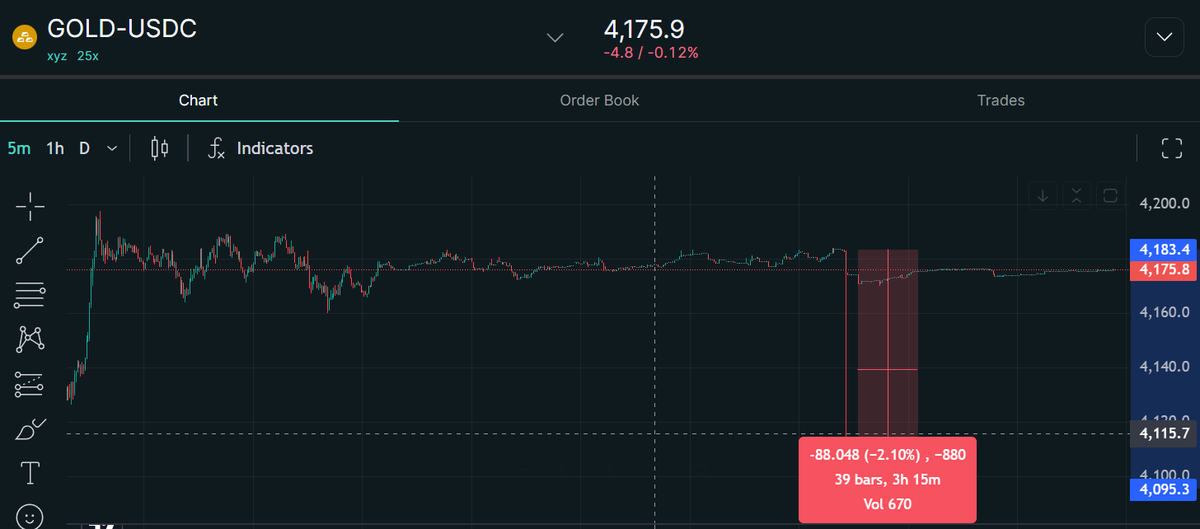
The solana:GoLDppdjB1vDTPSGxyMJFqdnj134yH6Prg9eqsGDiw6A market on @tradexyz dropped more than 2% in a single second after a market sell of 1,683.5 solana:GoLDppdjB1vDTPSGxyMJFqdnj134yH6Prg9eqsGDiw6A (worth $6.97M).
Executing an order of that size over the weekend resulted in approximately $54.4K of slippage.
Despite the sharp wick, no positions were liquidated.