GLM-5.3 Full (743B) now runs on just 2 DGX Sparks at 38tok/s decode on prose and 293k context.
This is the tractor of local LLMs.... Slow and steady!
69/80 on Human Eval, statistically tied with Exlr8 3.25bpw - huge surprise!
Most people see 2.25 bits/weight and assume the model is lobotomized. With EXLR8 mixed-precision experts + 4-bit MLA latent KV + native INT4 DFlash + 48 GB NVMe SSD KV you get:
- 38 tok/s c1 decode
- 98 tok/s c4 decode
- 400ish tok/s prefill
- 99% prefix caching
- beating 4 bit quants on evals...
Don't be fools by the 4bit KV. Gr8 uses a new hybrid method that performs better than FP8 in tests... At KindlingAI we like to have our cake and eat it too.
How Realmark Scores Work:
A = quality isn't too degraded
# = how fast the model feels to use (higher = better)
1 Session Realmark Scores:
Gr8 TP2: A - 800
Gr8 TP2: A - 1175
TF TP4 : A - 878
4 Session Realmark Scores:
Gr8 TP2: A - 790
Gr8 TP2: A - 1556
TF TP4 : A - 167 (Does not do concurrency)
Article coming soon where I talk about the tricks that went into this and how it stacks up against other popular GLM 5.3 Spark builds.
This one was super interesting. 2 months ago we were struggling to get this working on 4 Sparks. Now, it's working on 2!
https://t.co/8B6xDnnLY9
Now you can use my hyper optimized Inky 2 Mini build for AMD Strix Halo (gfx1151) with the Tess 4.5 fine tune!
The Tess editions of LLMs have been one of my favorite and one of the few to reliably add real utility and intelligence to the base model.
What’s in the package:
• Layers 0–19 stay in unmodified lossless NVFP4 (pre-tiled into native gfx1151 WMMA banks)
• Layers 20–23 (MXFP8 coda experts) freshly packed into Flash C1 G16 (~2× memory-bandwidth reduction on Strix Halo, with --original-weights available anytime)
• Full 1,048,576-token context, 48 GiB BF16 KV cache, 8 concurrent sequences, multimodal vision, native reasoning, and native tool calling
• Precompiled portable gfx1151 ABI v3 native HIP library included (no hipcc or rocm-sdk-devel needed)
Verified Strix Halo (gfx1151) benchmarks (--mode vision --context 1048576 --seqs 8 --kv-mib 49152 --tools, 1s
FULL HIP graph capture):
Default — Bundled Adaptive DSpark:
• 60.8 tok/s B=1 greedy (193 ms TTFT) | 51.4 tok/s B=1 T=1.0
• 213.9 tok/s aggregate at B=8
• 1,131,335 KV tokens (1.08× 1M) | 45 s warm startup | 2.71 tok/step acceptance
With --dflash2 (incoai/Inkling-2-Mini-DFlash2 + native RDNA 3.5 W6 WMMA):
• 123.3 tok/s math & reasoning
• 62.6 tok/s B=1 greedy (191 ms TTFT) | 52.9 tok/s B=1 T=1.0 (157 ms TTFT)
• 227.2 tok/s aggregate at B=8
• 1,269,761 KV tokens (1.21× 1M) | 29 s warm startup | 3.37 tok/step acceptance
(And on RTX 5090 sm_120, Tess-4.5-26B-A3B is a 100% drop-in swap on our Inkling 2 Mini SM120 NVFP4 + NVFP4-KV + DSpark kernels -- hitting 254.9–310.0 tok/s decode and 3.22 tok/step at 512K context in 29.7 GiB VRAM.)
Model card, weights, overlay, and quick-start scripts:
https://t.co/OVEIYAh2kU
Thank you @migtissera for your work.
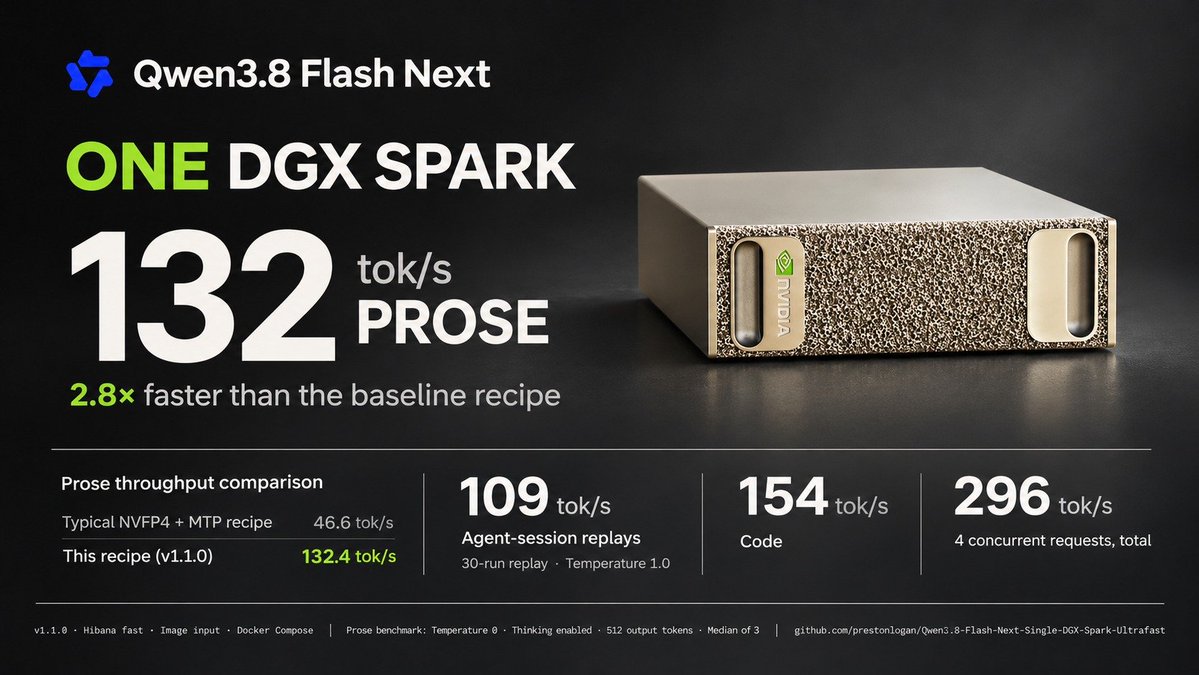
🚀 Single DGX Spark owners: Qwen3.8-Flash-Next at 132 tok/s on prose (111 at temp 1.0). 2.8× the typical recipe in the same test.
v1.1.0 of my recipe adds a distilled MTP draft head, a repetition guard and GB10 kernels. Prose is up from 101 in v1.0.0.
• 154 tok/s code
• 114 tok/s with an image in the prompt
• 296 tok/s total across 4 requests
• 0 of 30 agent sessions looped (v1.0.0: 2 of 30)
• New exact mode if you want drafting to never change the output
Uses Hibana's lossy fast profile, quality measurements below. Built on @dedene's recipe and @yemara22's Hibana engine 👇
TensorFold 1.3.6 is live 🚀
TFQ3 goes native on CUDA. On an NVIDIA GB10, Qwen3.8-27B-TFQ3 went from 15.1 to 56.6 tok/s with DFlash2 + DSpine. 3.75× the decode speed, with the same output tokens in that coding test.
Native 3-, 4- and 5-bit TFQ3 serving and speculative drafting for Qwen3.8-27B, GLM-5.3-Flash and Qwen3.8 Flash Next.
• Full GLM-5.3 runs on CUDA with MTP.
• Inkling 2 Mini gets to the first token in under 10 s on a cold 2K prompt on M4 Pro, down from over two minutes, with identical greedy output.
• LFM3-VL-2B gets image input on Metal. LFM3-1.7B adds NVFP4, block FP8 and MLX 4-bit on CUDA.
• Qwen3.8-27B can resume from edited messages with the optional message-start cache.
• Versioned Linux container images are up on GHCR for amd64 and arm64.
Since 1.3.5, we closed 204 PRs, including 91 merges, and resolved 20 issues.
Huge thanks to everyone who sent a patch, tested a model on their hardware or opened an issue with a repro. These releases happen because people take the time to do that. 🫶🏼
@atasrb@Bizuayeu@BlivionIaG@BobClawblaw@devopsfortunato@francip@unigilby@GrgaPalcic@javierbits@plotarmordev@Shoestring_Dev@petruspennanen
And on GitHub, BadAd84, bjornmonnens, cwschroeder, dcolley, garvrao80, jschmied, kotevcode, mrv777, niterider804, tacosta and trozzelle.
@MiaAI_lab@volatilemarkts@plotarmordev@jayleaton@petruspennanen
https://t.co/H2dBxCSaUV @tensorfold_dev
I didn't believe my Inkling 2 Mini numbers were that low next to everyone else's, so I ran every public single-Spark recipe through the same harness on the same box.
It turned out my benchmark is just the strictest one. Reasoning is on, the prompts are a mixed set of 73, and it's single stream.
Mine is the fastest under it: 73.5 tok/s vs 39–64 for the rest. On tonyd2wild's own benchmark, with reasoning off, it does 112 tok/s, against 100 for Mia's TensorFold and 87 for tony's recipe.
The authors' own numbers reproduce fine. They just measure an easier case.
Full table, scripts, raw results:
https://t.co/Lv0wpf1leR
Local RSI is here.
we took Inkling-2-Mini from thinkymachines and asked if it could recursively self-improve on local GPUs with no external teachers or labeled data.
results: in 10 minutes and 4 self-verified generations lift blind math +20.3 pp over default base!! (50.0% -> 70.3%, 0% repeats), LiveCodeBench v6 34.4% -> 40.6%
- repo: https://t.co/O6f6aJVizm
I give you the first open-weights RSI-generated looped model: https://t.co/lQ4Mk6Ri9b
A free online book: The LLM Stack: From Silicon to Agents by Prakash Kagitha (2026).
The book follows an LLM through its entire lifecycle, from arithmetic on accelerators to applications that retrieve information and use tools.
It connects the mathematics of learning to the hardware and software that make training possible, then follows the consequences of those choices into serving and evaluation.
The book combines explanations, from-scratch implementations, and examples drawn from production tooling.
The book has more than 800 exercises that you can work through with an AI tutor.
Read the book online on @chapterpal: https://t.co/24jMQ3LpBh
When reading on ChapterPal, use the built-in AI tutor when you feel stuck. Solve AI-generated quizzes to test and solidify your understanding. Do exercises with the AI tutor, which guides you instead of solving them for you.
TOP 10 UNCENSORED AI MODELS RIGHT NOW FOR LOCAL RUN :
1. DeepSeek V4.1 Flash 1017 Uncensored
- https://t.co/EtkDoYhOdW
2. Hy4 Flash Uncensored
- https://t.co/0LL8pcXWD2
3. GLM-5.3 Uncensored
- https://t.co/UuOROiGSsT
4. Inkling 2 Mini Uncensored
- https://t.co/aMPXmg457l
5. Qwen3.8-27B Abliterated
- https://t.co/2lSswBWimL
6. Qwen3.8-Flash-Next Abliterated
- https://t.co/QEc16FGDCJ
7. GLM-5.3 Flash Uncensored
- https://t.co/APLRIgg0R7
8. DeepSeek V4 Pro Qwen3.5 9B Heretic
- https://t.co/3L4OSKEoae
9. Gemma 4 31B Heretic
- https://t.co/2LFmmwpt5A
10. Ternary-Bonsai-2.5-27B-Uncensored
- https://t.co/yq6ANXvsH0
Not every AI model comes with the same restrictions.
Inkling 2 Mini on a DGX Spark writes code at 85.2 tok/s with the DFlash2 drafter and 58.3 with DSpark.
@MiaAI_lab switched her Inkling recipe to DFlash2 overnight, and her README shows it faster. So I ran both drafters one after the other on a Spark.
Only the drafter differs. Same TensorFold build, same Thinking Machines checkpoint (NVFP4 experts, MXFP8 layers), 262K window, 8 slots, fp8 KV cache.
DFlash2 is a draft model from Inco AI. DSpark is the draft head that ships inside the checkpoint.
DFlash2 is faster in every row. One stream gains 17 % on prose and 46 % on code, eight streams gain 13 % and 32 %.
Mia's settings in sparkDash (temperature 0.7, thinking on), 1 stream, DSpark to DFlash2 in tok/s
Code: 58.3 to 85.2, +46 % (hers +37 %)
Prose: 48.0 to 55.9, +17 % (hers +13 %)
Same method, 8 streams at once
Code: 130.4 to 172.6, +32 % (hers +25 %)
Prose: 140.9 to 159.6, +13 % (hers +23 %)
Her table uses Blackfrost's Derisked checkpoint, 512 tokens and her own harness.
I used the stock checkpoint with sparkDash, 400 tokens, median of 3 runs. So compare the gains, not the absolute numbers.
Our usual speed test (temperature 1.0, thinking on), DSpark to DFlash2 in tok/s
Code: 52.3 to 60.1
Prose: 63.6 to 79.2
1 request: 55.9 to 82.4
8 at once: 127.7 to 161.9
The DFlash2 prose number scattered by 20 % between runs, so 79.2 is the least certain one here.
Reading a prompt costs the same with both. 32K tokens take 10.8 s to the first token, about 3,095 tok/s in sparkDash.
DFlash2 also needs less memory per stream, 4.6 GiB against 5.6 GiB at the 262K window.
I ran Mia's exactness check on the DFlash2 build, at 0 and 3K of padding. Drafted, undrafted and 6 concurrent replies were identical at temperature 0.
I didn't run quality lists, since the target model verifies every draft.
If you run her recipe on a Spark, keep the new default. DSpark is one setting away (DRAFTER=dspark).
Setup: one DGX Spark, TensorFold Zig engine with Mia's patches 0001 to 0018, Thinking Machines NVFP4/MXFP8 checkpoint, DFlash2 revision 4f9088ea, 262,144 window, 8 slots, fp8 KV
Method: Mia's sparkDash decode test, median of 3 runs, 400 tokens. Our usual speed test, same box, same server flags except --drafter.
Recipe: https://t.co/edqoutPLMV
Inkling 2 Mini by Thinking Machines @thinkymachines. TensorFold by Ash @ashxhart, recipe by Mia @MiaAI_lab. DFlash2 draft model by Inco AI @inco_ai.
Releasing an uncensored version of Inkling 2 Mini.
By my metrics is scores better than any I could find on hugging face and improved some metrics of the base model.
Huge thanks to @TryMapleAI for sponsoring some of the compute costs!
https://t.co/Al5NEsbJPI
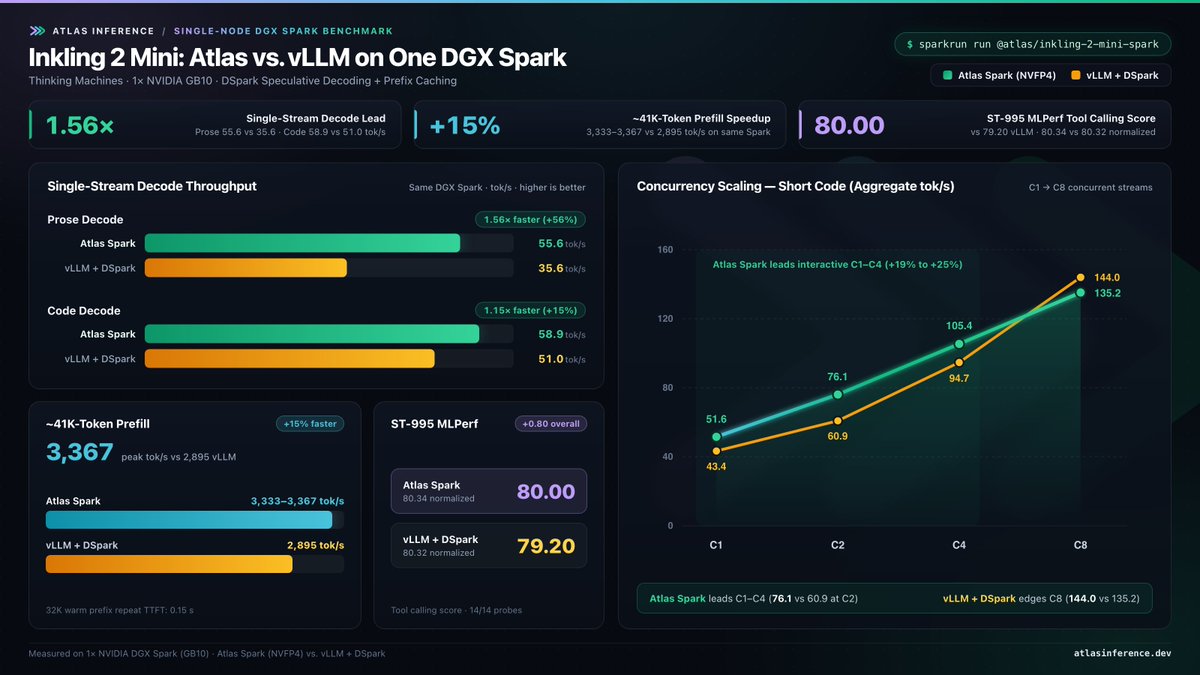
Inkling 2 Mini on a DGX Spark reads 32K in 10.0 s with SGLang, 10.8 with Mia's TensorFold recipe, 12.3 with vLLM.
Mia put out a new Inkling 2 Mini setup for TensorFold today. So I ran it straight against the images the vLLM and SGLang teams published for it.
All three run the same checkpoint (NVFP4 and MXFP8, revision 7a67ae23) with the DSpark draft model. Same test, and the engine is what I'm comparing.
Each recipe brings its own settings. The KV cache is fp8 on TensorFold and bf16 on vLLM and SGLang. Slots are 8, 256 and 48.
The window is 262,144 on TensorFold and vLLM, and 1,048,576 on SGLang. TensorFold ran on one Spark, vLLM and SGLang on a second one of the same model.
Reading speed is in the same range on all three. SGLang is fastest at 32K with 3,284 tok/s and TensorFold is second. With eight requests in parallel vLLM gives the most total speed.
Mia's method first: sparkDash, temperature 0.7, thinking on, in tok/s
Prose, 1 stream: 47.7 here, 48.3 in her README
Prose, 8 streams: 148.7 here, 145.0 in her README
Code, 1 stream: 55.2 here, 56.1 in her README
Code, 8 streams: 146.7 here, 149.4 in her README
Prefill at 32K: 3,082.8 here, 3,072.2 in her README
All five are within 3 % of hers. For vLLM and SGLang the authors list no Spark decode number in their blog, model card or cookbook, so there is nothing to put next to those.
Then the standard test here, sampled at temperature 1.0, the same prompts on every engine.
TensorFold, Mia's recipe
Prefill at 32K: 3,035 tok/s
First token after 32K: 10.8 s
4 requests at once: 105.1 tok/s
8 requests at once: 130.7 tok/s
SGLang image
Prefill at 32K: 3,284 tok/s
First token after 32K: 10.0 s
4 requests at once: 114.2 tok/s
8 requests at once: 170.0 tok/s
vLLM image
Prefill at 32K: 2,672 tok/s
First token after 32K: 12.3 s
4 requests at once: 100.8 tok/s
8 requests at once: 175.0 tok/s
vLLM's recipe page now points to the nightly build. I ran that too. It takes 12.0 s to the first token at 32K and does 159.3 tok/s with eight requests.
Writing speed isn't in the ranking. At temperature 1.0 two runs swing too much: vLLM wrote code at 109.6 and then at 46.2 tok/s.
For one person with long prompts, any of the three starts answering a 32K prompt in 10 to 12 s. With eight people on one Spark at once, vLLM and SGLang hand out more tokens in total.
Setup TensorFold: Mia's recipe at commit 6061fa8, tensorfold-native on pull request 4441 plus the recipe's patches 0001 to 0017, 8 slots, fp8 KV, 262,144 window
Setup vLLM: vllm/vllm-openai:inkling-2-mini, 256 slots, bf16 KV, 262,144 window. SGLang: lmsysorg/sglang:inkling-2-mini, 48 slots, bf16 KV, 1,048,576 window
Method: standard test is a median of 2 runs, 512 tokens, seed 42. Prefill and first token are medians of 3 runs. The first block: sparkDash at her main commit 86f972e, top_k 20, 400 tokens.
Recipe by Mia
@MiaAI_lab
, TensorFold by Ash Hart
@ashxhart
. Inkling 2 Mini by Thinking Machines
@thinkymachines , its TensorFold engine by Jürgen Schmied.
You can run Uncensored Cyber Inkling-2-Mini model locally on your 12GB RAM with Zero refusals.
- Inkling 2 Mini hits 48.2% on DeepSWE v1.1
- Post-trained for cybersecurity
- vulnerability analysis, vulnerability reproduction, red teaming & offensive-security research.
- 98.01% pass@1 on CyberGym Level 1
- 1M context
- function calling & OpenAI-compatible API.
- https://t.co/9NsMYfagZg
We're excited to also release OrcaCyber's Inkling 2 Mini Abliterated / Uncensored weights in native BF16 precision.
Download the model and run it locally, or use our API.
Weights: https://t.co/PaZPz0cH1S
API: https://t.co/MzsGMA0LdP
Run Inkling-2-Mini on your DGX Spark ✨
Two options running it:
- Official Inkling-2-Mini quant (default)
- DERISKED quant by @Blackfrost_AI
- Runs on TensorFold
Decode performance (2200 cap)::
- Prose 48 tok/s, single stream
- Prose 75 tok/s, 2 streams
- Prose 106 tok/s, 4 streams
- Prose 145 tok/s, 4 streams
Numbers are non-greedy, thinking on.
Prefill (2200 cap):
4k-32k: 3497-3072 tok/s
64k-128k: 2749-2267 tok/s
I love this model. It's not just about how it performs in all coding tasks vs others. It won't beat Qwen3.8-Flash-Next on frontend. It's the way this model thinks and talks. That's where the model shines.
Get it here:
https://t.co/7L0LCOG3Gr
Inkling-2-Mini on 1× DGX Spark: recipe 🔏
• 47 tok/s prose, 56 tok/s chat, thinking on
• Prefill up to 4.3k tok/s
• 262k context
• Measured with my Speedbench
• Same quality, same model, no lossy tricks
Built on SGLang + DSpark, with a few speed fixes on top.
Full recipe, measurements and credits:
https://t.co/nPDDQ5c2xT
New model time!
America is making a come back. Thinking Machines new Inkling 2 Mini is truly smarter than Qwen 3.8 27b, and it's an MoE!
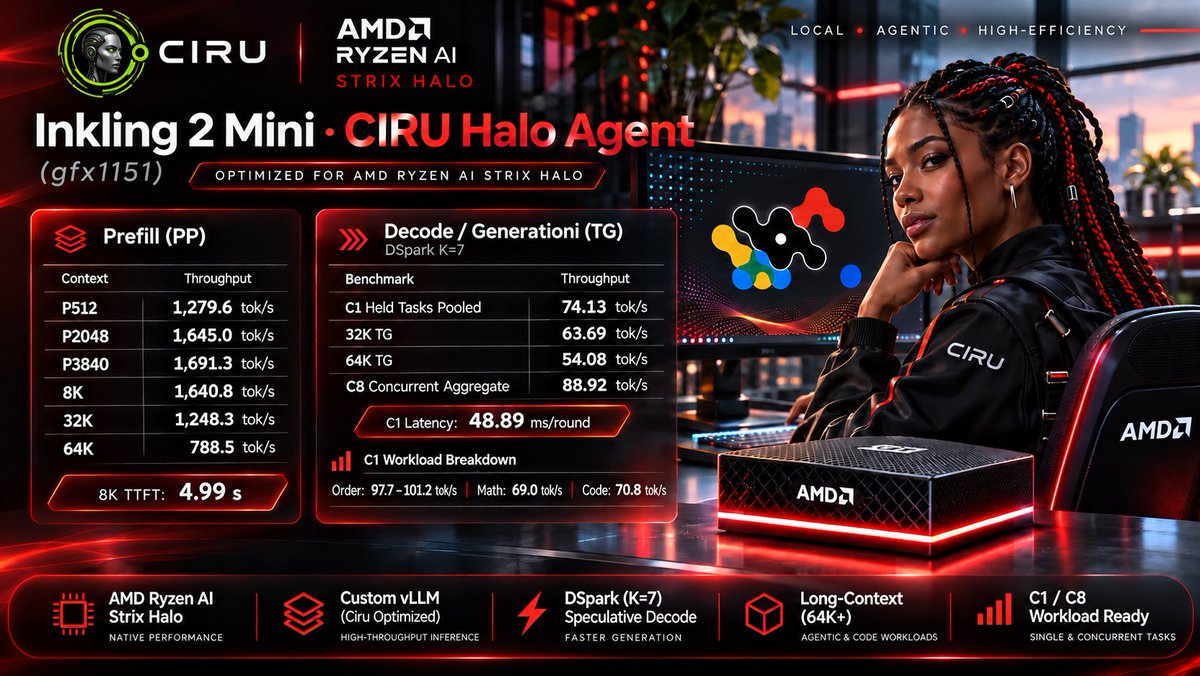
Inkling 2 Mini · CIRU Halo Agent
Faster and smarter than any other engine for this model on AMD. Powered by custom Wave 5.2 ROCm/Triton kernels, vLLM, and DSpark K=7
Performance Highlights:
Prefill (PP): 1,691 tok/s at 4K, 1,641 tok/s at 8K , and 1,248 tok/s at 32K.
Generation (TG): 74.1 tok/s single-stream, ~100 tok/s on structured JSON, 63.7 tok/s at 32K, and 54.1 tok/s at 64K
Reaching ~90–95% of physical DRAM bandwidth during single-stream decode.
Model Fidelity: Just 0.0095 nats mean full-vocabulary KL divergence across 2,044 tokens, with native reasoning and tool-calling capabilities.
Model:
https://t.co/NFT4wlYPUs