On tap at noon for today's Garden Hour with MU Extension: bagworms, National Garden Bureau plants of the year, cherry trees and more! Please join University of Missouri for up to date horticulture info. https://t.co/IhCzUmTIkS #2xAg2030@cafnr@MUExtAgEnviron@MUExtension
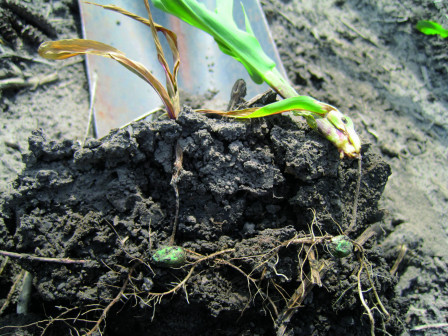
Many pathogens cause corn seed decay and seedling blight. The first symptom may be an area of the field with poor or no stand.
Decayed seeds are very soft and may be covered with fuzzy fungal growth; seeds can be difficult to find if badly rotted.
Postemergence damping off appears as yellowing and wilting; seedlings soon collapse leaving only dead leaves above the soil. Nodal roots may show the same decay symptoms as seminal roots and the mesocotyl. If the nodal root system escapes decay, the plant will survive; it may be stunted or recover fully.
Favored by cool, wet soils, these diseases are more common in low-lying or poorly drained areas or in fields planted too early in spring. Ask local Extension for more information.
@alisonrISU@cropdoc08@alabamaED@ppp_trey@travisfaske@DTelenko@MandyBish1@tjcksn@MPlumblee@dsmuelle@YuanZeng3@baldpathologist@bobkemerait@badgercropdoc@MartinChilvers1@maddishires@NationalCorn@kscorn@MississippiCorn
#plant26 #corn #agx #seeds #farming
On tap at noon for today's Garden Hour with MU Extension: selecting bedding plants, direct seeding flowers and more! Please join the University of Missouri for up to date horticulture info. https://t.co/3SQnV7Zh8J #2xAg2030@cafnr@MUExtAgEnviron@MUExtension









![CropNetwork's tweet photo. "...every [seed treatment] product has limitations and may not always work as intended. Conversely, a user may expect a product to work in a manner it was not designed for. In this publication, we answer some common questions that emerge when soybean plants do not."
From "Seed Treatments: Questions that Emerge When Plants Don’t" at https://t.co/qwp8zqex7a by @cropdoc08 @dsmuelle @cropdisease @MartinChilvers1 @DylanMangel @badgercropdoc @AlbertTenuta @baldpathologist @MandyBish1 @MahDuffeck @travisfaske @maddishires @alabamaED @DTelenko @BisonBeanDoc +more
@TheSCNCoalition @OntarioSoilCrop @ISUExtension @UKAgriculture #USSoy](https://pbs.twimg.com/media/HFi6rf5X0AATqlN.jpg)


