I’m thrilled to share one of the studies from my PhD, which has just been published in @PNASNews 🤗
“Mitochondrial remodeling in skeletal muscle underlies exercise-induced reversal of age-associated functional decline in mice and humans”
🔗👇🏼
https://t.co/k97dhmKfhf
Controlled sleep restriction studies consistently show the same pattern: restrict healthy adults to 4-6 hours a night, and within a week, cortisol, glucose tolerance, insulin sensitivity, muscle protein synthesis, appetite hormones, and testosterone all move in the wrong direction. No single marker tells the story. The tax is cumulative.
Leproult & Van Cauter, JAMA, 2011; Buxton et al., Diabetes, 2010; Spiegel et al., Lancet, 1999; Saner et al., J Physiol, 2020; Zuraikat et al., Diabetes Care, 2024
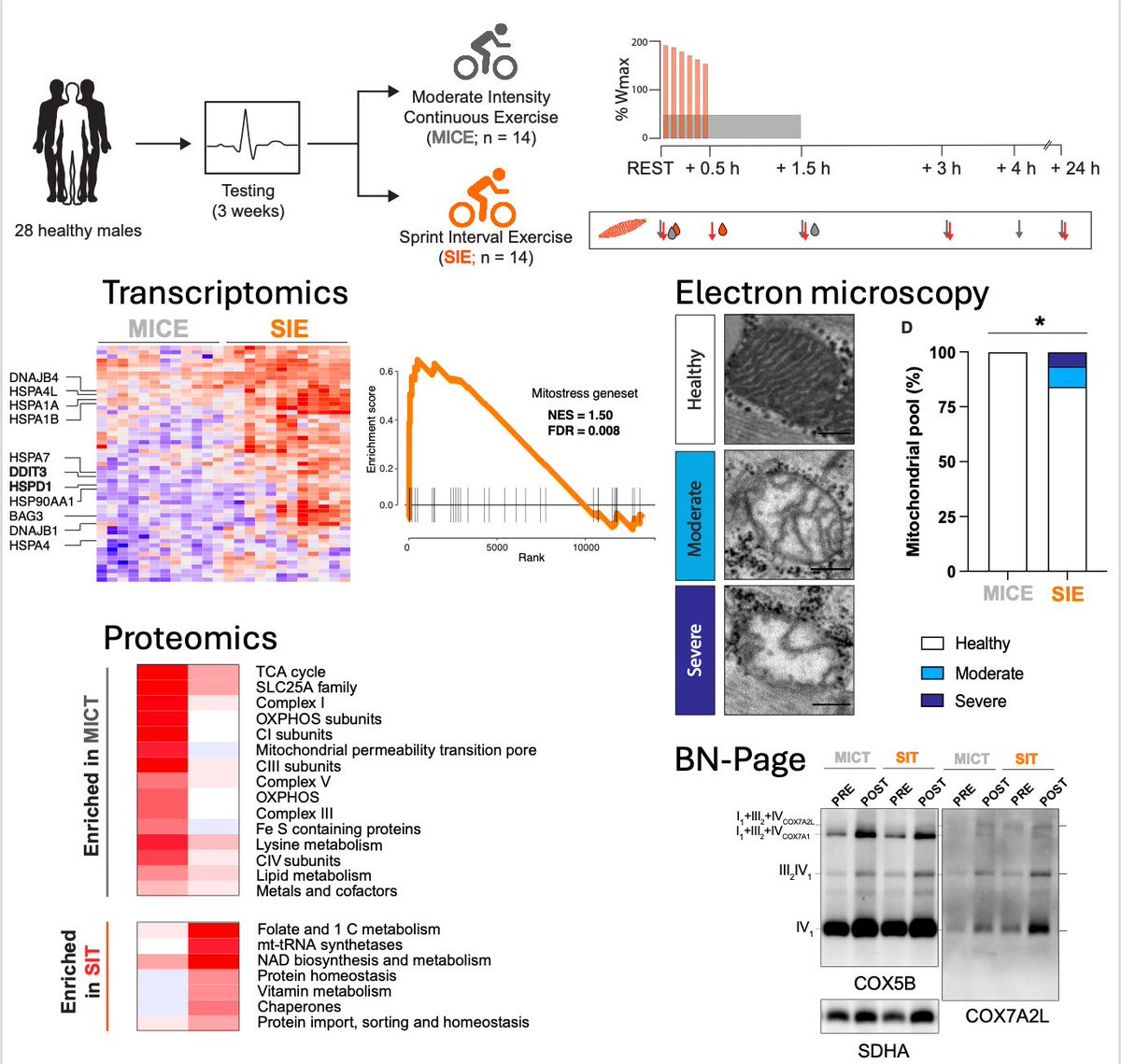
Our latest work in @natureComms, led by @javi_iup: Sprint exercise disrupts mitochondrial ultrastructure, driving a unique mito stress response & remodelling in men https://t.co/vfhUZgejMs supports targeted exercise prescriptions to achieve specific mito adaptations.
Thread 🧵👇🏽
Exercise Intensity Terminology is a bit of a mess 😵💫
Our attempt to try & summarise some of the different approaches, and make some recommendations going forward, has finally been published in both MSSE: https://t.co/iHdsdK4Mhx & JSaMS: https://t.co/ONLEM5g8U8.
Excited to share our latest pre-print: https://t.co/9mxteYPW5h
“Exercise induces time-dependent but not sex-specific transcriptomic changes in healthy human skeletal muscle”
Led by @DaleFTaylor with @LizReisman, @bluebirdi, @Romain_Barres, @NolanJHoffman & @JohnAHawley
🧵 1/9
🚨📰Our paper: "Delaying post-exercise carbohydrate intake impairs next-day exercise capacity but not muscle glycogen or molecular responses" is now available:
https://t.co/7Womi6c8AB
Huge thanks & congrats to @JavierDiazLara1@LizReisman@javi_iup@LouiseMBurke@BlueSpotScience
This is the 2nd paper from my PhD, and came with an award for the best article published in the July special edition of @PhysiologicalG: Integrative physiology & translational omics of exercise & physical activity 🏅
A big thanks to all authors involved. Check it out below!
It’s been an incredible few weeks visiting @INSEP_PARIS (as part of the PHC FASIC program) to see the high-quality research being conducted prior to the Olympics. Thanks to @Mathil_Poignard and everyone that made it such a great experience @iHealthSportVU
How fat hidden inside our muscles is ‘critical’ to health outcomes
https://t.co/zba2BDVJB7
Over the moon 😃 to read our recent multi-continent manuscript being highlighted in the Sydney Morning Herald @smh@theage by @sarzberry! 🗞️
Thanks @DavidScottPhD for your expertise and support.
Big kudos to Julia Timms!
@flowersmarcelo@KopinkeLab@F_Helmbacher@GordonSLynch
Access our latest review on delineating aging & physical activity-related changes in mitochondrial characteristics:
🔗https://t.co/m1j4Z5VCJu
This was a great collaborative effort with @NickSaner Alessandra Ferri @Esther_GD_@JamesRBroatch@BlueSpotScience
Age-related changes in human skeletal muscle transcriptome and proteome are more affected by chronic inflammation and physical inactivity than primary aging
https://t.co/oupchrvOoL
Night matches at the Australian Open are a great spectacle 🎾 but sleep disruption is likely to wreak havoc even on professional athletes, writes @NickSaner (@victoriauninews) + @LivKnowles1 (@Deakin).
https://t.co/iARuRUhREX
As little as 1 percent reduction in deep #sleep per year for people over 60 years of age translates into a 27 percent increased risk of #dementia, according to a study published today in JAMA Neurology. https://t.co/zEFNfxwZ2p


![M_Stamatakis's tweet photo. BIG day for @ProPASSconsort, 1st study out in Eur Heart J , modelling replacement FX of #PhysicalActivity/#Sleep/sitting/standing on cardiometabolic risk. Replacing [anything] with 4-5 mins of MVPA ➡️ gr8 promise. 🙏👋 to amazing #EMCRs @blodgettjm @Matthew_Ahmadi_ @AJAtkin https://t.co/KAyZtgo6ab](https://pbs.twimg.com/media/F-igueja4AADCQQ.png)






![M_Stamatakis's tweet photo. BIG day for @ProPASSconsort, 1st study out in Eur Heart J , modelling replacement FX of #PhysicalActivity/#Sleep/sitting/standing on cardiometabolic risk. Replacing [anything] with 4-5 mins of MVPA ➡️ gr8 promise. 🙏👋 to amazing #EMCRs @blodgettjm @Matthew_Ahmadi_ @AJAtkin https://t.co/KAyZtgo6ab](https://pbs.twimg.com/media/F-ih5liaUAA3PL4.png)


