@EmiratesSupport@emirates travelling in <24 hrs — emirates charged card twice in error and telling me it’ll take 7-14 days to fix. I’ll be back by then thanks avoid emirates holidays lol
Founders cannot outsource recruiting.
“Recruiting is the most important thing because you need creativity; you need motivated people. Ideally, the early people are all geniuses. They’re self-managing, low-ego, hardworking, highly competent, builders, technical—maybe one or two sellers—but you can’t watch everything. You can’t micromanage everything.
The early people are the DNA of the company. When you outsource recruiting, when you have other people hiring and interviewing and making hiring decisions without your direct involvement and veto, that’s a sad day. That’s the day that the company’s no longer being driven directly by you.
There’s now a fly-by-wire element in between. There’s some mechanical linkage going through another human, often at a distance. And other people are not going to have the same level of selectivity that you will as a founder.
The important size at which a company starts changing is not some arbitrary number, like 20 or 30 or 40. It’s the point at which the founder is not directly recruiting and managing everyone. The moment that there are middle layers of management, then you are somewhat disconnected from the company, and your ability to directly drive a product team that can take the company from zero to one goes away.
So we really cannot outsource recruiting. People think you can. They hire recruiters, for example. Maybe you can outsource a little bit of sourcing, but I would even argue that’s difficult. The reason recruiting is so, so, so important—and a lot of it is obvious, I’ll skip the obvious reasons—but one non-obvious reason is that the best people truly only want to work with the best people.
Working with anyone who’s not at their level is a cognitive load upon them. And the more people they’re surrounded by who are not as good as they are, the more keenly they’re aware that they belong somewhere else, or they should be doing their own thing.
The best teams are mutually motivated. They reinforce each other. Everyone’s trying to impress each other.
One good test is when you’re recruiting a new person, you should be able to say to them, “Walk into that room where the rest of the team is sitting. Take anyone you want—pick them at random—pull them aside for 30 minutes, and interview them. And if you aren’t impressed by them, don’t join.”
When you do that test, you will instinctively flinch at the idea of them interviewing randomly a certain person that’s kind of in the back of your mind. That’s the person you need to let go. Because that’s the person keeping you from having this high-functioning team that all wants to impress each other.”
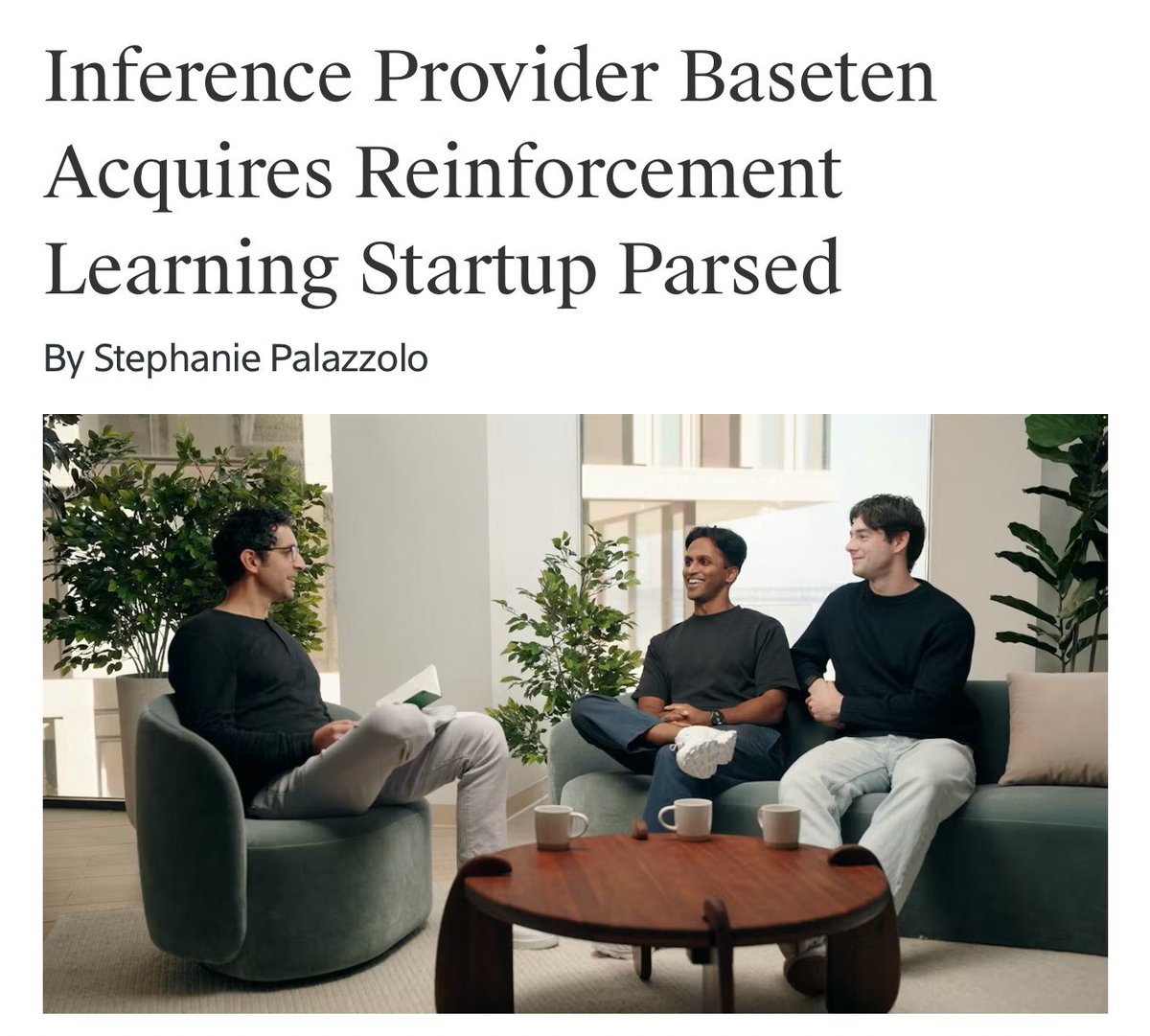
Always a monumental moment when your portco gets acquired by one of the best players in the world 🔥
With Parsed as part of Baseten, they are now a full-stack model-customization + inference platform
Incredibly proud of you guys, what a ride! Excited to be a part of the Baseten family. Full steam ahead 🚀
@mudithj@oneill_c
cc: @svennj@steph_palazzolo@parsedlabs@baseten
🚨How does an AI-native startup unseat an incumbent?🚨
👇Enter the Greenfield Strategy: AI-native startup bingo.
The battle between every startup and incumbent comes down to whether the startup gets distribution before the incumbent gets innovation. One of the most powerful, and underrated, ways for startups to win distribution is to serve companies at their formation: greenfield companies.
@stripe@deel@mercury@cartainc@brexHQ@tryramp have all done this at scale.
Why does this work?
Simply put, acquiring customers de novo is easier than getting customers to switch:
- Many of the large software incumbents have hostages, not customers. Their customers would love to switch, but ripping and replacing existing software is risky and expensive. New companies don’t face those switching costs; they simply look for the best solution and evaluate based on merit.
- New companies don’t need as many features to have a complete solution.
- New companies have fewer stakeholders. You only have to convince the founders.
Grow with your customers:
If you attract all of the new companies at formation and grow with them, you will become a big company as your customers become big companies. Consider @stripe: many of Stripe’s customers did not yet exist when Stripe was founded. Some of those early customers later became large businesses in their own right. So when enterprises outside of Silicon Valley also needed to prepare themselves for a shift to ecommerce models, Stripe was an obvious choice, with plenty of relevant reference customers already in place.
Incumbents, on the other hand, would much rather sell to existing businesses vs. companies that don’t exist now but might exist in huge numbers in a few years. They are bound by the rules of P&L (Profit & Loss) – and there’s no “P” for greenfield companies that don’t exist yet, just “L” (in sales, marketing, and product development costs). The startup, however, isn’t bound to a financial model – the startup doesn’t need one; it's still figuring stuff out! That leaves ample room for the startup to define the category.
Graduation moments:
In a similar way, software “graduation moments” (the moments when a startup begins to develop enterprise needs) also create opportunities to execute this greenfield strategy. QuickBooks may be great for single-product, single-entity companies, but once businesses add multiple subsidiaries, currencies, or more complex reporting needs, they outgrow it and require the controls, integrations, and scalability of an ERP like NetSuite. And you can now build a far better ERP with AI - just look at @RilletHQ.
AI-native startup Bingo:
There are many different categories of enterprise software. Enough to fill a 5x5 Bingo board and more!
In each category of the Bingo board, there sits an incumbent that could be dethroned by an AI-native alternative.
So, how does a new company win the game of Bingo?
- Pick a square
- Make a narrow wedge much better
- Find a constant source of new customers
- Rapidly iterate and add features to grow with your customers
- Don’t be constrained by the division of existing categories
If you’re building a category-defining company on the Bingo board - come and talk to us.
cc: @arampell@astrange@a16z
@curveimagine been using curve for past 6 years! referred 20+ people. I’m on premium - my card literally stopped working whilst abroad SF and nonchalant customer service is 2 days wait! Painfully bad cx.
@ShaanVP https://t.co/eH6PhVMWA3 can we send you some rockstars guitar 🎸— we help AI startups make 10x hires mostly former founders — just placed: Replit’s Director of Product Engineering, Vapi’s first Product hire, Wordware’s Founding Engineer!
Main problem is every founder wants to hire level 5 talent and give them .3% in the company..
My #1 advice is to always give WAY more equity when you find these people.
No one has regretted it so far!
10 years ago today, I published my big post on AI. It has aged quite well if I may say so myself. Of the many 2015 predictions I cited in the post about the rate of AI progress ahead, it seems that the most bullish are the ones who had it right.