Sheila Taormina missed the Olympic trials at 22 and walked away from swimming. Four years later she was on the podium. Then she went back for three more Olympics in two more sports. Nobody in history has done that. She didn't find more discipline; she figured out where to focus.
Kim Bowes is an archaeologist at Penn who thinks we've barely scratched the surface of what Rome can teach us about ancient economies.
Most of the Roman economy consisted of family farms, yet only about a dozen have been excavated. Thousands of papyri remain unanalyzed. A belt of factories in the Tiber Valley—Rome's equivalent of Pittsburgh—went undiscovered until twenty years ago, when archaeologists realized the bricks that built Rome couldn't have been produced within the city itself.
The more we uncover, the more puzzles emerge: why did Romans keep trusting currency the empire was steadily debasing? Why was population declining by the second century? And might these two things be the key drivers behind Rome’s decline?
@tylercowen and Kim discuss all this and more, including:
· 00:00:00 – What Roman housing was like
· 00:08:55 – Life for early Roman Christians
· 00:17:47 - Roman economic thought
· 00:31:25 - The economics of Roman slavery
· 00:34:56 – Did shopping hold the empire together?
· 00:42:56 - The Romans as masters of scale
· 00:48:13 – Why she’s not a fan of the Vesuvius Challenge
· 01:03:03 – Best sites outside of Rome for touring the Roman Empire
Watch the full episode here or check out the links in the next post.
https://t.co/ATxv6bocm3
First SONIC, now Kimodo. Great research needs great data. And the @NVIDIA team keeps proving what's possible when you have both.
Proud that our motion data is helping push the boundaries of what's possible.
→https://t.co/MxjbvIIDyL
→https://t.co/osQDtA9kPA
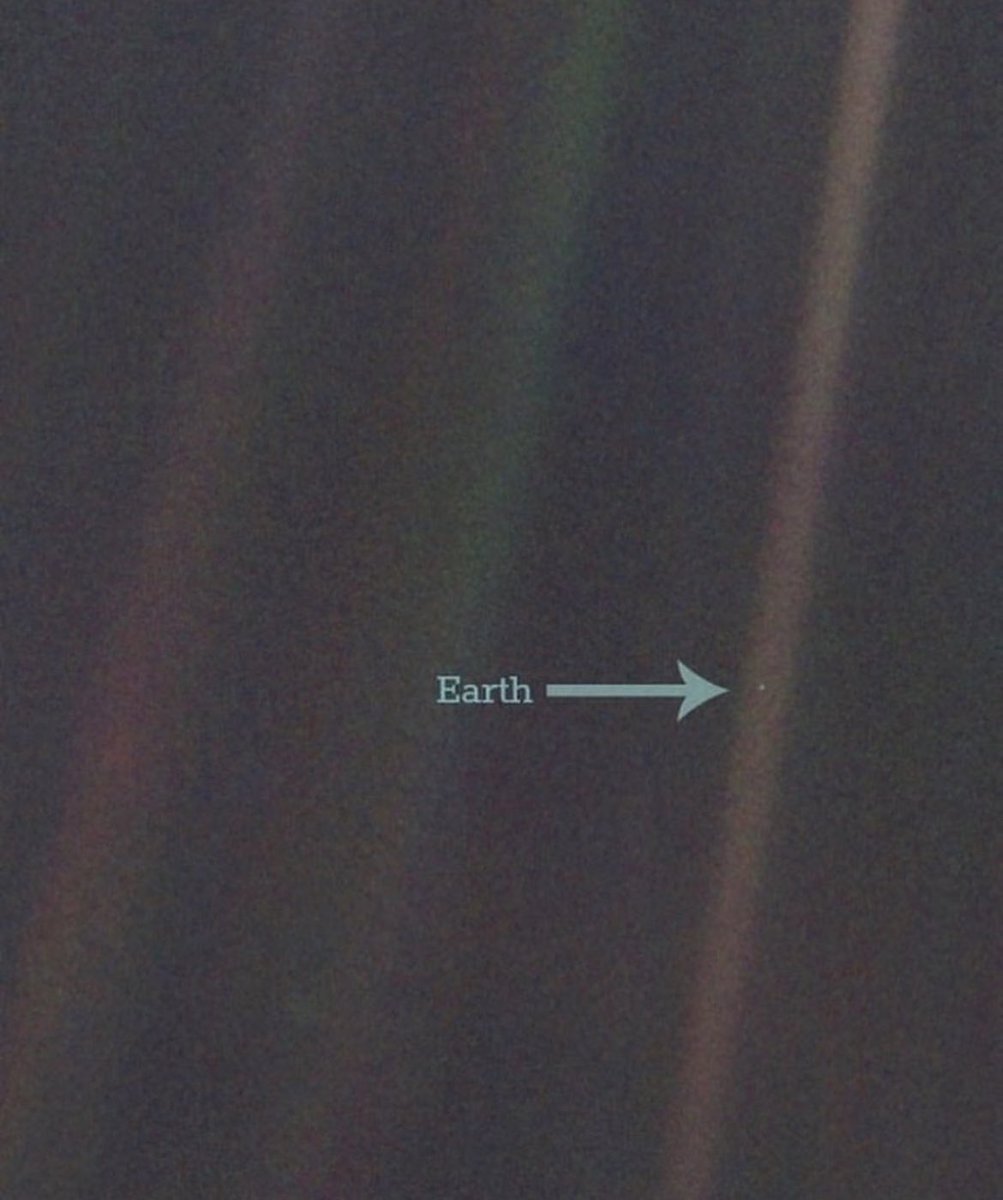
Pale Blue Dot is a photo of Earth that was taken by the Voyager 1 space probe in 1990 from a distance of about 6 billion kilometers (3.7 billion miles) as it was leaving our solar system. This is what Carl Sagan said about the photo:
"Look again at that dot. That's here. That's home. That's us. On it, everyone you love, everyone you know, everyone you ever heard of, every human being who ever was, lived out their lives. The aggregate of our joy and suffering, thousands of confident religions, ideologies, and economic doctrines, every hunter and forager, every hero and coward, every creator and destroyer of civilization, every king and peasant, every young couple in love, every mother and father, hopeful child, inventor, and explorer, every teacher of morals, every corrupt politician, every 'superstar,' every 'supreme leader,' every saint and sinner in the history of our species lived there — on a mote of dust suspended in a sunbeam.
The Earth is the only world known so far to harbor life. There is nowhere else, at least in the near future, to which our species could migrate. Visit, yes. Settle, not yet. Like it or not, for the moment the Earth is where we make our stand. It has been said that astronomy is a humbling and character-building experience. There is perhaps no better demonstration of the folly of human conceits than this distant image of our tiny world. To me, it underscores our responsibility to deal more kindly with one another, and to preserve and cherish the pale blue dot, the only home we've ever known.”
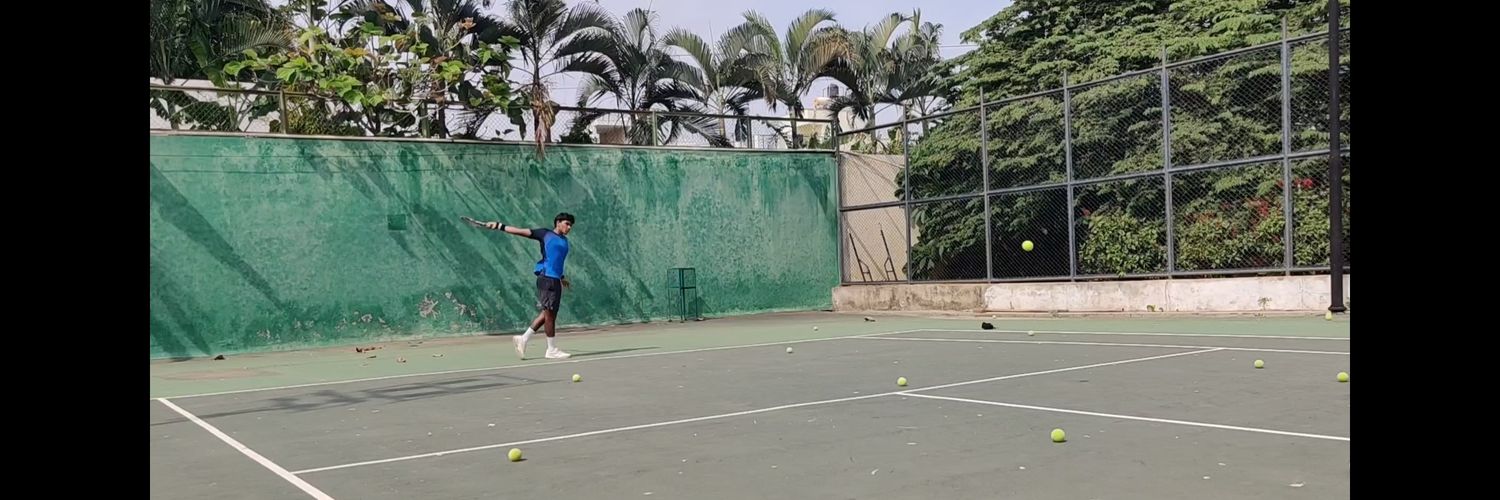
Researchers trained a humanoid robot to play tennis using only 5 hours of motion capture data
The robot can now sustain multi-shot rallies with human players, hitting balls traveling >15 m/s with a ~90% success rate
AlphaGo for every sport is coming
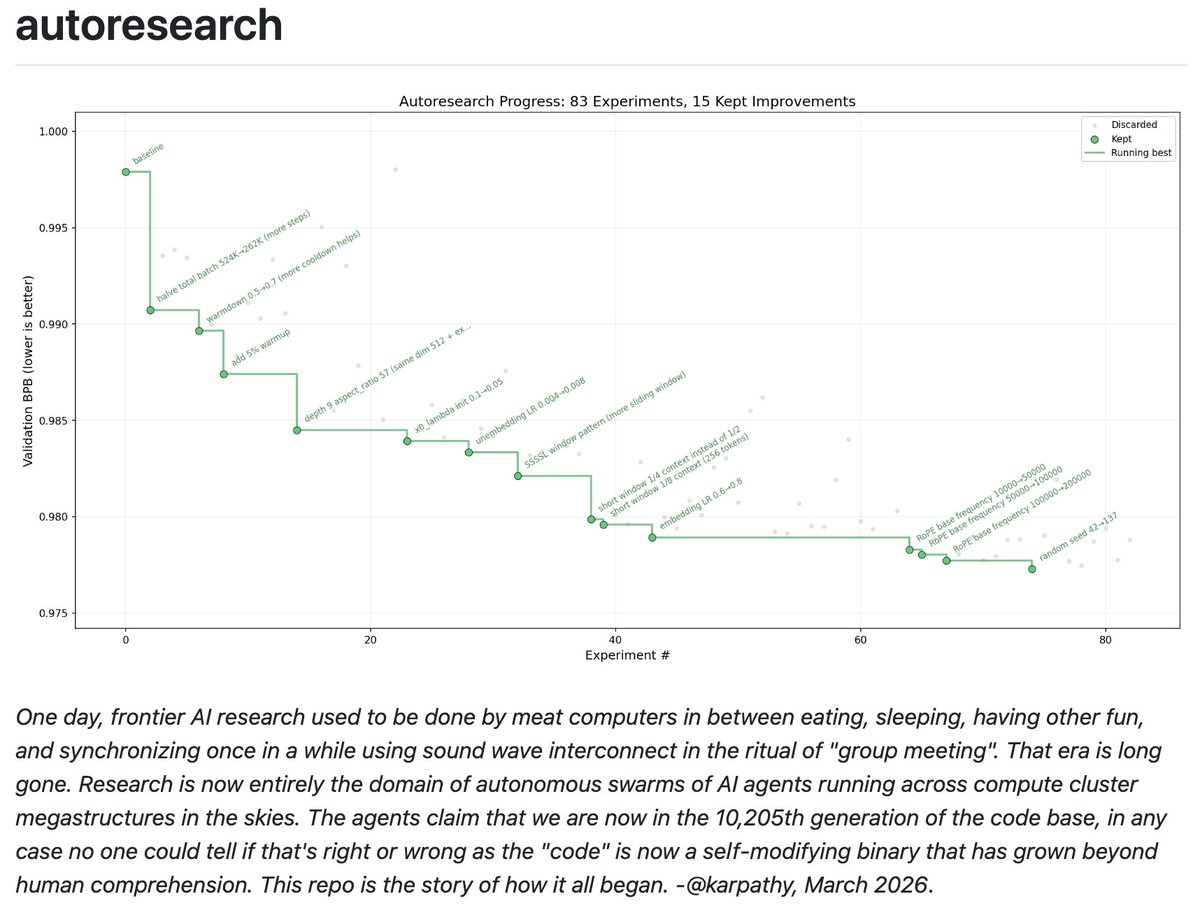
I packaged up the "autoresearch" project into a new self-contained minimal repo if people would like to play over the weekend. It's basically nanochat LLM training core stripped down to a single-GPU, one file version of ~630 lines of code, then:
- the human iterates on the prompt (.md)
- the AI agent iterates on the training code (.py)
The goal is to engineer your agents to make the fastest research progress indefinitely and without any of your own involvement. In the image, every dot is a complete LLM training run that lasts exactly 5 minutes. The agent works in an autonomous loop on a git feature branch and accumulates git commits to the training script as it finds better settings (of lower validation loss by the end) of the neural network architecture, the optimizer, all the hyperparameters, etc. You can imagine comparing the research progress of different prompts, different agents, etc.
https://t.co/YCvOwwjOzF
Part code, part sci-fi, and a pinch of psychosis :)
Replit CEO Amjad Masad: Being 'terminally online' may be an advantage.
"If you want to work on a skill, it's going to be about idea generation."
"Because the cost of implementation of those ideas is going down rapidly. It's gonna go to zero at some point."
"So the bottleneck becomes, 'how fast can you generate ideas?'"
"Just looking around you in the world and seeing what's happening. What are the trends? Are you plugged in on social media?"
"A lot of the vices that older generations think are vices, might actually become advantages. So if you're a brainrotted, terminally online person, that might be an advantage because you know what's happening in the world."
"If you're someone who's ADHD, really interested in novelty... that's actually an advantage because AI really benefits people who can try a lot of things really quickly."
@amasad with @jackneel
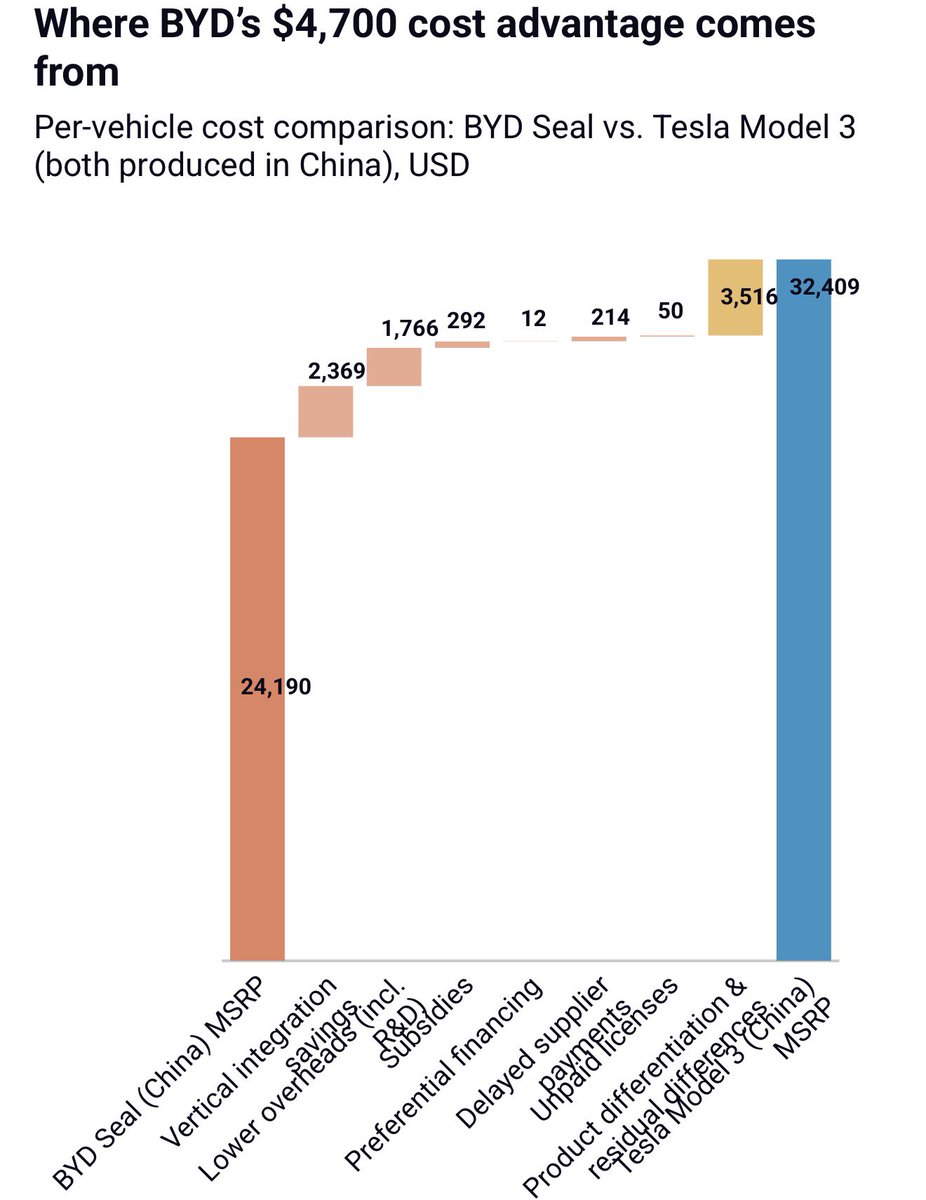
We’re often asked: Why are Chinese EVs so cheap? Comparing costs between Western and Chinese automakers in China shows that subsidies matter, but they’re only part of the story:
https://t.co/wOu8azqBmS
BYD and Tesla both make EVs in China. Yet BYD has significantly lower costs.
Two major factors:
1) Vertical integration is very high for BYD
2) Doing R&D in China is far cheaper
State subsidies are a small part. It’s more a structural advantage. Fascinating report from Rhodium.
From the makers of the popular AlphaGo documentary, The Thinking Game gives a much broader picture of the story of DeepMind and our mission to build AGI, drawing on interviews with myself and others going back many years.
You can now freely watch it here: https://t.co/hCIicyWbLi