Chain-of-thought transformed AI reasoning, but it is limited to words.
What's the physical-world analogue?
Introducing Ψ-0.6, one model that reasons in *streams of thought*: words, depth, motion, camera pose, and imagined scenes. And it learns when to use which! 🧵
One major challenge for agentic robotics is its latency. By treating robotics as an orchestration problem between generalist VLMs and specialist DSLs or policies, Waddle’s approach seems capable of interpolating at arbitrary points along the Pareto frontier of generalisation vs latency.
had fun helping out with the PSIBorg demo at CoRL, led by @AtlasKazemian , @KlemenKotar , @wenlong_huang and @ieva_bagd ! 🤖
PSIBorg brings next-token prediction to robotics. A single model can be used for various robotics capabilities (policy, simulation, progress tracking, etc.) simply by changing how we prompt it.
Last week at CoRL, we ran a two-day live demo of our new robot model!
We brought the robot and a bunch of objects, people in the audience brought some of their own and helped decide what the robot should do.
Here is how it went:
Last week at CoRL, we ran a two-day live demo of our new robot model!
We brought the robot and a bunch of objects, people in the audience brought some of their own and helped decide what the robot should do.
Here is how it went:
@randall_balestr@KerdaVaraku@ylecun really like correcting for unseen disturbances. could you not provide this as context to a world model instead, at train and test time? like an LLM updating its counterfactual prediction when a user provides an additional detail. what motivates post-hoc correction?
Tired of pick-and-place benchmarks?
Want to explore manipulation tasks of different difficulty levels?
Introducing ManiLadder 🪜, a simulation manipulation benchmark that organizes 112 simulated tasks into 4 calibrated difficulty levels × 8 suites. 🧵
https://t.co/NfBierkYK3
That’s why we evaluate robots at scale, in the wild, with @RoboColosseum. Physics just can't go wrong.
We’re giving away 10,000 hours of free real-world robot evaluation. Sign up now: https://t.co/jTMBDN8bAR
Scaling in almost every domain is bottlenecked by data. That makes data efficiency the most important algorithmic problem in AI.
I'm thrilled to share *universal* data-efficient algorithms with massive gains, up to 56x data efficiency for molecules, 24x for DNA, and 24x for crystals against SOTA autoregressive recipes.
After fine-tuning, we beat models pretrained on hundreds of times more data.
I believe this will fundamentally change our approach to data-constrained scaling across all domains.
w/ @asatheesh6561, @bishmdl76, @madhavsinghal_, @akshayvegesna
really interesting work! it's nice to see other approaches toward data efficiency that operate at a different "level of abstraction" from our work
as a reader, one thing i'd find super useful in these blog posts is a summary table comparing the full method against tuned repetition, tuned single pass, and the individual ablations, at a fixed unique-data budget. it'd be especially helpful to see validation loss, data multipliers (relative to tuned single pass), number of training epochs, and total training/inference FLOPs (normalized to the full method). i think the careful comparisons you've already run make this kind of analysis particularly interesting!
one question i'm especially curious about is how much of the gain over tuned repetition persists at matched training FLOPs -- e.g., if the conventional baseline could use that compute to train for more epochs or increase model capacity, without looping or distillation. i realize this is a different question from data efficiency itself, but i'd be really interested in understanding the tradeoff
in any case, really exciting work, and i think you're pushing the frontier in an important direction :)
Scaling in almost every domain is bottlenecked by data. That makes data efficiency the most important algorithmic problem in AI.
I'm thrilled to share *universal* data-efficient algorithms with massive gains, up to 56x data efficiency for molecules, 24x for DNA, and 24x for crystals against SOTA autoregressive recipes.
After fine-tuning, we beat models pretrained on hundreds of times more data.
I believe this will fundamentally change our approach to data-constrained scaling across all domains.
w/ @asatheesh6561, @bishmdl76, @madhavsinghal_, @akshayvegesna
We’re releasing all 57 intermediate checkpoints from Marin “Mochi” 535B-A23B pretraining, including 10 from long-context extension. 18.2T tokens, about 61 TB of weights.
https://t.co/MmfZeQdB1V
Blog: https://t.co/kNCJ6PoNW5
Introducing Second, and a $10M seed led by @a16z.
Second builds a model of you that you own, and your agents can use as an API.
Truly personal software needs a deep understanding of you: not just your emails and messages, but how you work, what motivates you, your people, priorities, style, goals, and intent.
This requires a new kind of personal AI infrastructure. One that continuously aggregates your context, distills it into durable understanding with a ton of compute, and then serves it securely, ubiquitously, and up-to-the-minute. One that builds your *portable user model*.
Second is that infrastructure. It installs seamlessly on your Mac, and your context just comes out. Live APIs of your priorities, to-dos, wikis, writing samples, preferences. Or what you did minutes ago. Or context packs of anything, dynamically assembled in seconds.
Second is streaming-state from local to a private cloud, which means anything you connect to--whether Claude, Dot, Muse, Grok Bot, Instinct, or iMessage--shares the same, growing, continuous understanding of you.
Your portable user model is as powerful as it is sensitive. We founded @FirstPersonLabs on the principle that it should belong to you. This commitment means taking on hard systems and security problems and making sovereignty an invariant of Second from the beginning.
We've barely scratched the surface of what portable user models can unlock. Deep understanding of us, served at machine speeds, could drive the next leap in personal software, human-computer interaction, large-scale coordination of humans and agents, and more!
We're tremendously grateful to be supported by @a16z (@martin_casado, @YODELAGARZA), Mozilla Ventures, @JeffDean, Ram Shriram, Jeetu Patel (@jpatel41), @percyliang, J. Alex Halderman (@jhalderm), @sanmikoyejo, and many others.
Our vision is for a future where every person is more powerful, because they have the ultimate affordance: personal computers that fully understands them on their own terms.
If this excites you, we're hiring and come build with us!
Through my wonderful time at NVIDIA and Stanford, one question has kept me up at night:
Should the future of AI be monolithic or plural?
To answer this question, we’ve raised $110M to get started, backed by @MenloVentures, @MadronaVentures, @NVIDIA, @NEA, @KindredVentures,@Wing_VC, @aixventureshq, @Principal_VC, @Cisco, @Snowflake, among others.
Today, Carlos (@guestrin) and I are stoked to launch Noeri, a neolab to push the frontier of plural intelligence.
Noeri means “the plural of intelligence” or many intelligences.
The future of AI we root for is plural: a healthy ecosystem of many intelligences, in all sizes, strengths, and quirks.
Discovery, in particular, has always been plural: many curious minds, each devoted to their own question, often on roads less traveled.
Our path there is self-improving AI that:
-> learns continually on the job, closing the gap between what AI can do off the shelf and what the dynamic world demands
-> learns to use other AIs as tools and make new tools to overcome its own limitations
-> picks the right-sized model for your problem, at a fraction of the frontier cost
Then the power of intelligence, from the craftsmanship of making AI to ownership, can be in the hands of all.
@noeri_ai mission reflects who we are as the founding team. My career has been anything but linear, literally continual learning on the job. Carlos has devoted his career to building tools that empower people through AI.
We are all a bit contrarian, a bit adventurous, and above all, big believers in pluralism.
Join us to build this future together: https://t.co/oAAoe0lzEH
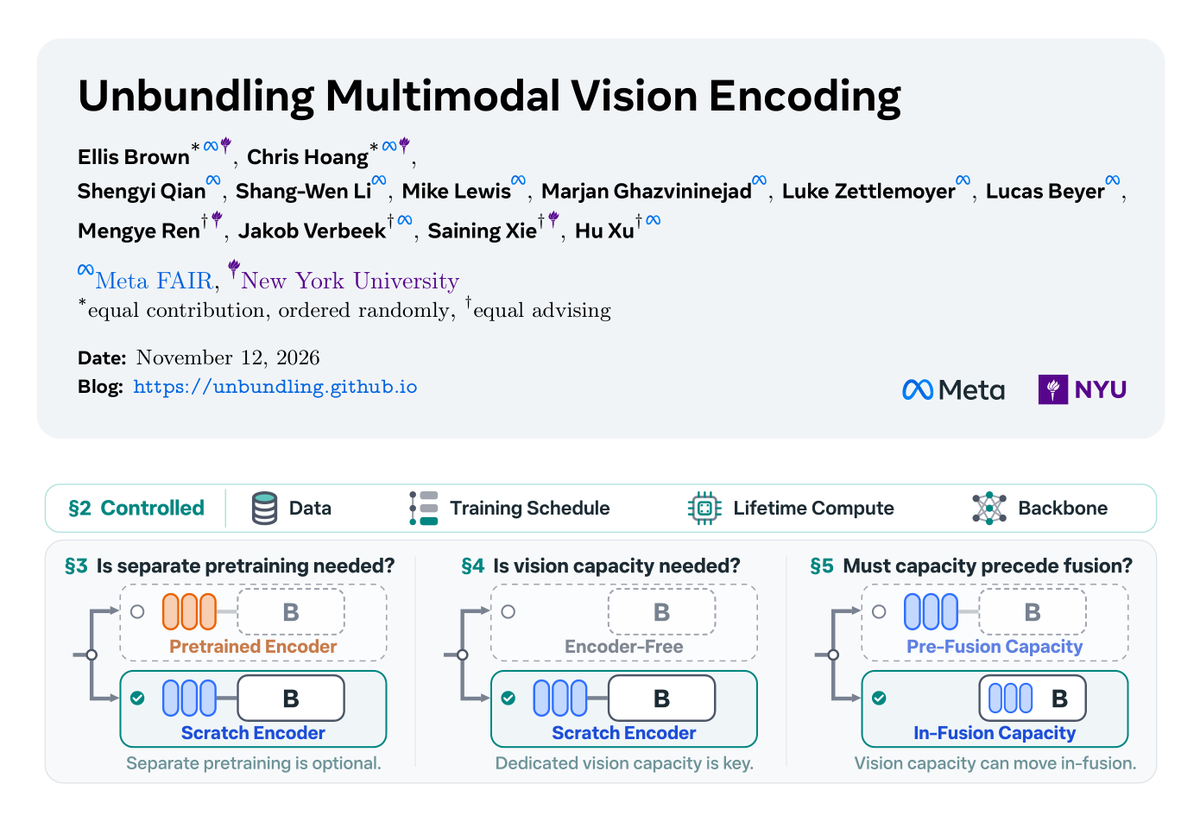
how should multimodal models encode visual input?
→ pretrained encoder?
→ encoder-free?
→ before the LLM?
published models bundle these choices together. we trained 200+ models from scratch to see which of these choices matters
only one of them does
🧵 [1/n]
Labs disagree on vision encoders for MLLMs! ⚔️
Gemma 4 12B scrapped the encoder.
Kimi K3 dropped encoder pretraining.
Inkling 2 Small revived the encoder Inkling killed.
We trained 200+ models in a controlled study to settle it:
✅ Keep vision parameters, skip the pretraining. And they don't have to be an encoder! 🤔
Paper: https://t.co/e8JRIfPU2m 🧵
Really enjoyed this, and totally agree that sample efficiency is one of the biggest gaps between AIs and humans. One framing I've found helpful is to split it into two parts. The first is learning broadly useful knowledge from limited experience, which "data to reach a given loss" captures pretty well. The second is using that knowledge on new tasks without any task-specific training. Kids seem to manage both, and current models only get partway on each. I wrote about this in the first post of a short series, in case it's of interest: https://t.co/0QnUpJ9k3D
The rest of the series is about our recent work on it. We trained a Zero-shot World Model (ZWM) on just one child's experience, and it gets pretty close to state-of-the-art on a range of tasks, zero-shot. The last post touches on something close to your argument: evolution as a hint that the priors behind data-efficient learning could themselves be found by search. The nanoGPT speedrun feels like an early, human-run version of that.
Never would have thought that we would have this community formed around @RoboPapers when @chris_j_paxton & I first started the pod.
Awesome to have @DJiafei@ruijie_sg joined this journey too!