What I started as a "6-month side project" took 5+ years to complete, and the work is finally out in @MolecularCell! It's about molecular chaperones and stress-triggered adaptive protein clusters. Please check it out! https://t.co/MMlruHs0MX
See this? This = implanting mouse embryo. Usually this happens inside its mother and is invisible to us, but we can actually watch implantation ex vivo with the hope of understanding why implantation goes awry in embryos of older women. A 🧵...
Very excited to share our new work on gastruloids by the incredible @ugcgccacc! We mapped gene expression across 26 individual gastruloids at single-cell resolution and discovered some pretty amazing patterns about how these "mini-embryos" organize themselves.
My first first-author paper is out! It was an amazing collaborative effort with a lot of amazing people including @ArvindSPillai1 and @JoeThorntonLab. Please read if you like things involving evolution and biochemistry.
https://t.co/DqmKCuIjED
Great article (in which I am quoted) about biomolecular condensates—in my field of cellular stress responses, “the revolution we have been waiting for.” Many thanks to author Philip Ball for going deep.
https://t.co/9ydwwUzKxW
The Proteostasis Group at UNCC are excited to announce the Rising Stars in Proteostasis seminar series! This is open to postdoctoral researchers in the US. We have funds to pay for travel costs. If you are interested, please complete the google form here: https://t.co/EIl22NePUc
@arnaud_kr and I have been talking about organizing a single-molecule genomics meeting for years! We're excited to do so at @embl while bridging the fields of single-molecule genomics and microscopy with our co-organizers. Hope to see you there July 15-18 https://t.co/wlmCEQXiLh
Our perspective on Hsp90 as a global modifier of the genotype-phenotype-fitness map and its implications for evolution in nature and the clinic is now out in JMB! We review the literature, identify open questions, and share new analyses. https://t.co/8HFJzi2Xho
Excited to share my first paper as a postdoc with @KaHochberg@mpi_marburg! We've made some fascinating discoveries about the evolution of animal stem cells in colab with @jauchr and @deMendoza_Alex. 🧬🔬
Link: https://t.co/YPMo9Pjfmr
(1/n)
New paper in @ScienceAdvances: We've uncovered the nuclear speckle transcriptome, revealing gene groups with distinct speckle localization properties and that speckles boost splicing for localized transcripts. Thanks to all co-authors! @regevlab https://t.co/bgYKtTQRsT
(1/n) Are you ready to plunge into depths of our oceans with us! This is the story of “hidden comet tails” & our discovery of how a crucial biological process across our planet can put brakes on carbon capture in our oceans. Latest in @ScienceMagazine https://t.co/ch4f2g0MS4
Excited to share a new preprint!
(1)🔬The nucleolus is the most prominent nuclear condensate, with a fascinating multilayered liquid-like structure, and is the site of ribosome biogenesis. But how does this multiphase architecture form and function?
https://t.co/xKP9tGFFlQ
Our paper was published in @Nature. We discovered a new aspect of the meiotic homolog pairing process named Rapid Homolog Juxtaposition (RHJ). During RHJ, homologous loci undergo spatial juxtaposition from far apart to very close together in a short time.
https://t.co/AvWJb113Ob
Nominations for the 2025 Weintraub Award are now open! Celebrate the achievements of an outstanding graduate student in biology by nominating them here: https://t.co/IrUdWPFWLf
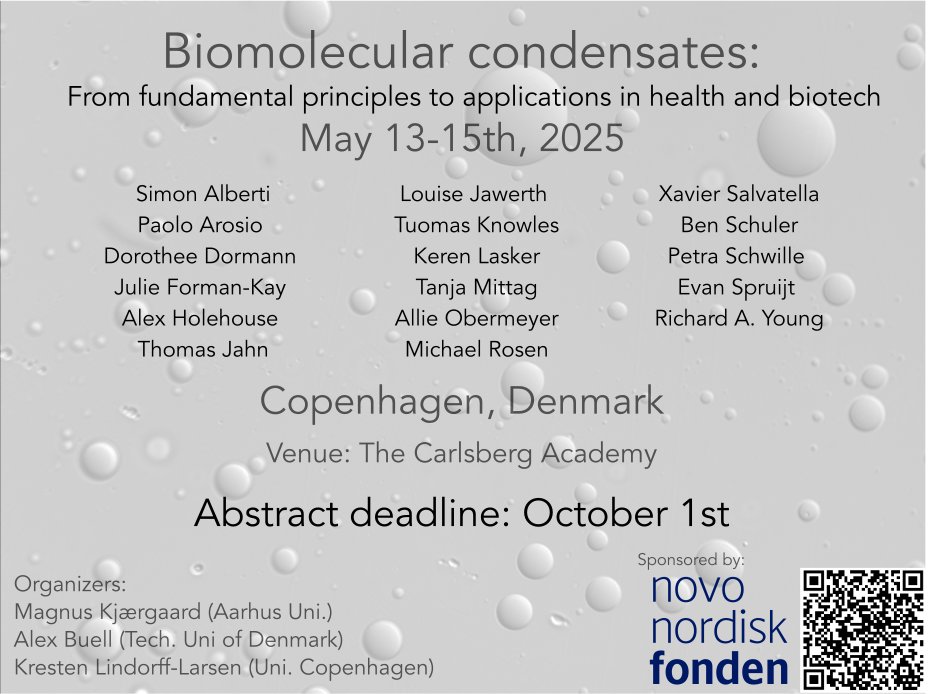
The abstract submission deadline of our conference on biomolecular condensates is approaching fast!
Sign-up before Oct. 1st to be considered for a short talk and secure one of the limited seats!
https://t.co/wSFuXBaBNF
Lab evolution experiment leads to discovery of Arg-to-His mutation that is essential for adapting in pH fluctuating environments.
https://t.co/MyYN50y0XU
Goes straight to the top of the "to read" pile–
MAYEX is an old long noncoding RNA recruited for X chromosome dosage compensation in a reptile | Science https://t.co/FSMkwJccit
(MAYEX seems to be syntenic with TUG1, a rather famous mammalian lncRNA, yet TUG1 isn't mentioned?)