I think 2-of-2 is often the cleanest Bitcoin multisig setup for people managing multisig themselves - unless they use a collaborative 2-of-3 service like Casa or Unchained.
Before replying “no, you dont have redundancy you idiot!” read the entire argument.
Multisig has to solve two separate problems:
Recovery
Signing
Recovery means making sure you can still access the wallet if a device is lost, a house burns down, or you die.
Signing means keeping the required keys separated until you intentionally authorize a transaction.
The second problem gets harder as you add more independent keys.
With 2-of-2, I only need to manage two key roles:
My key.
The shared key.
My key is mine. I back it up and store it carefully.
The shared key can be copied and distributed.
I can seal one copy and send it to my cousin in Vermont.
Another can go to my sister nearby.
Another can stay with my lawyer.
Those are not three different keys.
They are three backups of the same second key.
That distinction matters.
I can improve geographic redundancy without increasing the number of independent keys required to sign.
The backups can use tamper-evident bags, steel plates, hardware wallets, or dedicated offline devices.
My lawyer could even hold a phone or hardware wallet loaded with the shared key and learn how to sign a PSBT.
When I want to move funds, I sign with my key and coordinate one signature from the shared key.
That is the whole signing system.
Legacy planning is also straightforward.
Leave your wife, child, executor, or trustee instructions explaining where your key is, where copies of the shared key are held, where the wallet configuration is stored, and how to sign.
Now compare that with self-managed 2-of-3:
To remain independent, you usually control at least two of the three keys.
But those two keys must stay separated.
Otherwise, you have recreated a single point of failure.
So where do they go?
One at home and one at the office?
Those locations may be close, accessible to the same person, or exposed to the same theft and coercion risks.
One at home and one at a vacation house?
Better separation, but now signing may require travel.
One on your phone and one in your safe?
Convenient, but both keys may still live in the same environment.
Two hardware wallets in the same safe?
That barely preserves the security benefit of multisig.
One burglary, fire, or coercion event can reach both.
The more often you transact, the stronger the pressure becomes to keep two keys nearby.
That is the core problem with self-managed 2-of-3.
On paper, you can lose one key.
In practice, you often end up storing the two keys you control in similar places because you need both available to sign.
The setup gains redundancy but loses actual separation.
There is another recovery problem that gets worse as multisig grows.
A 2-of-3 wallet only needs two private keys to spend.
But reconstructing the wallet still requires the public-key information for all three signers.
Lose one private key and you may still be able to spend.
But lose that key and the only record of its extended public key or wallet descriptor, and the remaining seeds alone may not reconstruct the wallet.
The same issue becomes worse with 3-of-5.
You may only need three private keys to sign, but recovery still depends on the complete five-key wallet configuration.
Multisig recovery is not just:
Keep enough seeds.
It is:
Keep enough seeds, all cosigner public keys, derivation paths, quorum, script type, and the full wallet descriptor or configuration.
Your family also needs to find and understand all of it.
More keys add signing redundancy.
They also add recovery state.
That tradeoff is usually ignored.
Key ordering can matter too, depending on the wallet construction.
Sorted multisig (BIP67) removes the manual ordering problem, but it does not remove the need to preserve the complete set of public keys and wallet metadata.
With 2-of-2, there are fewer independent keys, fewer cosigner records, fewer derivation paths, fewer backups to coordinate, and fewer ways for an heir to reconstruct the wrong wallet.
The obvious tradeoff is that 2-of-2 has no key-level redundancy.
If either key is completely lost, the wallet is lost.
That is why the backup design matters and you have to be able to pass the Fenton Tests.
The answer is not to store both keys together.
The answer is to create multiple geographically separated backups of each key while keeping the two key families separate.
One personal key family.
One shared key family.
Simple enough to understand.
Simple enough to test.
Simple enough to explain to your family.
A collaborative 2-of-3 setup changes the equation.
With Casa or Unchained, the provider holds the third key.
Normal signing may only require one of your keys plus the provider.
Your two personal keys can remain separated.
If the provider disappears, you can still recover with your two keys.
That gives you redundancy without forcing you to routinely bring your own two keys together.
So my view is simple:
For self-managed multisig, 2-of-2 is often the cleanest setup.
For collaborative custody, 2-of-3 makes sense because the provider changes the signing and recovery model.
The safest setup is not automatically the one with the most keys.
It is the one where the keys stay genuinely separated, signing remains usable, recovery is tested, and your family can understand what to do when you are gone.
This 50-minute lecture by Jeff Bezos will teach you more about business than a 2-year MBA program.
Bookmark it and give it 50 minutes today, no matter what.
A billionaire went on stage and explained in 42 minutes how the entire economy works. for free. Wall Street spent the next decade pretending nobody saw it.
he didn't sell a course. he didn't plug a fund. he stood at a whiteboard and drew three lines that explain every crash, every recovery, and every rate decision since 1929.
MBA programs charge $200,000 to teach frameworks he covered in the first 15 minutes. six of the models he drew on that board are still classified as proprietary at three major banks. he gave them away on YouTube.
the part nobody talks about: he predicted exactly what happened in 2020, two years before it played out. interest rates hitting zero, the central bank running out of tools, the money printer. he drew it on a whiteboard in 2018 like he was reading tomorrow's newspaper.
a portfolio manager at a top-five firm told me every new analyst on his desk watches this before they're allowed to open a terminal. not the CFA prep. not the internal training. this one lecture.
40 million people have seen it. almost none of them can name the three forces he draws in the first ten minutes.
it is still free.
I lost 6.42 BTC overnight.
A little over $400,000 at today’s price.
I noticed it early this morning when I opened Wasabi and the balance immediately looked wrong.
Then I saw the outgoing transactions.
None of them were mine.
What makes this so hard to understand is that this wasn’t Bitcoin sitting on an exchange or in some hot wallet.
My keys were on a Coldcard that had never been connected to the internet and was physically locked away in a safety deposit box.
That was literally the whole reason I used that setup.
No seed in the cloud.
No photo on my phone.
No password manager backup.
No browser wallet.
The BTC had been sitting there untouched for a long time.
Then overnight, several transactions went out within minutes and the wallet was basically emptied.
I spent the next few hours checking addresses, old devices and everything else I could think of, trying to find some obvious mistake on my end.
So far, nothing.
That’s the part that bothers me more than the number itself.
If I’d signed something stupid or fallen for phishing, at least I’d know exactly where I screwed up.
Instead I’m looking at a cold-storage wallet I deliberately made difficult to access, and somehow the coins still moved.
I’m documenting the transactions now and tracing where the BTC went.
Do I expect to get $400k back?
Probably not.
It’s a disgusting amount of money to lose overnight, but I’m not going to spend the next six months staring at a blockchain explorer feeling sorry for myself.
I made the money once.
I’ll make it again.
This CC vulnerability fucked even non-CC users in terms of privacy for the next years.
There now is big number of CC seeds that are very easy to get access to.
Even if funds have been saved or drained froma compromised seed, when you get the seed you have FULL access to that wallet's history.
So even if you saved your funds, you are still linked to the original wallet, so an attacker can still follow your UTXOs
Any government entity or chainanalytics company or bad actor can get this lists with VERY low cost.
(it will become public or sold soon anyway online)
Anyone that interacted with a compromised CC wallet their privacy is fucked.
(depending on specifics, ofc)
So beside loosing people's money, this effectively is THE BIGGEST blow to bitcoin privacy ever.
This allows ANYONE to construct a map of UTXOs and de anonymise coinjoins or any other privacy techniques, and just link multiple UTXOs belonging to 1 user.
When you have the history of a wallet, its allows you to link entities.
Depending on how big and connected this map of UTXOs is it could possibly help de-anonymise and reason about certain UTXOs belonging to an entity.
The blockchain just has UTXOs and there is a certain fog on top of it.
This exploit has lifted the some of that fog.
The size depends on how many affected seeds there are and how connected they were to others.
Most seeds ofc were cold storage send and forget wallets, so not that connected, but still very bad.
Bitcoin is transparent by design, but we still could get some privacy.
Now even this small privacy is fucked.
This is literally the biggest disaster that ever happen in the bitcoin ecosystem in terms of privacy.
I don't even want to think of how many attacks and new types of attacks this will unleash.
And the most scary part, is that there is nothing to do about it.
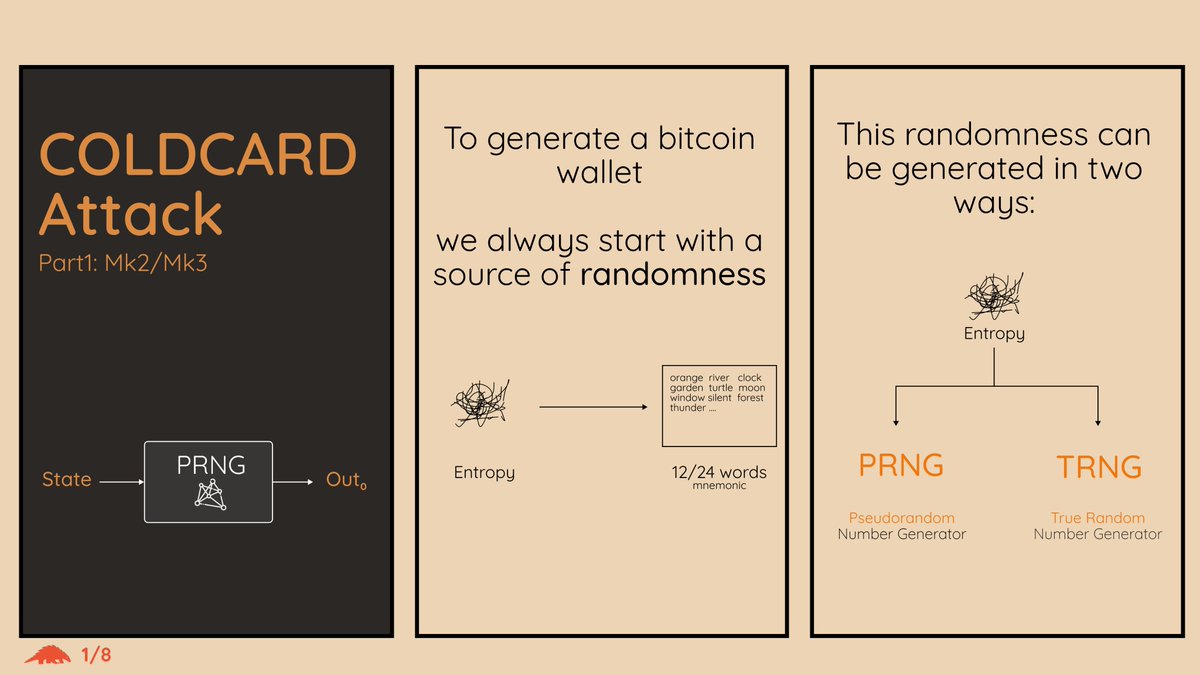
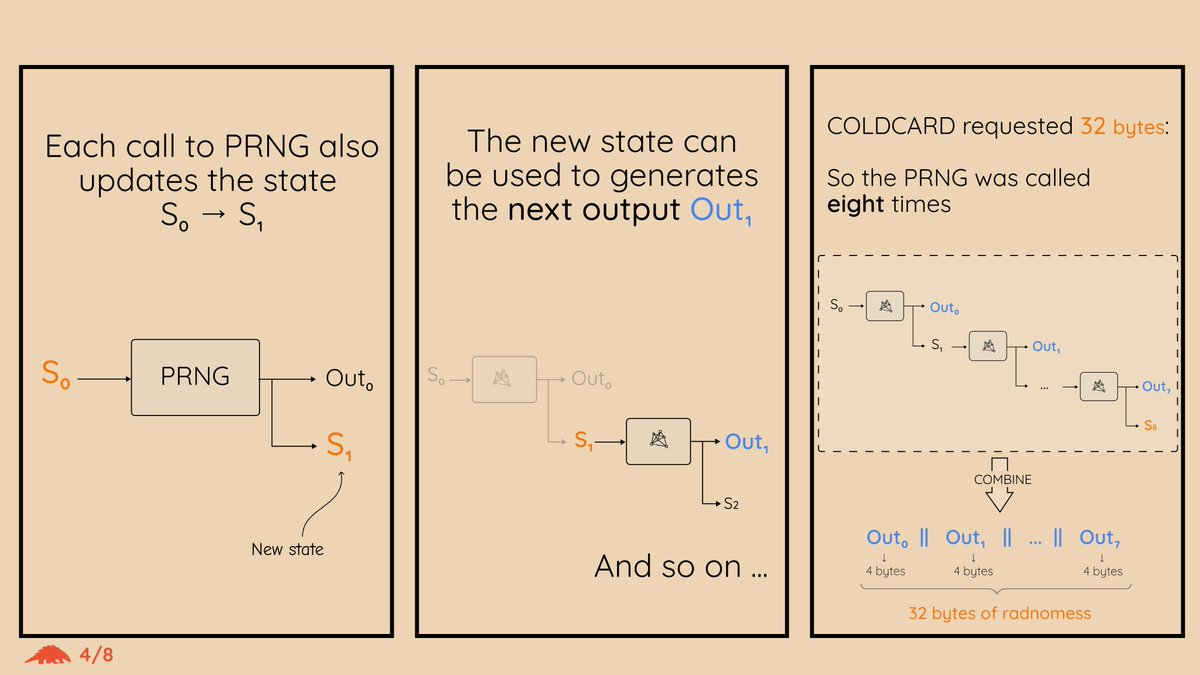
The most common question I am getting right now in the fall out of the news of COLD CARD MK3, MK4, MK5 and Q having compromised entropy, is:
"Rob, what would you do right now if you were in my shoes? Where would you send your bitcoin to be safe?"
I will share with you my list of what I would do, but first, there is AN URGENT SECURITY ADVISORY IN THE BITCOIN ECOSYSTEM.
Below is my personal assessment of the situation.
If you or someone you know:
Uses an MK3, MK4, MK5, or Q in a single signature
OR
A multi signature wallet where the cold card devices can move the funds on their own (Example, 2 cold cards and a Ledger).
Please continue reading. You may be in danger. If this does not apply to you, keep on reading if you like, but you are not impacted by this issue.
If you are still here, there are three identified mitigations that protect you at the moment. They are all different forms in which you may have brought your own entropy.
A: DICE - This is done by either rolling dice from the start, or adding dice rolls to the generated seed phrase. At least 50 dice rolls would be my threshold at 128 bits of entropy.
OR
B: PASSPHRASE - You used a passphrase of sufficient entropy (128 bits).
128 Bits of entropy pass phrase examples include RANDOM combinations of the following:
- 12 BIP 39 seed words.
- 10 common words in the english language
- 25 mixed lower case letters and numbers
- 20 if you use ASCII characters
Note on pass phrases: This does not include the same word 12 times, 10 words in a sentence, etc. This combinations of characters/numbers OR words should never have been seen or spoken before in the total sum of all human knowledge and experiences. It needs to be RANDOM for it to be entropy.
OR
C: EXTERNAL ENTROPY - Your seed phrase was derived entirely outside of the cold card ecosystem. (It was imported into the cold card, not generated on it)
Now, if you are still reading, and you do not have any of these mitigations in place, you need to move your funds. The urgency of circumstances are as follows:
TIER 1: AS SOON AS POSSIBLE
Scenario A: If you are in a signature wallet with an effected device, and did not use any of the mitigations listed above. You need to move funds right now. Find someone to help you, any moment your funds can be stolen.
Scenario B: If you have an N of N (eg 2 of 2, 3 of 3, etc) multisig of just cold card devices that did not have mitigations listed above (dice and/or passphrase).
Attackers will be grinding all of the combinations of compromised keys. They know all your seed phrases. You are compromised. It is just a matter of time for them to assemble the puzzle pieces together and steal your funds.
If this scenario is you, I will have more below on how to mitigate risk when broadcasting your transaction.
TIER 2: URGENTLY
If you are in a single signature wallet with an effected device, and you used either less than 50 dice rolls OR a pass phrase less secure than what I shared above. The entire security of your bitcoin is reliant on how much of Dice AND Passphrases you applied to your wallet.
Attackers know your seed phrase. Your entropy from dice or pass phrase is the only thing protecting you. Did you add a pass phrase of 'bitcoin'? You are basically in tier 1. Did you use 6 words? You are not at tier 1, but you aren't safe. You need to make plans to move funds quickly.
TIER 3 SOON, BUT IMPORTANT CONTEXT:
You have a multi signature wallet where the compromised devices have sufficient ability to move the funds. An example is a 2 of 3 multisig where you have 2 cold cards and another signer.
The issue with Tier 3 is that an attacker may have already figured out your insecure seed phrases. This means when you broadcast your bitcoin transaction, an attacker in theory can then steal your funds.
NOTE: IF YOU ARE IN THIS SITUATION, AND YOU HAVE REUSED ADDRESSES, ALL REUSED ADDRESSES PUT YOU RIGHT BACK AT THE TIER 1 MOVE RIGHT AWAY YOUR FUNDS ARE AT RISK AT THIS VERY MOMENT
You should look into finding a way to use the @MARAFoundation_ slipstream service, which uses a private mempool. This means that by the time an attacker could see your attempted recovery, it is already in a block and not possible for them to steal funds.
TIER 4: KEY ROTATION. This is where you have an insecure cold card(s) in your multisig quorum, and you know that the other keys in your quorum are not impacted by this bug.
If there is a MK3,MK4,MK5 or Q in the quorum, BUT they either: 1. Rolled sufficient dice (50 min) 2. Have a strong pass phrase (as defined above). 3. Used entropy not sourced from the device, they are not impacted by this bug in the Cold Card (see notes earlier on mitigations).
You are in a position where a minority of your keys are compromised. Funds are safe, but you are at reduced security. Make plans when you are able to remove the compromised device from your wallet.
Now. With that security advisory out of the way, back to the question, what would I do in this situation?
Below is just my opinion, but you should not rely on only my opinion, you will have to make your own choices based on what you feel is best for you.
I want to be clear, if you are not on this list. It is not that I think your product/business is bad, insecure or at risk, I am directly answering the question of what I would do. This is my personal judgement given my decade of experience in bitcoin.
First, a disclaimer:
My bitcoin is at my company @AnchorWatch. I have full skin in the game in that if I'm offering a custody solution, there will never be another place I store large amounts of bitcoin long term for myself or my family, and it will be this way as long as I am here.
I was the first bitcoin that went on our Trident Vault platform. If the day ever comes, I will be the last bitcoin to leave the platform.
The years of what we built at AnchorWatch were for exactly moments like this. Avoiding catastrophic risk of ruin scenarios.
We offer 2 products:
1. Our Flagship Product where you as the customer can hold 1 or 3 keys, and we act as a cosigner. We leverage bitcoin native smart contracts which allow for your bitcoin to have different ways it can be spent across time.
2. Multi Institution Custody, where we let you distribute your keys across 3 institutions of ourselves, @bitgo and @CoinCorner. 2 of the 3 institutions must sign off on the transaction, and you have to present a Yubikey signature before withdrawing to mitigate deepfake and compromised accounts.
For both products as, since we are a cosigner, we are able to enforce rules like whitelisted addresses, and velocity controls (how much bitcoin can you send how often). You can even disable the send button on the platform if you so choose!
We also offer 1:1 insurance backed by Lloyd's of London.
If you want to learn more about what we do, hit up @_joerodgers or @BeccaAmilee to learn more, or check out our website.
Now with that out of the way, places where I'd leave my bitcoin (besides @AnchorWatch) in no particular order:
Custodian:
I'd trust my life savings at @River under a duress situation. This is one of those times. @Leishman and the entire team at River are elite operators. It is my favorite bitcoin services business in the market today outside of my own.
They own their own custody infrastructure, and at times like this, you want those who have extreme ownership and control over how their customer's money is being managed.
@River does monthly proof of reserves, and you can turn on the force field feature which will freeze withdrawals of bitcoin. They have a world class custody team as well, and are making improvements regularly with a larger upgrade that has been planned for a long time, happening later this year.
Collaborative Custody:
1. The @Bitkey is an incredible product with an elite team of engineers supported by the @BlockEng organization. They have exceptional bitcoin developers across @spiral_xyz and @CashApp teams who deeply understand Bitcoin.
@jack has been a long time believer in bitcoin who has built an organization that has no peer in the resources they have not just understanding bitcoin, but building on bitcoin.
You can pick it up a Bitkey at best buy today!
I do want to add a disclaimer that all keys are managed within the Bitkey ecosystem. The Bitkey team has gone to great lengths to keep things secure, but in light of recent events, I want to call that out. At the moment, the Bitkey is my only exception to a purist ideal of multi vendor multisig (more below).
2. @CasaHODL - @Nneuman and @lopp have been on top of this incidence response, and have built a very clean user experience to let people be safe. You can either use a 2 of 3 or 3 of 5 multisig with a great mobile app. Casa is the best UX for soverign collaborative multisig that exists in the market today.
3. @uncahined - Unchained pioneered the collaborative custody model and the multi institution custody model. They have been working around the clock trying to support customers and have even been able to use slip stream going the extra mile on short notice to keep customers bitcoin safe.
Self Custody:
I have spent close to $5k on LLM tokens over the past 24 hours scanning over a hundred bitcoin related repositories. As of now, I have seen no vulnerability that has me concerned about any hardware device outside of the Cold Cards.
Even so, you can't be sure. So I would follow the @mflaxman "Bitcoin 10x security guide". Its how I held my bitcoin before I founded @AnchorWatch, and even though the guide is 6 years old, the principles are timeless. I would remove his suggestion of using the cold card and replace it with any other hardware wallet. I would replace the cold card with a @Ledger at this time if it were my decision. You can pick up a Ledger up at Best Buy in the US.
Michael pioneered multi vendor multisig as a concept, and if you want a fully sovereign solution, as of today there is no better mental model on how to think through this, he has advanced tabs to further increase the security. For his cold card guide he fairly calls out the added benefit of rolling dice, which would have saved you today.
I think the future is combining the tech we use at @AnchorWatch to move beyond the single signature/ multi signature paradigm of custody, with the principles of @mflaxman's 10x security guide and the support of collaborative custody.
More on that later, but I would check out @lianabitcoin from @Wizardsardine as well, they offer a fully open source wallet that enables these more advanced smart contracts and are security researchers in the bitcoin ecosystem.
With that, I'm going to get back to work. I will post a followup reply if I have additional information or any corrections or clarifications to make.
Bitcoin Could Split on August 8th - How To Protect Your Stack
@PortlandHODL and @w_s_bitcoin join to discuss:
🔸 What to do with your BTC during a chain split
🔸 Policy vs. Consensus
🔸 Who actually governs Bitcoin
📺: https://t.co/TV3rPP7lPW
I'm a cardiologist. Everyone is sharing this study as a skin story. They're burying the part that matters.
Scientists took the aorta of a 75-year-old donor, applied a single engineered enzyme, and stripped away more than 70% of the molecular damage — bringing it down to the levels you'd see in a 30-year-old artery.
Published five days ago in Nature Communications. Revel Pharmaceuticals, with Calico and the University of Colorado.
Here's what they erased.
Sugar reacts with proteins in your body the same way heat browns bread — slowly, over a lifetime. It leaves behind a residue called CML, the most abundant advanced glycation end product in aging tissue. It welds itself onto collagen and elastin in your skin, your eye lens, and your arterial walls.
Two things follow. Your arteries stiffen. And CML latches onto a receptor called RAGE, which drives chronic inflammation — the exact fire I've been writing about for months as the engine of heart disease.
Since the 1980s this damage was considered permanent. Your body has no enzyme to remove it. Every existing approach only slows new damage from forming. Nothing touched what was already there.
So they built an enzyme that doesn't exist in nature. They screened 45,000 protein structures, then ran five rounds of directed evolution across more than 500 million variants until they had CMLase — a molecular lawnmower that oxidizes the CML off the protein and restores the original, healthy lysine underneath.
Not patched. Reversed.
Over 70% cleared from elderly arterial tissue. Over 55% from elderly skin — below the levels found in 31-year-old skin. 45-78% in lens proteins. The CEO said they expected 20% and were floored.
Arterial stiffness drives systolic hypertension, heart failure, and stroke, and I have no drug that reverses it. I can slow the process. I cannot undo it. This paper says undoing it may be possible.
The caveats are real and I won't skip them. This was done on donated tissue in a dish, not in a living person. No functional data yet — we don't know if that artery got measurably more elastic. Delivering a large enzyme deep into human tissue is a hard, unsolved problem. Clinical trials are years away.
But something considered permanent for forty years just came off human tissue.
We spent a century learning to slow aging. Someone finally figured out how to erase it.
Thank you @theallinpod@friedberg@chamath@pesottas
🚨 THE US REGULATORY SYSTEM JUST BROKE
In 48 hours, SpaceX goes public at $1.77 TRILLION - the biggest IPO ever
I've been trading for over a decade, and I have never seen them rewrite the rulebook like this
Nasdaq, MSCI, and the biggest brokers in America all bent their own rules for ONE private company
That doesn't happen by accident
Let me show you exactly what they did:
First, Fidelity dropped its minimum account size from $500,000 to $2,000
A 99.6% cut
Think about that:
The most exclusive door on Wall Street, thrown wide open to millions of small investors - days before the biggest debut in history.
Ask yourself one question
Why do they suddenly want YOU in?
Because somebody needs people to sell to.
SpaceX reserved 30% of the deal for retail
THREE TIMES the normal share
And even then, most people didn't get a full allocation.
So to grab more at Thursday's open, they're dumping everything else TODAY to raise cash.
That's half of the selling you're seeing.
The other half? The smart money front-running July.
Here's the trick:
SpaceX doesn't join the Nasdaq 100 on day one.
It joins 15 days later, because Nasdaq cut its own waiting period from 3 months to 15 days
Just for this.
The moment it joins, every QQQ fund on Earth is FORCED to buy.
$22–27 billion in automatic buying.
Translation: imagine 50 buses all forced to pull into the same gas station on the same morning.
The funds know the stampede is coming.
So they're selling now to free up cash for it. Retail selling. Institutions selling. At the exact same time.
THAT is your selloff.
Now here's the part nobody will say out loud:
When the most connected money on the planet builds a $1.7T exit door and hands the keys to the smallest investors in the market…
That's NOT generosity
That's distribution at the top.
We've seen this movie twice:
➮ 2000 Dotcom
➮ 2021 SPAC mania
Insiders cash out at insane valuations while the crowd chases the hype.
The math ain't mathing.
So you've got two choices in the next 48 hours:
Chase the most expensive IPO in history at the open…
Or read the prospectus and realize you might BE the exit.
The next few days will be INSANE, but don't worry - I'll break down every move as it happens, like I always do.
Like it or not, I called every major top and bottom of the last decade publicly. I'll call this one too.
Many people are going to wish they followed me before June 12, 2026.
Soon, you'll understand why.
Bitcoin isn't broken, and it isn't being manipulated.
It's being correctly repriced as exactly what it is:
a long-duration liquidity asset, and the AI IPO supercycle is the largest competing claim on risk capital Bitcoin has faced to date.
🚨 Anthropic just showed a 27-minute workshop on how to actually do prompts for Claude.
Taught by the people who built it.
Free. No registration. No paywall.
I've seen $300 courses that don't cover what they teach in the first 8 minutes.
Watch it and bookmark it now.
🚨🇺🇸🇨🇳 The myth of a global peace with China is officially dead, as the world realigns under a more aggressive U.S. umbrella.
While some argue the U.S. is alienating allies, Global Monetary Expert Jeffrey Snider suggests the UAE’s move to double down on Washington shows that regional players know where the real security lies.
The Chinese were never going to be "just like us," and the West is finally waking up to their strategic clash of interests.
@JeffSnider_EDU
Elon Musk avait dit un truc qui m'avait marqué sur l'allocation de ressources. En substance : passé un certain niveau de richesse, l'argent n'est plus de la consommation, c'est de l'allocation de capital.
Cette phrase change tout.
L'économie, dans le fond, c'est juste un problème d'allocation. Tu as des ressources finies et des usages infinis. Qui décide où va quoi ?
Imagine une cour de récré. 100 enfants, des paquets de cartes Pokémon distribués au hasard. Tu laisses faire. Très vite, un ordre émerge. Les bons joueurs accumulent les cartes rares, les collectionneurs trient, les négociateurs trouvent des deals. Personne n'a planifié. Et pourtant chaque carte finit dans les mains de celui qui en tire le plus de valeur. Le système maximise le bonheur total de la cour. C'est ça, la main invisible.
Maintenant fais entrer la maîtresse. Elle trouve ça injuste. Léo a 50 cartes, Tom en a 3. Elle confisque, redistribue, impose l'égalité. Trois effets immédiats. Les bons joueurs arrêtent de jouer, à quoi bon. Les mauvais n'ont plus de raison de progresser, ils auront leur part. Les échanges s'effondrent. La cour est égale, et morte. Elle a maximisé l'égalité, elle a détruit le bonheur.
Le problème de la maîtresse, c'est qu'elle ne peut pas avoir l'information que la cour avait collectivement. C'est le problème du calcul économique de Mises, formulé en 1920. L'URSS a essayé de le résoudre pendant 70 ans avec le Gosplan. Résultat : pénuries, queues, effondrement. Pas parce que les Soviétiques étaient bêtes, parce que le problème est mathématiquement insoluble en mode centralisé.
Quand Musk a 200 milliards, il ne les consomme pas, il les alloue. SpaceX, Starlink, Neuralink, xAI. Chaque dollar est un pari sur le futur. Et lui a un track record. PayPal, Tesla, SpaceX. Il a démontré qu'il sait identifier des problèmes immenses et y allouer des ressources avec un rendement spectaculaire.
L'État aussi a un track record. Hôpitaux qui s'effondrent, éducation qui décline, dette qui explose, services publics qui se dégradent malgré des budgets en hausse constante. Le marché identifie les bons allocateurs, la politique identifie les bons communicants.
Le profit n'est pas une finalité, c'est un signal. Il dit : tu as alloué des ressources rares vers un usage que les gens valorisent suffisamment pour payer. Plus le profit est gros, plus la création de valeur est grande. Quand Starlink est rentable, ça veut dire que des millions de gens dans des zones rurales ont enfin internet. Quand un ministère est en déficit, ça veut dire qu'il consomme plus qu'il ne produit. L'un crée, l'autre détruit, et on appelle ça redistribution.
Dans nos sociétés il y a deux catégories d'acteurs. Les entrepreneurs et les bureaucrates. L'entrepreneur prend un risque personnel pour identifier un problème, mobiliser des ressources, créer une solution. S'il se trompe il perd. S'il a raison, ses clients gagnent, ses employés gagnent, ses fournisseurs gagnent, l'État collecte des impôts. Il est la cellule de base du progrès humain.
Le bureaucrate ne prend aucun risque personnel. Son salaire est garanti. Au mieux il maintient une rente existante. Au pire il la détruit par excès de réglementation, mauvaise allocation forcée, incitations perverses qui découragent ceux qui produisent. Mais dans aucun cas il ne crée.
Regarde les 50 dernières années. iPhone, internet civil, SpaceX, Tesla, Google, Amazon, Stripe, mRNA, ChatGPT. Toutes des inventions privées, portées par des entrepreneurs, financées par du capital risque. Pas un seul ministère n'a inventé quoi que ce soit qui ait changé ta vie au quotidien.
La France est devenue le laboratoire mondial de la dérive bureaucratique. 57% du PIB en dépenses publiques, record absolu. Une administration tentaculaire, une fiscalité qui pénalise la création de richesse. Résultat : décrochage face aux États-Unis, à l'Allemagne, à la Suisse. Fuite des cerveaux. Désindustrialisation. Dette qui explose.
Et le pire c'est que la mauvaise allocation s'auto-renforce. Plus l'État prélève, moins les entrepreneurs créent. Moins ils créent, moins il y a de base fiscale. Plus l'État s'endette et taxe. Boucle de rétroaction négative parfaite. La maîtresse pense qu'elle aide, et chaque année la cour produit moins.
Dans nos sociétés, ce sont les entrepreneurs, toujours, qui font avancer la civilisation. Les bureaucrates au mieux maintiennent une rente, au pire la détruisent. Aucune société n'a jamais progressé en taxant ses créateurs pour subventionner ses gestionnaires.
La question n'est jamais qui a combien. C'est qui alloue le mieux la prochaine unité de ressource pour maximiser le futur de l'humanité. La réponse depuis 200 ans n'a jamais changé. Ce ne sont pas les fonctionnaires.