I'm excited to introduce Embo!
We are building the brain for intelligent robots to help people around the world.
We believe intelligent robots will unlock an era of abundance, making goods and services affordable for everybody. But to deploy them at scale, robots need to work out of the box in unfamiliar scenarios. At Embo, we are building frontier AI models with a deep understanding of physical reality and fine-grained motor skills.
Today's robot skills are fragile. Demonstrations can teach repetitive behaviors, but they cannot cover every object or situation a robot will encounter. We need general pretraining at internet scale to fill the gaps between individual tasks and practice to develop reliable motor skills.
The world models our team has pioneered unlock a path to general robots. Our robot brain pretrains on massive amounts of internet video to learn about objects, physical interactions, and how tasks unfold. It then practices motor skills in diverse imagined scenarios to become robust to unexpected situations.
Our team is behind seminal work in AI including Dreamer, VideoGPT, and Diffusion Forcing, with experience from DeepMind, Meta Superintelligence Labs, NVIDIA Cosmos, Berkeley, and MIT.
We have raised a $110M Seed led by @a16z. We are excited to partner with them, @khoslaventures, DST Global, NVentures (@nvidia), @strikervp, and other strategic investors to bring reliable intelligent robots out into the world.
@EmboAI
Qiayuan (@qiayuanliao) and I wrote about modeling the Unitree G1’s closed-loop ankle linkage in @mujoco.
We look at how the linkage changes the ankle’s motion and dynamics, and what it takes to simulate it reliably.
We spent quite a bit of time on the blog post making interactive demos and shareable models, and we hope you find it useful!
https://t.co/3ujBvBHhGK
Excited to introduce QF3: Fast Flow RL with Filtered Q-Gradients!
Train humanoids from scratch, fine-tune VLAs, even fine-tune image models... all with one simple off-policy update ✨
Egocentric human data is the key to a major breakthrough in robotics foundation models. Huge congratulations to the GSI team, especially @AdemiAdeniji, whose work is making this vision a reality
Grounded API is live.
- SOTA on hand-tracking benchmarks (< 1 cm)
- SOTA on SLAM benchmarks
- In-the-wild ego data -> enriched data in minutes
- Integration with @huggingface@LeRobotHF & @rerundotio
- Built for @BitRobotNetwork RoboCap suite
Technical report & more↓
I'm excited to release mjbatch, a simple tool that lets you step thousands of MuJoCo simulations in parallel on your CPU, all from the comfort of Python!
https://t.co/H4dEXA5ret
To show how far this primitive can take you, I built some fun, self-contained examples with it 👇
I came from a world where I measured robotics research in days: collect hundreds of demonstrations, train, then watch the policy break as soon as the setup changed.
Since I joined Sunday, I’ve watched that loop compress dramatically.
ACT-2 can learn a new folding strategy from one demonstration, with just five minutes of fine-tuning, then transfer it to unseen garments and beds. What once took a week can now happen in an hour.
That’s the deeper impact of scaling pretraining: it doesn’t just produce a better policy. It produces a better learner.
Introducing ACT-2 Preview
The first robotics model to unify broad generalization with high reliability. A single fine-tuning example can teach Memo a new behavior that generalizes.
Zero shot, real unseen homes, 99% success rate.
FPO++ code is out!
We’re releasing the full training and evaluation code for locomotion, motion tracking, and manipulation.
https://t.co/wza3kZcxlb
Co-led with @brenthyi
we started a company!!
so, we’re tackling continual learning: what’s the learning algorithm to take arbitrary data — documents, conversations, the models’ own experience — and make better models? how do we scale compute in the same way we’ve already seen with pre-training and inference time, but scaling on the same data we see as humans, day after day with no labels, no rewards?
A lot of the ingredients are out there already (rl, distillation, long-context, sparse / param-efficient architectures, etc.). our team is at the frontier of these topics, and we’re singularly focused on this. we want to understand this problem better than anyone else in the world.
nobody’s solved this problem yet, but even today it’s extremely greenfield opportunity to co-develop research & useful products. in our space, how people interact with the models defines what the data distribution is - and working on this problem end-to-end, from core science to end user, gives us incredible freedom to define the problem and imagine new kinds of experiences.
i expect we’ll use models that continually learn much differently than we’re using them today. it’ll feel different when the models _just know_, and build on our thinking and direction in ways we can’t even imagine. we don’t even know the queries we’re not asking, the things we would do but aren’t able to today.
i’m so excited to share what we’re doing with the world in the coming months!!
and the team is extremely cracked :) tackling this grand challenge and working alongside @jxmnop@EyubogluSabri@dan_biderman@MayeeChen@__howardchen@shizhehe and many others has made every day so fun. come work with us!
Introducing ABC: open data, training, and infrastructure for robotics.
We release the largest teleop dataset to date, and extensively investigate design decisions, pretraining, and post-training techniques.
@arthurallshire@Cinnabar233@adamrasb@redstone_hong@davidrmcall
Philipp and team are some of the most hardworking and talented scientists I’ve met. So bullish on this team!!! Very much worth keeping an eye out for them 👀
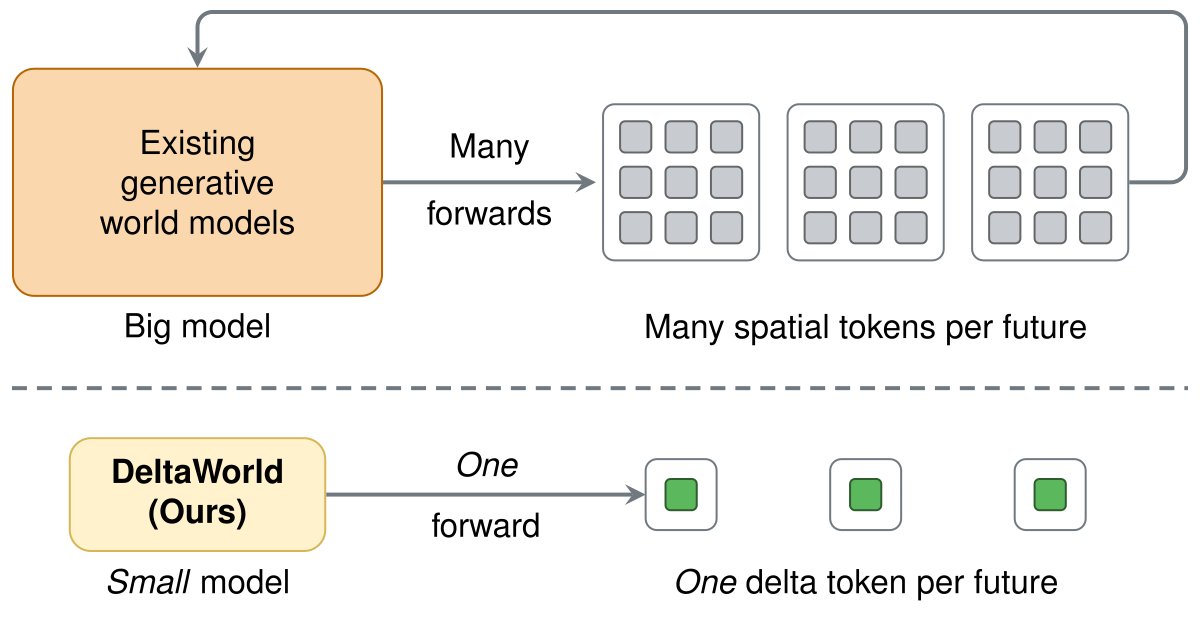
World models are heavy. They don't need to be.
Each frame is encoded as 1024 spatial tokens. What if it were just 1?
In our #CVPR2026 Highlight from Amazon FAR, we compress frames into "delta" tokens for efficient generative world modeling.
Paper, code & models below ↓
(1/7)
What’s the right representation for a world model? 3D, pixels, or something else?
Excited to release our new paper “Forecasting Motion in the Wild” where we propose point tracks as tokens for generating complex non-rigid motion and behavior
From @GoogleDeepmind@Berkeley_AI@TTIC_Connect
Robotics: coding agents’ next frontier.
So how good are they?
We introduce CaP-X: an open-source framework and benchmark for coding agents, where they write code for robot perception and control, execute it on sim and real robots, observe the outcomes, and iteratively improve code reliability.
From @NVIDIA@Berkeley_AI@CMU_Robotics@StanfordAILab
https://t.co/MVcc6XWQhY
🧵
Excited to share our latest work on motion generation! We tackled multi-agent generation across diverse tasks using Diffusion Forcing.
Check out the project page for more! 🚀